

Key Takeaways
- Gait training exercises can improve balance, stability, and coordination.
- You can do ankle pumps and calf towel stretches to improve your range of motion.
- Strength-training exercises like squats and step ups help power the legs and improve stability.
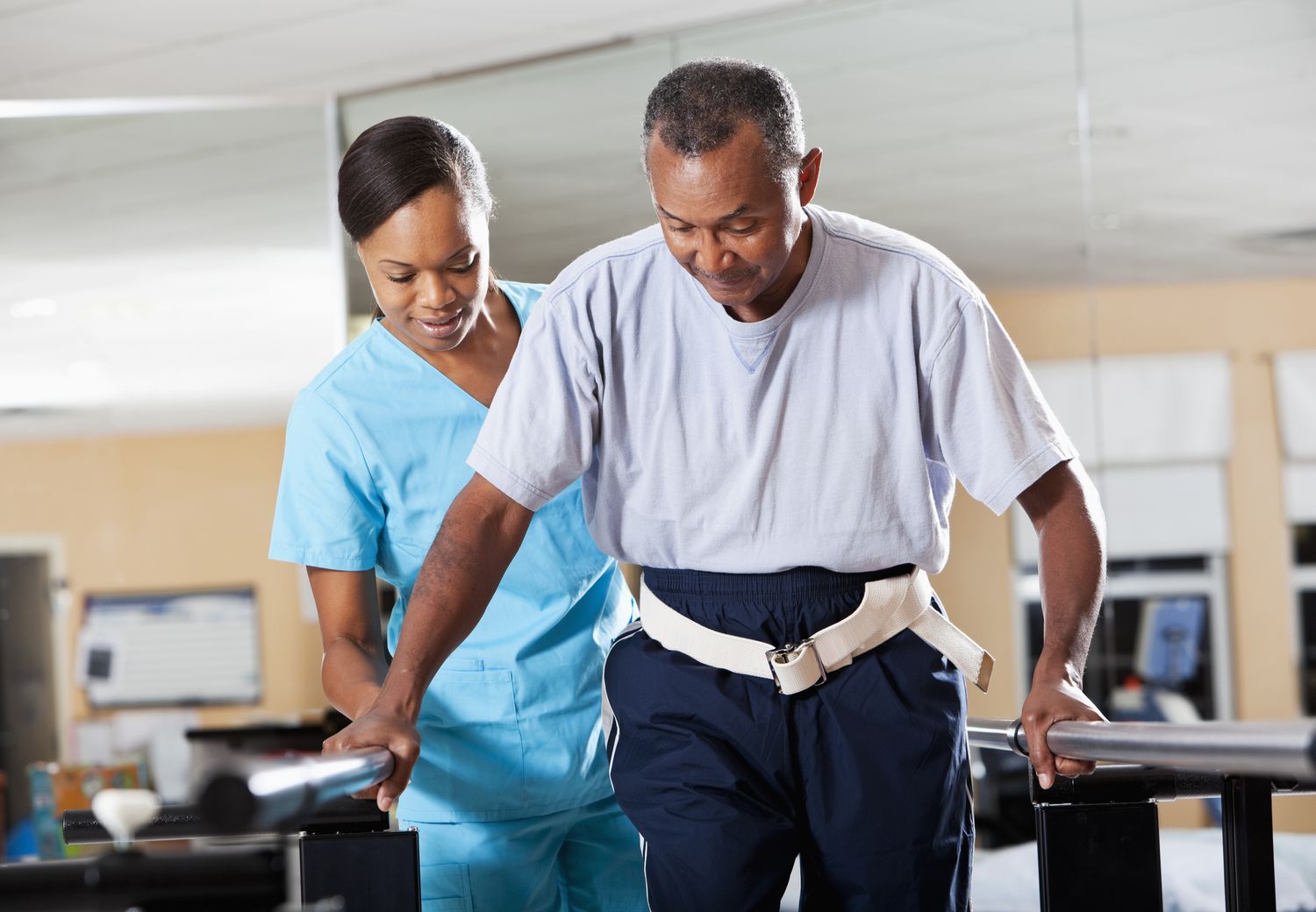
Gait training exercises are movements designed to help improve strength, balance and coordination when walking. They may be part of a physical therapy program for a person recovering from a stroke, an injury, or surgery, as well as those dealing with a chronic condition that affects their ability to walk.
While you may be referred to a physical therapist if you’re having problems walking, you can also do gait training exercises at home. However, it’s important to consult your healthcare provider before starting any new exercise program.
Jan-Otto / Getty Images
Range of Motion Exercises
Range of motion (ROM) refers to the extent a joint or muscle can move comfortably. This range may be restricted after being immobilized due to injury or surgery. Gait training includes exercises to improve ROM.
ROM gait training exercises include:
- Ankle pumps: Sit or lie down and flex your feet, as if you’re trying to bring your toes toward your knees. Then, point your toes down toward the floor. Continue at a quick pace for two minutes.
- Calf towel stretch: Sit on the floor with your legs extended in front of you and a towel looped around the middle of your right foot. Gently pull the ends of the towel toward you until you feel a stretch in your right calf. Hold for 10 seconds and then release and repeat on the left leg.
Ben Goldstein
Lower-Body Strength Exercises
Strong muscles power the legs, ankles, and feet during walking and also improve stability.
Strength-training exercises for gait training include:
- Straight leg raises: Lie face up with your arms extended at your sides, palms on the floor. Extend your left leg on the floor and bend your right knee, placing your right foot on the floor. Lift your left leg several inches off the floor, then lower it and repeat. Do 10 reps, then repeat on the opposite leg.
- Squats: Stand with feet hip-width apart and extend your arms at shoulder height in front of you, palms facing the floor. (Place hands on the back of a chair for support, if needed.) Push your hips back as you bend your knees as if you’re sitting down in a chair. Stand up to return to the starting position. Do 10 reps.
- Step ups: Stand facing the first step of a staircase. Place your right foot on the step and bring your left foot up beside it. Reverse the motion (step down with your left foot and then your right) to return to the starting position. Do 10 reps, then repeat on the opposite side, stepping up with your left foot first.
Sam Edwards / Caiaimage / Getty Images
Obstacle Training
Stepping over obstacles mimics the motions (such as hip flexing and raising the knees) legs go through when walking.
Here is how to perform obstacle training:
- Set up five or six small obstacles in a row about 15 inches apart. (Obstacles can be rolled towels, athletic hurdles, or small stacks of books.)
- Stand facing the obstacles, and step over one with one foot. Place your other foot next to your first foot.
- Repeat walking over the obstacles with one foot. Then, turn around and step over the obstacles leading with your other foot first.
- Continue walking over the obstacles for 10 repetitions.
Side-Stepping Exercises
Stepping sideways over obstacles can improve your stability when walking in different directions.
Here’s how to perform side-stepping gait exercises:
- Stand with your obstacles to your side.
- Step one foot sideways over the first obstacle, raising your knee high.
- Place your foot down on the other side of the obstacle, leaving enough room for your second foot to land.
- Lift your second foot up, raising your knee high, and then place it next to your first foot. Repeat, moving over all the obstacles.
Target Stepping
Target stepping helps enhance coordination and control over foot placement during walking. Here’s how to perform it:
- Place four or five targets on the ground in a semicircle, about one foot apart. You can use small pieces of paper or paper plates as targets.
- Stand to one side of the targets on the floor and slowly step with one foot to tap a target.
- Return that foot to the starting position, then reach out again to another target and tap it with your foot.
- Continue, tapping each target with one foot, and then repeat with the other. Try to softly and slowly land each tap.
Retro Walking
Retro (backward) walking may be recommended by your physical therapist to help improve your gait. The benefits of backward walking include:
- Improved hamstring flexibility
- Improved quadriceps activation
- Improved balance
- Improved coordination
- Improved walking speed
- Improved step length and stride length
Here’s how to safely perform retro walking with a treadmill:
- Set the treadmill to the slowest speed and turn around so you’re facing backward.
- Start the treadmill and reach one foot backward, moving through the toes, midfoot, and heel.
- Continue, walking backward.
Retro walking should be done slowly so you remain in control. Use the safety emergency stop function on the treadmill.
Photo courtesy of SeanCochran.com; used with permission
Balance Exercise
Walking requires you to stand on one foot while the other swings forward through the air. That means that single-leg balance is an important component of safe walking.
Try this single-leg balance:
- Bend one knee, so your foot is raised off the ground and your weight is on the other leg.
- Hold for 10 to 20 seconds, then repeat on opposite leg.
- To make this exercise more challenging, perform it with your eyes closed or while standing on an unsteady surface such as a BOSU.
The Gait Cycle
The gait cycle includes all of the movements involved in walking: lifting the foot, moving it forward, putting it back down, rolling through the foot, and lifting it off the ground again. A comprehensive gait-training exercise program should include components that address every part of this cycle.
:max_bytes(150000):strip_icc()/BrettSearsPT_1000-b66602ce9ab7482cb78acf5d2c3de153.jpg)