
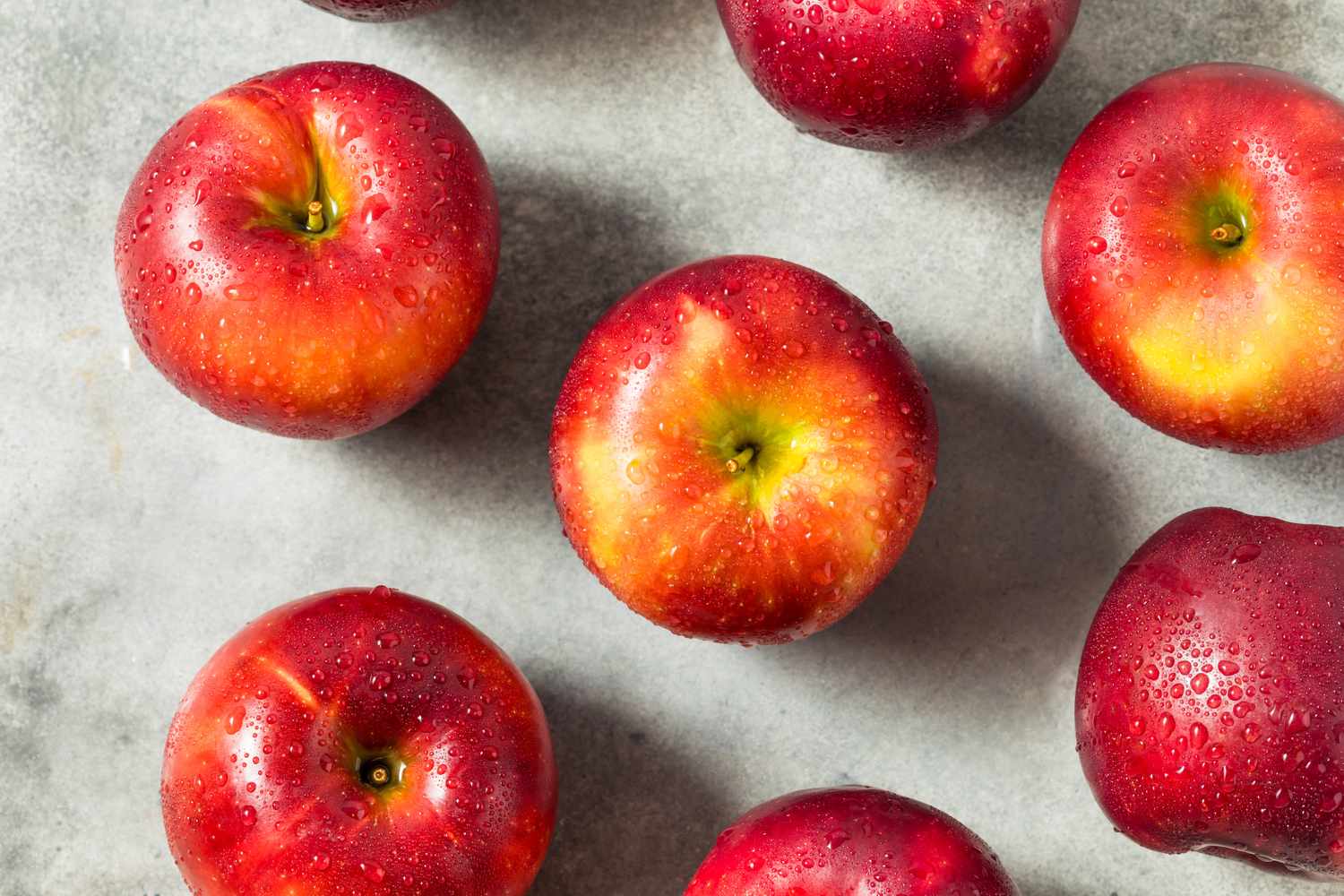
6 Healthiest Types of Apples for Digestion, Blood Sugar, and Gut Health

6 Healthiest Types of Apples for Digestion, Blood Sugar, and Gut Health

Apples are packed with fiber and other nutrients that promote heart, gut, and blood sugar health. Some varieties like Red Delicious, Granny Smith, and Fuji deliver more health benefits than others.

1. Red Delicious

vkbhat / Getty Images


Fiber: 5 grams (g)
Serving size: 1 medium apple

A medium Red Delicious apple provides more than 17% of the daily value (DV) of fiber. The same size also contains about 22 g of sugar and 29 g of carbohydrates, a lower amount than other sweet red apples.

These apples contain antioxidant compounds like quercetin, which may help prevent heart disease by combating cell damage and inflammation.

2. Gala

GCapture / Getty Images


Fiber: 4 g
Serving size: 1 medium apple

Research shows people who ate three Gala apples daily for six weeks experienced, on average, a 17% reduction in C-reactive protein (CRP) blood levels, compared to people who didn’t eat the fruit. Experts believe the heart-protective benefits come from the apple’s phenolic antioxidant content.

As a marker of inflammation, having high-CRP levels is linked to an increased risk of developing heart disease, along with type 2 diabetes and Alzheimer’s disease.

3. Fuji

Westend61 / Getty Images


Fiber: 4 g
Serving size: 1 medium apple

In addition to keeping you feeling fuller for longer, the pectin fiber in Fuji apples acts as a prebiotic to support the balance of healthy gut bacteria.

One study showed that consuming two Fuji apples daily for one week resulted in elevated levels of certain enzymes that boost the body’s antioxidant defense system, suggesting that this variety may combat heart and other types of disease.

4. Honeycrisp

Prostock-Studio / Getty Images


Fiber: 3 g
Serving size: 1 medium apple

Known for their sweet taste, Honeycrisp apples contain some of the highest amounts of phenolic antioxidants compared to other apple varieties. These antioxidants can help slow biological aging and protect against heart disease.

This type of apple is also rich in the antioxidant phloridzin, a potential anti-diabetes compound that may help the body absorb less glucose from food, lowering blood sugar levels.

5. Renetta Canada

Wirestock / Getty Images


Fiber: 2.6 g
Serving size: 1 medium apple

While they may not be quite as well-known as other types, Renetta Canada apples are worth consuming for their heart health benefits. Research shows that consuming two Renetta Canada apples daily for eight weeks can lower total cholesterol and low-density lipoprotein (LDL) cholesterol levels, impacting heart disease risk.

The soluble fiber in this apple may help prevent atherosclerosis (plaque build-up in the arteries), one of the main causes of heart disease.

6. Granny Smith

Lilechka75 / Getty Images


Fiber: 2.5 g
Serving size: 1 medium apple

These green apples are often described as sour or tart, but they may be your best bet for supporting blood sugar level management. Granny Smith apples contain some of the lowest amounts of sugar compared to other apples, which is key for people with diabetes.

In addition to fiber and antioxidants, Granny Smiths provide about 10 g of sugar and 14 g of carbohydrates in a half-apple serving size.

Tips for Incorporating More Apples into Your Diet

Apples are a great portable snack used in sweet and savory recipes. Tips for incorporating apples into your meals include:

  • Pair apples with nut butter or cheese for a filling, nutritious snack.
  • Stew apples and serve them with savory dinner foods, such as roasted pork or autumn-inspired soups.
  • Slice apples and add them as a salad topping.
  • Add apples to baked goods, such as muffins or cakes.
  • Store apples in the refrigerator for longer ripening times, or at room temperature if you want to eat them soon.
  • Eat the skin of the apple along with its flesh to get the full fiber benefits.

While having a true apple allergy is relatively rare, it’s possible to experience an allergic reaction after eating one, known as oral allergy syndrome (OAS). See a healthcare provider if you notice mouth, tongue, or throat irritation, itchiness, or swelling after apple consumption.

Verywell Health uses only high-quality sources, including peer-reviewed studies, to support the facts within our articles. Read our editorial process to learn more about how we fact-check and keep our content accurate, reliable, and trustworthy.
  1. Oyenihi AB, Belay ZA, Mditshwa A, Caleb OJ. “An apple a day keeps the doctor away”: The potentials of apple bioactive constituents for chronic disease preventionJ Food Sci. 2022;87(6):2291-2309. doi:10.1111/1750-3841.16155

  2. Sandoval-Ramírez BA, Catalán Ú, Calderón-Pérez L, et al. The effects and associations of whole-apple intake on diverse cardiovascular risk factors. A narrative reviewCrit Rev Food Sci Nutr. 2020;60(22):3862-3875. doi:10.1080/10408398.2019.1709801

  3. U.S. Department of Agriculture. Apples, raw, red delicious, with skin (Includes foods for USDA’s Food Distribution Program)

  4. Nazari-Khanamiri F, Ghasemnejad-Berenji M. Quercetin and heart health: From molecular pathways to clinical findings. J Food Biochem. 2023;2023:1-9. doi:10.1155/2023/8459095

  5. Popiolek-Kalisz J, Fornal E. The impact of flavonols on cardiovascular riskNutrients. 2022;14(9):1973. doi:10.3390/nu14091973

  6. U.S. Department of Agriculture. Apples, gala, with skin, raw.

  7. Liddle DM, Lin X, Cox LC, et al. Daily apple consumption reduces plasma and peripheral blood mononuclear cell-secreted inflammatory biomarkers in adults with overweight and obesity: A 6-week randomized, controlled, parallel-arm trialAm J Clin Nutr. 2021;114(2):752-763. doi:10.1093/ajcn/nqab094

  8. Luan YY, Yao YM. The clinical significance and potential role of C-reactive protein in chronic inflammatory and neurodegenerative diseasesFront Immunol. 2018;9:1302. doi:10.3389/fimmu.2018.01302

  9. U.S. Department of Agriculture. Apples, raw, fuji, with skin (includes foods for USDA’s Food Distribution Program).

  10. Holscher HD. Dietary fiber and prebiotics and the gastrointestinal microbiotaGut Microbes. 2017;8(2):172-184. doi:10.1080/19490976.2017.1290756

  11. Giaretta AG, Schulz M, Silveira TT, et al. Apple intake improves antioxidant parameters in hemodialysis patients without affecting serum potassium levels. Nutr Res. 2019 Apr;64:56-63. doi:10.1016/j.nutres.2018.12.012

  12. U.S. Department of Agriculture. Apples, honeycrisp, with skin, raw.

  13. Xu Y, Fan M, Ran J, et al. Variation in phenolic compounds and antioxidant activity in apple seeds of seven cultivarsSaudi J Biol Sci. 2016;23(3):379-388. doi:10.1016/j.sjbs.2015.04.002

  14. Esposito S, Gialluisi A, Costanzo S, et al. Dietary polyphenol intake is associated with biological aging, a novel predictor of cardiovascular disease: cross-sectional findings from the Moli-Sani studyNutrients. 2021;13(5):1701. doi:10.3390/nu13051701

  15. Koutsos A, Lima M, Conterno L, et al. Effects of commercial apple varieties on human gut microbiota composition and metabolic output using an in vitro colonic model. Nutrients. 2017 May 24;9(6):533. doi:10.3390/nu9060533

  16. Mannino G, Chinigò G, Serio G, et al. Proanthocyanidins and where to find them: a meta-analytic approach to investigate their chemistry, biosynthesis, distribution, and effect on human healthAntioxidants (Basel). 2021;10(8):1229. doi:10.3390/antiox10081229

  17. Koutsos A, Riccadonna S, Ulaszewska MM, et al. Two apples a day lower serum cholesterol and improve cardiometabolic biomarkers in mildly hypercholesterolemic adults: a randomized, controlled, crossover trialAm J Clin Nutr. 2020;111(2):307-318. doi:10.1093/ajcn/nqz282

  18. Commisso M, Bianconi M, Poletti S, Negri S, Munari F, Ceoldo S, Guzzo F. Metabolomic profiling and antioxidant activity of fruits representing diverse apple and pear cultivars. Biology (Basel). 2021;10(5):380. doi:10.3390/biology10050380

  19. Inoue Y, Cormanes L, Yoshimura K, et al Effect of apple consumption on postprandial blood glucose levels in normal glucose tolerance people versus those with impaired glucose tolerance. Foods. 2022;11(12):1803. doi:10.3390/foods11121803

  20. U.S. Department of Agriculture. Apples, granny smith, with skin, raw.

  21. U.S. Department of Agriculture. Apples.

  22. Academy of Nutrition and Dietetics. 4 fall foods for your family.

  23. Siekierzynska A, Piasecka‐Kwiatkowska D, Myszka A et al. Apple allergy: Causes and factors influencing fruits allergenic properties—reviewClin Transl Allergy. 2021;11(4). doi:e12032. doi:10.1002/clt2.12032

  24. MedlinePlus. Food allergy.

Headshot

By Cristina Mutchler

Mutchler is an award-winning journalist specializing in health and wellness content. She is based in Illinois.