

Key Takeaways
- If your finger is swollen or hurts from touching the bone, it might be broken.
- Getting an X-ray is important to know if there is a fracture.
- Sometimes a splint or buddy taping can help heal a broken finger.
Signs of a broken finger may include pain, bruising, swelling, and/or the inability to move the finger. If you think you have a broken finger, it’s important to get it checked out. While most finger fractures have simple treatments, others may require surgical intervention.
Our fingers are capable of very fine, coordinated motions, and disruption of this motion can have a big impact on very normal activities such as eating, typing, or tying your shoes. Because of the importance of our fingers, all fractures should be appropriately diagnosed so the best treatment plan can be initiated.
This article will present an overview of the symptoms, causes, diagnosis, and treatment of finger fractures.
Symptoms of a Broken Finger
Signs and symptoms of a broken finger include:
- Pain when touching the bone
- Swelling of the finger
- Bruising of the finger
- Difficulty bending the finger
- Deformity of the finger
Other problems of the fingers can have similar symptoms, including infections, dislocation, and tendon injuries. Therefore, it is important that you have an injury evaluated if you are unsure of the diagnosis.
There are many situations where fractures are best treated early after the injury, before any healing or scar tissue has developed.
Causes of a Broken Finger
Most finger fractures occur as a result of an injury. Common situations that can result in a finger fracture include:
- Trying to break a fall or pushing away from an object
- Crush injuries
- Rotational or twisting injuries to the finger
- Weakened bones (which can be caused by osteoporosis, infections, and tumors)
When to Call a Healthcare Provider
Any suspicious injury to the finger should be evaluated by a healthcare provider to determine if an X-ray is needed. It is not uncommon for someone to think they sprained their finger, when in reality they sustained a fracture that requires treatment.
If an injury is treated as a sprain, when in actuality it is a fracture that requires specific treatment, a delayed diagnosis can lead to a worse long-term outcome. Often, this means limited mobility or chronic deformity of a finger.
Diagnosing a Broken Finger
If you have symptoms of a broken finger, your healthcare provider will examine the finger and obtain a medical history. During the examination, your healthcare provider will see if there is:
- Shortening or rotation of the finger as a result of the injury
- Tendon damage or other injury that could alter the treatment recommendations
The choice of treatment of finger fractures depends on three primary factors:
- First, if the fracture involves one of the joints of the finger
- Second, if the fracture is “stable” or “unstable”
- Third, if there is a deformity of the finger
Your healthcare provider will also obtain an X-ray to determine if there is a fracture. Not all fractures show up well on a single X-ray, so it may be necessary to obtain multiple X-rays in different orientations if the diagnosis is unclear.
This type of imaging will help your healthcare provider determine if the fracture:
- Involves a joint: It is important to make sure there is no irregularity of the joint surface.
- Is “stable” or “unstable”: To determine the stability of a fracture, your healthcare provider will look at the pattern of the break on the X-ray to predict if the fracture will tend to slip out of position over time, or stay in a stable position.
- Has caused any finger deformities: This includes shortening and rotation. Your fingers on the injured hand should line up the same way as the fingers on your uninjured hand.
If the joint surfaces do not line up well, if the fracture is unstable, or if there is a deformity that needs correction, surgery may be necessary to allow for optimal function after healing of the injury.
Treating a Broken Finger
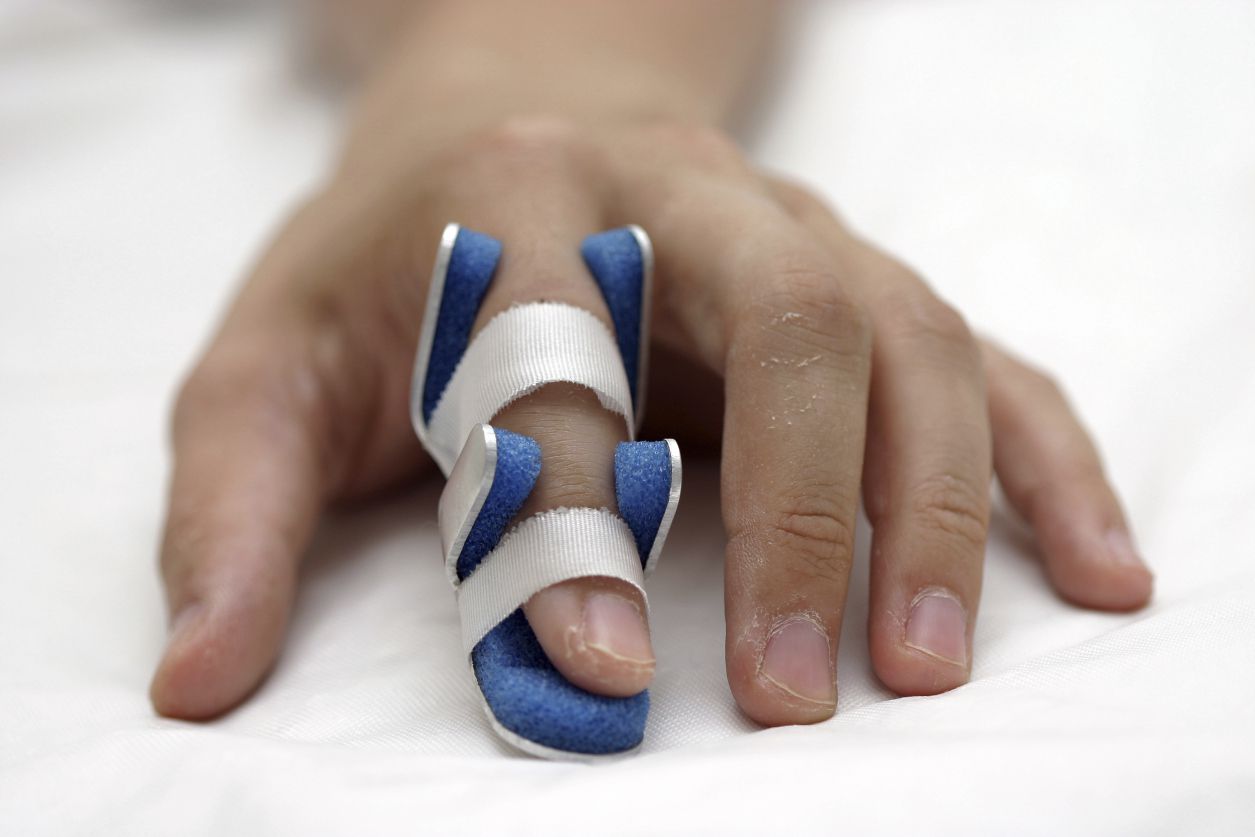
If no treatment is needed, a small splint or cast may be placed to protect the injured finger. In some cases, the finger next to the injured finger can be used as a splint; in this scenario, the two fingers are “buddy taped.” A splint on a fractured finger is typically worn for about three weeks.
When the broken finger is out of position, the deformity may need to be corrected, or “reduced.” Often this can be done under local anesthesia. In this case, an injection is given into the small nerves at the base of the finger. The injection anesthetizes the finger and allows your healthcare provider to manipulate the fracture and correct the deformity.
Can a fractured finger heal without a cast?
While it’s possible for a finger fracture (particularly a minor one) to heal without a cast, it’s always best to seek care. Without proper treatment, a broken finger may end up misaligned, painful, or stiff.
When Is Surgery Needed?
Surgery may be necessary to treat a finger fracture if:
- The joint surfaces do not line up well.
- It is unstable.
- There is a deformity that requires correction.
Pins, plates, and screws can all be used to hold the fracture in the proper position. Finger fractures can be difficult to manage with surgery, as stiffness can be a common result after surgical intervention.
In some cases, your healthcare provider may recommend nonsurgical treatment even in some situations where the bone is not aligned perfectly. The reason is that stiffness can be a worse outcome than a subtle malalignment of the digit.
Outlook for a Broken Finger
Finger fractures generally heal well after appropriate treatment. However, the outcome largely depends on the type and severity of the finger fracture, as well as the kind of treatment required.
Simple fractures can be easily treated and result in excellent recovery. More severe or complex cases may result in stiff and poorly functioning fingers—even with optimal treatments.
Preventing a Broken Finger
Most finger fractures happen from accidents that cannot be prevented. However, there are some steps you can take to reduce your risk of a fracture due to weakened bones. They include:
- Eating a balanced diet and getting enough calcium and vitamin D
- Protecting your fingers when participating in activities that may injure your hand
- Getting regular health checks to identify early signs of health issues that can affect your bones
:max_bytes(150000):strip_icc()/Jonathan-Cluett_1000-2407608be738446cb867da6adba1642c.jpg)