

Published March 22, 2026 04:37AM
Yoga Journal’s archives series is a curated collection of articles originally published in past issues beginning in 1975. This article first about Reclining Hero Pose (Supta Virasana) appeared in the September-October 1994 issue of Yoga Journal.
Similarly, within our internal environment, the habitat we call the body, all the structures are linked in an elaborate dance that allows us to be balanced while in movement. This homeokinetic process is designed so that as one element changes, all the other elements change in response.
One very important strand in the web that makes up the human body is the psoas muscle. The psoas (pronounced so-az) is a deep muscle that is key to a balanced, well-organized body.
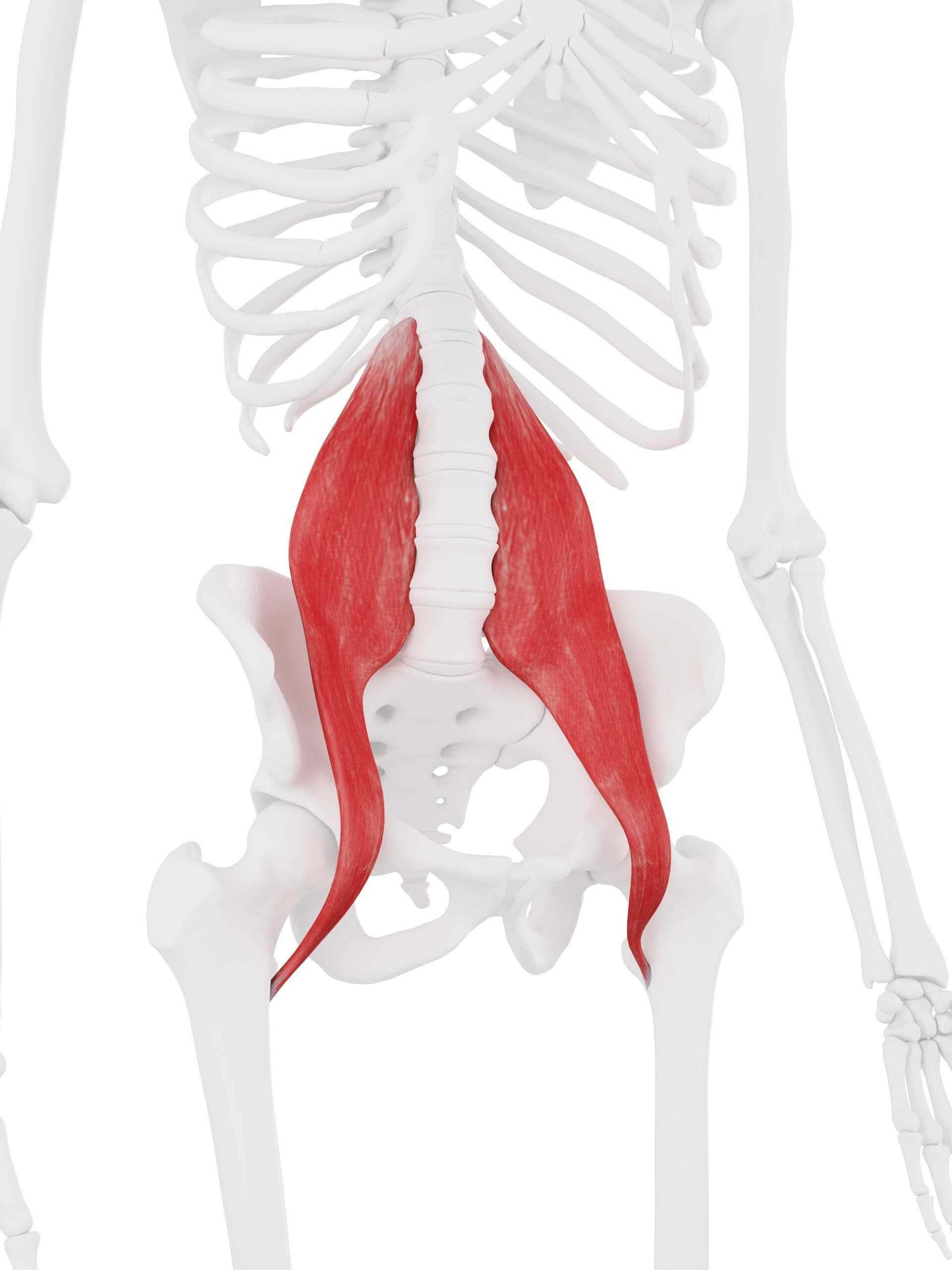
Anatamy of the Psoas Muscle
The psoas originates from the front of the mid-spine (the 12th dorsal vertebra) behind the diaphragm. Journeying down along the side of the spine, it transverses the pelvis and inserts along the inside of the femur (the head of the thighbone) As the psoas crosses the top rim of the pelvis, it is joined by the iliacus muscle, a fan-like muscle that lines the inside of the pelvis basin. These two muscles share a common tendon at their insertion point on the inside of the femur (Figure 1).
The psoas acts as a bridge between the lower torso, pelvis, and legs. Before we look at the function of the psoas, it will be helpful to examine its proximity and relationship to other body structures and systems. In doing so, we can start to see just how important this deep muscle is, and why stress or imbalance there can profoundly affect well-being.
The innervation of the pelvic area and leg, sometimes called the abdominal brain, is a complex arrangement of nerve ganglia that lies approximately at the level of the psoas and the diaphragm. Thus, contraction or imbalance in the psoas may affect optimal neurological function by pressuring or displacing the nerves.
Similarly, because the psoas and the diaphragm share a common insertion place, constriction in the diaphragm may shorten the psoas, and tightness in the psoas may restrict the ability of the diaphragm to move freely. Also, any constriction in the diaphragm will prevent full, whole body breathing, a dynamic process that massages the internal organs and promotes strength and vitality.
The kidneys are situated behind the psoas; the intestines and reproductive organs lie in front of it. When the psoas is tight and constricted, the lumbar curve becomes exaggerated, causing the abdominal organs to fall forward against the abdominal muscles, which were not designed to carry this weight. No amount of sit-ups (or “crunches,” as they have been so fittingly named in recent times) will draw the belly in when the deeper underlying support of the psoas is inadequate. In fact, the hardening and shortening of the superficial muscles decreases their functional strength and may make it impossible to sense the deeper, more integral psoas muscles.
The major aorta—the primary artery that carries the blood from the heart—also runs very close to the psoas muscles, and some bodyworkers postulate that an imbalance in the psoas may affect optimal blood circulation throughout the upper and lower extremities. Many people feel a flush of heat down the legs and up into the chest when the psoas releases.
Thus the strategic positioning of these deep muscles can affect circulatory, respiratory, neurological, and organ function. And this is even before we consider the effect the psoas has on the musculoskeletal balance and integration of the body.
The psoas acts primarily as a hip flexor; without it, normal walking and running would be impossible. The psoas also contributes to external rotation of the hips. When the psoas won’t release, this external rotation may cause the legs to turn outward during intense backbending, an undesirable action that pinches the muscles and nerves of the lower back.
What Causes Psoas Tightness?
Before we turn our attention to learning how to locate and lengthen the psoas through asana practice, let’s look at some of the factors that contribute to psoas shortness and dysfunction.
The psoas draws the thigh and the trunk close together, an action intimately connected with the fear reflex, which prepares us to flee, fight, or protect ourselves by playing dead. Cringing or assuming a fetal position to protect the soft, vulnerable frontal body is an instinctual behavior common to all humans. If the fear reflex fires repeatedly and with little recovery time, as when we are “stressed out,” our bodies may become chronically habituated to this high level of physical tension. In The Psoas Book, Liz Koch states that “when the psoas releases spontaneously without the use of invasive or manipulative techniques, people often report elusive feelings of fear or a sense of general unrest… As the psoas continues to release and the pelvis begins to extend, the ‘excitation’ flowing chaotically at first gradually becomes ‘sensation’ flowing smoothly through the whole body.” My own experiences—and those of students who have worked with me to open and lengthen the psoas— have borne out many of Koch’s observations.
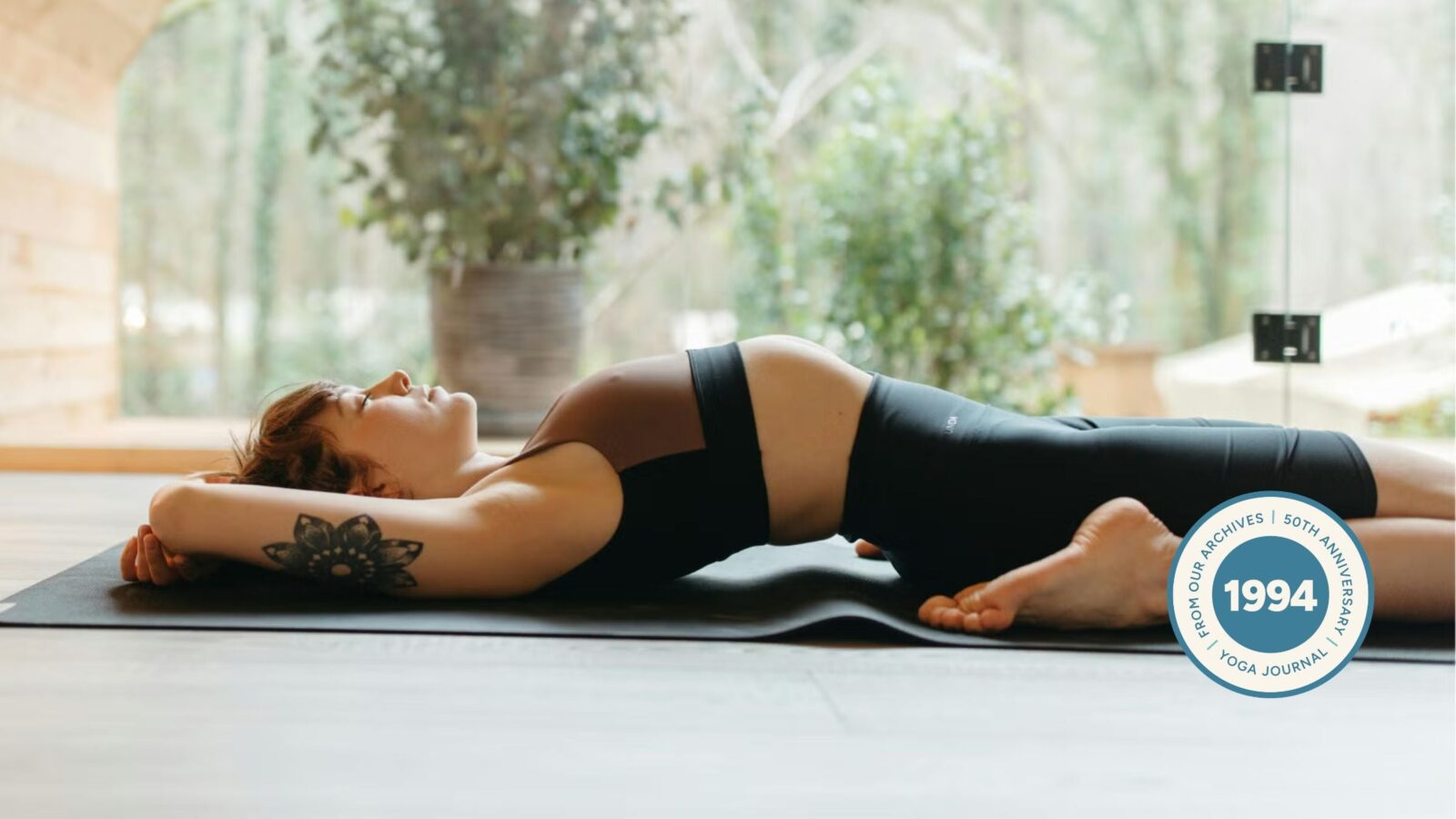
Supta Virasana, or Reclining Hero’s Pose, is one of the most powerful movements in the yogic repertoire for releasing the psoas. If done patiently and carefully, the lengthening of the psoas can promote free, upright posture as well as prepare the body for pain-free backbending.
First, let’s find our psoas muscles, so we can distinguish them from the more superficial muscles.
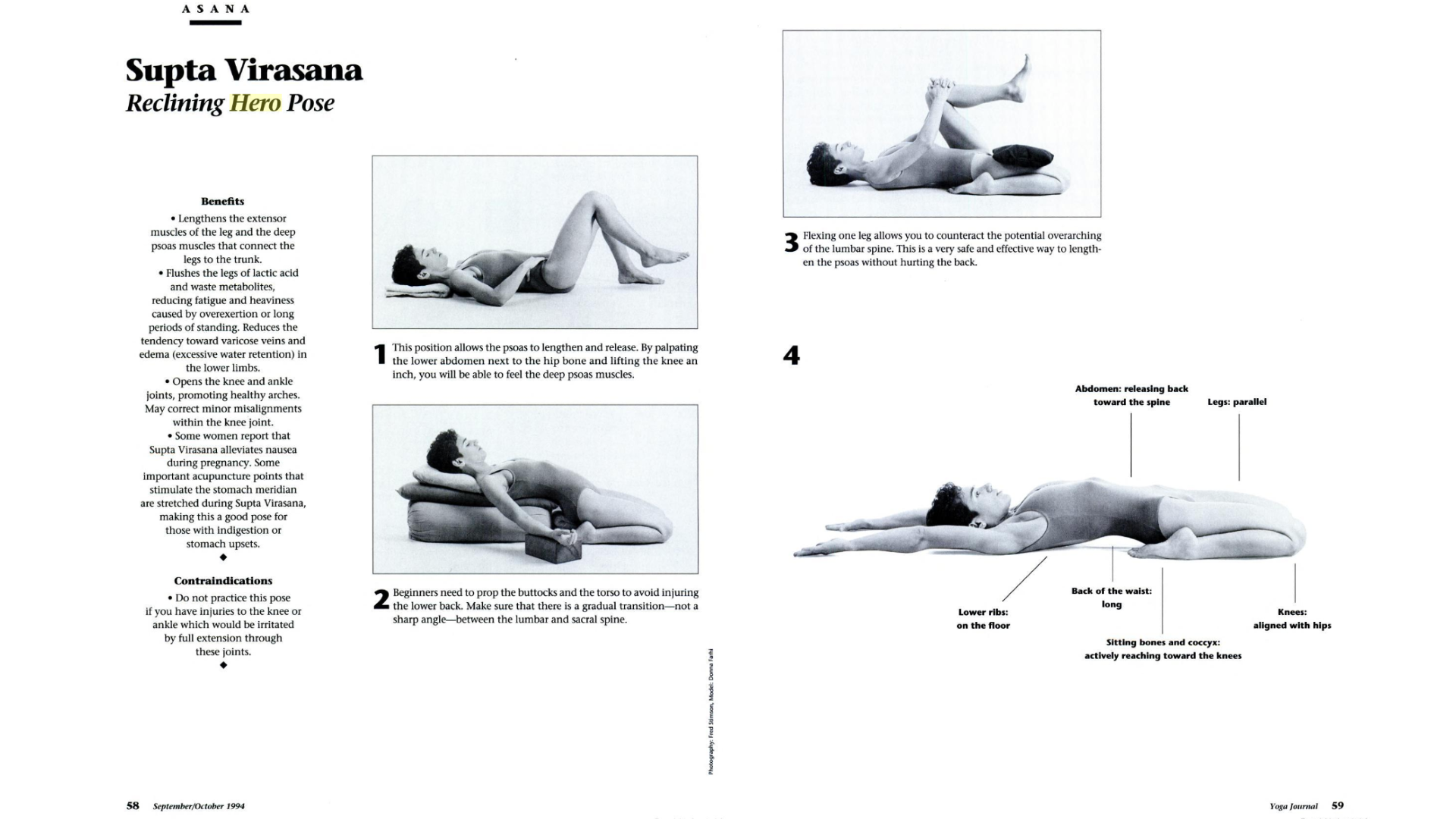
Release the Psoas With Supta Virasana (Reclining Hero Pose)
The following exercise is modified from Lulu Sweigard’s Human Movement Potential: Its Ideokinetic Facilitation. Lie down with your knees bent, your feet flat on the floor, and your arms by your sides. Place a folded towel under your head and neck and align the sitting bones to the heels. Adjust the distance between your heels and buttocks until the upper and lower leg bones are resting against each other like balanced cards. When you find this position, you will experience almost no tension in the legs and abdomen and no tendency for the knees to fall in or out. Experiment with your position until you find the most restful place for the legs.
Lying in this position in Reclining Hero Pose while focusing on releasing the abdomen and the insides of the thighs will lengthen and release the psoas muscles. To palpate the lower portion of the poas, slide the fingers of one hand along the inside of your hip bone (the anterior superior iliac spine). Move your hand so that it is about halfway between the hip bone and the midline of the belly at the back of the pelvis (Figure 2). Now lift that knee up toward the ceiling about an inch, and no more. The cord-like muscle you feel under your fingers is the psoas. Gently follow the psoas as far as you comfortably can. If you were to continue to lift and lower the knee and follow the psoas up along its length, you would eventually have your hand right next to the front of the spine all the way up where the diaphragm inserts.
Palpate the other side and determine whether the two sides feel the same. Is one side closer to the surface of the belly? Is one side painful? Once you have made these observations, return to a relaxed, bent-leg position and stay there for 10 to 15 minutes. Notice if the upper legs and lower abdomen begin to tremble or if the lower back lengthens on the floor. Also be aware of sensations of heat and any emotions that may arise.
When you are ready, roll over on your side and sit up.
Reclining Hero Pose With Props
Not surprisingly, the most frequent complaint in Supta Virasana (Reclining Hero) is pain in the lower back. Because the psoas is in intimate association with the lumbar spine, if we do not stabilize the lumbar and pelvic areas when lengthening the psoas, we may end up compressing the lumbar spine.
As most beginners will not be able to assume the full position, it’s important to know how to prop a modified variation correctly so the lower back doesn’t hurt. Before you begin, have two towels and a stack of blankets (or a rectangular bolster) handy by your side.
1. Begin by kneeling with your buttocks resting on your heels. Stay here for a minute to warm up the knees and legs.
2. Now lift your buttocks up and, leaning your weight forward, use your thumbs to draw the calf muscles outward before sitting down in between the two feet. If lowering your buttocks all the way to the floor is uncomfortable, raise your seat on a folded towel, blanket, or block. Check that your feet are pointing directly backward, not turning in or out. If your ankles are very uncomfortable, try placing a folded washcloth under the ankle joints or raising your seat a little higher.
3. Stack your bolster and blankets (about eight inches wide and three feet long) behind you so that they are about six inches higher than the propping for your seat. Lower yourself down with the support of both arms onto the blankets, raising the head onto a towel so the head is higher than the chest (Figure 3). Throughout the movement, actively draw the tailbone toward the knees so you open the psoas rather than arch the lower back. If you have propped yourself very high, you should support your arms on two blocks so that the weight of the hanging arms does not pull on the lower back.
4. If you feel pinching or any uncomfortable sensations in your lower back, try raising the props under your buttocks and back. If you still experience discomfort, come back to the upright position and slowly begin to lean back partway, actively drawing the tailbone under. Support yourself on your arms or elbows and actively hold this position for one to three minutes.
Half Reclining Hero Pose
For students who can comfortably sit in Virasana without any propping under the buttocks, the following variations will open the psoas more fully without compromising the lumbar spine. The basic technique involves having one leg folded in Virasana and the other straight. This position will counteract the tendency for the lumbar spine and pelvis to extend while allowing the psoas to lengthen.
1. Sit in Virasana, checking that the knees are in line with the head of your hips. As you proceed through this variation, be sure not to let the legs move out of the parallel position, a common error that reduces the lengthening of the psoas.
2. Now extend the right leg forward in front of you on the floor. Place a folded blanket underneath the right hip and buttock until the pelvis is evenly balanced. Now place one or two sandbags, if you have them, across the upper left thigh. Slowly lean back onto your elbows, drawing the base of the rib cage onto the floor first, then releasing the whole torso to the floor. You may want to raise the head with a folded blanket.
3. Press out through your right heel so the pelvis is drawn into a neutral position. This action will intensify the sensation along the top of the left leg and into the groin and lower abdomen. Stay for one to three minutes, then repeat on the other side.
If you felt comfortable with the previous variation, return to the first side, except this time draw the right knee in toward the chest (Figure 4). By drawing the knee into the chest, you will be flexing the pelvis and lumbar against the extension of the bent leg. To deepen the opening, press the back of the left foot into the floor, an action that will lower the left femur closer to the floor. Stay for one to three minutes, then repeat on the other side.
Reclining Hero Pose
After practicing the previous variations, you are ready to attempt full Supta Virasana.
1. Sit as before with the buttocks between the heels. Actively drawing the coccyx under, let the abdomen fall back toward the spine as you begin to lean back, using the support of your arms. Go slowly so you can maintain the position of the parallel legs and ensure that the knees stay on the floor. Lower the base of the rib cage onto the floor first, then continue to recline until the whole torso is lying on the floor.
2. Actively elongate the sitting bones toward the backs of the knees so the pelvis is kept in a neutral position. Then reach the arms overhead, reaching through the backs of the hands so the spine grows long and relaxed (Figure 5).
Remember that Supta Virasana is not a backbend but an opening for the front of the groin. The lower rib cage should be in contact with the floor and the lumbar curve should not be exaggerated. A gap between the lumbar spine and the floor is normal, but this gap should not be pronounced. If it is, you are probably not ready to assume the full position and should use some propping. Any pain in the lower back is a sure sign that you are arching the back rather than lengthening the psoas.
3. After you have practiced Supta Virasana, straighten both legs completely. You may want to lie in relaxation with the legs extended, or stand and walk. Sense deeply into your body, observing how the parts of the body have changed in relationship to each other and to the whole-and whether these changes have brought more harmony within you.
Some people find that long stays in Reclining Hero Pose irritate their knees, so be conservative at first. Stay one minute and then wait 24 hours to see how your knees feel. It’s normal to feel a general stretch just above the knee, but if you feel specific areas of pain, especially on the inner or outer borders of the knee, raise the buttocks more. Some students find that a very thin washcloth folded and placed inside the fold of the knee alleviates discomfort. Knees are unforgiving joints, so if you continue to have problems in this pose, discontinue practicing the pose.