

:max_bytes(150000):strip_icc():format(jpeg)/sleep-deprived-eeg-and-seizures-4628312_final-a8f1e5e503d04324918753e48f6d1521.png)
Key Takeaways
- A sleep-deprived EEG is a test that records brain activity to help diagnose seizures.
- This test is usually safe, but it might trigger a seizure if you have epilepsy.
- You should avoid caffeine on the day of the test and arrange for a ride home because you might be tired.
A sleep-deprived EEG, or an electroencephalogram, is a type of EEG that’s done when you’ve had much less sleep than usual. It’s used to detect subtle seizures, like absence seizures or focal seizures.
Like standard EEGs, this non-invasive test records the electrical activity of the brain and can pick up on abnormal brain waves through electrodes attached to the scalp. When you fall asleep or doze during the test, the machine will continue to record activity in your brain.
Learn about sleep-deprived EEGs, their purpose in diagnosing seizures, potential risks, and costs, and what to expect before, during, and after the testing is completed.
Purpose of Test
The relationship between sleep and epilepsy has been studied extensively. Sleep deprivation can act as an “activation procedure” to trigger seizures or reveal abnormal electrical patterns, known as interictal epileptiform abnormalities, that occur between seizures and are characteristic of epilepsy.
A neurologist may suggest a sleep-deprived EEG if a standard EEG has not shown unusual electrical activity in a person suspected of having seizures.
Sleep deprivation can enhance the accuracy of epilepsy diagnoses and increase the likelihood of detecting the electrical patterns indicative of epilepsy.
Standard EEGs may detect many findings, including evidence of:
A sleep-deprived EEG further assesses changes in brain activity that can indicate various brain disorders, like epilepsy or other seizure disorders. A sleep-deprived EEG can be used to diagnose and differentiate various types of epilepsies.
Sometimes seizure activity can manifest with psychiatric symptoms. Therefore, in some psychiatric presentations, a sleep-deprived EEG may be ordered by your healthcare provider to identify abnormalities that are typically seen with seizures.
While sleep-deprived EEGs are common tests for detecting epilepsies, the protocol for these tests can vary significantly depending on the healthcare provider’s orders. The amount of sleep the person obtains the night before, the duration of the EEG, and the time of day the examination is administered are not specific to the test. These may contribute to some differences in the results at times encountered when comparing studies done at different institutions.
Risks and Contraindications
A sleep-deprived EEG is safe and painless, with no significant risks involved. Most people feel little or no discomfort during the test. Electrodes only detect electrical activity in the brain—they do not send electrical charges.
However, like other procedures that involve flashing lights or rapid breathing, sleep deprivation can trigger a seizure during the test. If you’re having a sleep-deprived EEG, you’ll be closely monitored.
If a seizure occurs, which is a possibility for those predisposed to such conditions, fast-acting anti-seizure medication will be administered immediately.
For prolonged seizures, known as status epilepticus, oxygen and safety equipment are on hand, and protocols are in place to quickly end the seizure.
Before the Test
Timing
A standard EEG takes about one to one-and-a-half hours, including electrode application and 20–40 minutes to record brain activity. A sleep-deprived EEG usually lasts a few hours, with recording continuing as you fall asleep. After the test, you can go home right away.
Prior to the test, the healthcare provider will ask you to sleep less or avoid sleep completely the night before the test. How much sleep you get will depend on your healthcare provider’s orders and you should try to follow the directions as carefully as possible.
It is likely that your healthcare provider may have you go in for the sleep-deprived EEG early in the morning in order to ensure you are drowsy during the test and don’t accidentally fall asleep during the day.
Location
A sleep-deprived EEG is typically an outpatient procedure, meaning that it occurs without the need for hospitalization. It can be performed in a healthcare provider’s office, hospital, lab, or clinic. In some cases, a sleep-deprived EEG may occur as part of longer video EEG monitoring on an epilepsy monitoring unit in a hospital.
Arranging Transportation
Because you are likely to be drowsy during and after the sleep-deprived EEG, it is in your best interest to arrange for someone else to drive you to and from the testing.
What to Wear
Because you will be seated or lying down during the exam, you should wear something comfortable. A top that buttons or zips up is advised, so you don’t have to pull anything over your head. Jewelry is permitted, but keep in mind that large or dangling earrings could get in the way, depending on where the electrodes are placed.
Hair Care
You should wash your hair the night before or the day of the test and ensure that your scalp is clean and free of natural oils. Refrain from putting any conditioners, hair creams, sprays, or styling gels in your hair. Hair products and oils make it more difficult for the sticky patches or adhesive paste to stick and adhere to the electrodes to your scalp.
Food and Drink
Avoid anything with caffeine, like coffee or tea, on the day of the test or at least eight to 12 hours prior. Caffeine can interfere with the test results.
It is important to eat before the test, as a low blood sugar level can also interfere with the test results.
If you are taking any prescription medications or regularly take over-the-counter drugs or supplements, make sure your healthcare provider is aware. You should take your medications as usual, unless instructed otherwise. Most medications are fine to take prior to an EEG, although anything that acts as a sedative can interfere with test results. It is best to confirm what you should take on the day of the test prior to the procedure.
Cost and Health Insurance
With health insurance, an EEG can be covered as long as it is considered medically necessary and corresponds to the terms of your policy. Of course, you may be responsible for a copayment for the procedure or visit, especially if you have not met your annual deductible.
The estimated national average for the cost of a sleep-deprived EEG is $930, however, the cost can vary depending on where the procedure takes place, your state of residence, and other factors. Generally, extended EEGs, unlike standard EEGs that cost from around $200 to $800, may cost between $1,000 and $3,000, or more.
Some hospitals may offer discounts of up to 30 percent for patients who don’t have health insurance or who pay out-of-pocket for an EEG. Be sure to ask. Try to verify your financial responsibility prior to the testing if this is a concern.
During the Test
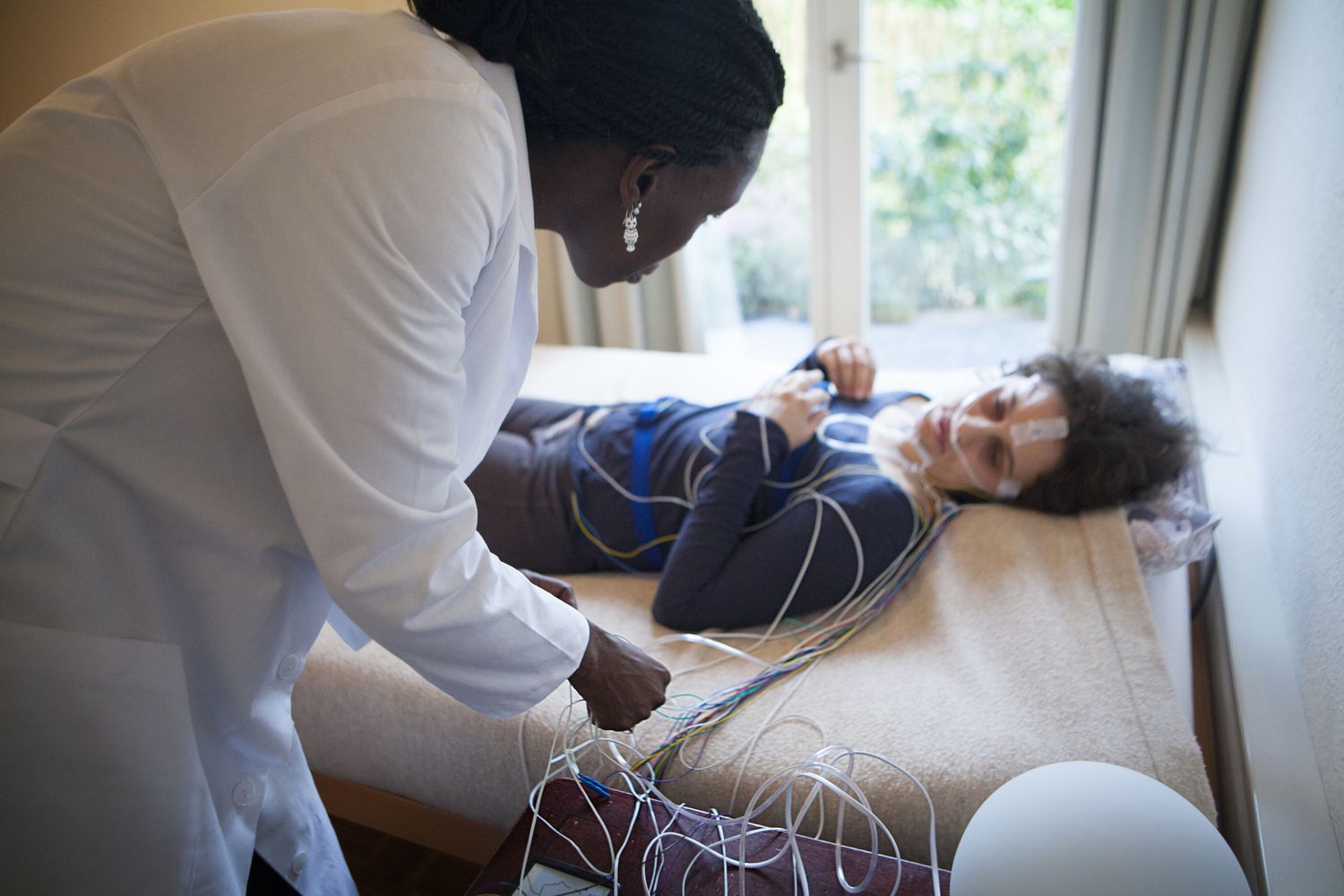
When you arrive, you will likely be checked in and asked to sign a form of consent. The EEG technician will be responsible for running your test and monitoring you during its duration. She will escort you to the testing room, or if you are in a hospital, the epileptic monitoring unit, which is usually in the neurology or epilepsy department. The room you will be tested in will probably be dim and quiet. You will be asked to relax and to sit in either a reclining chair or to lie comfortably on a bed.
Before placing the electrodes, the technician will measure your head to find the accurate spots to place them. She will mark these spots with a wax crayon. At least 16 and even up to 25 electrodes can be placed on your head for the sleep-deprived EEG. The technician will gently scrub each spot with a gritty cream that allows for better application of the adhesive paste or glue, which in turn, will help lead to a quality reading.
At the start of the sleep-deprived EEG, the technician will ask you to relax and close your eyes. She will probably suggest starting with a few deep breaths. Once the test begins, it is important that you remain as still as possible. Even blinking or swallowing can throw off a reading. During the test, it is alright if you doze, and you might be encouraged to do so. The technician will also be watching you to see any signs of seizures triggered during the test.
After the Test
Once the test is over, the EEG technician will remove the electrodes, and will probably use the help of some warm water or acetone to wash off or remove the adhesive paste.
After the test, you should be able to return to your normal activities, although you will likely be much more tired than normal. Again, having someone drive you or arranging a pick up would be in your best interest to ensure safety behind the wheel.
You will probably want to wash your hair as soon as possible. Your scalp may be slightly irritated in the spots where the electrodes were placed, but the irritation goes away fast, often within a few days.
If you stopped taking medications before the test, your healthcare provider will inform you when you may resume them.
Interpreting Results
The EEG recordings are interpreted by a board-certified neurologist with expertise in epilepsy diagnosis. These results will be relayed via a report to your provider. The time it takes to get your results back may depend on how soon the neurologist can finish interpreting the data and share this information with your healthcare provider. You could get your results as soon as a day later, but it may take a few weeks.
The neurologist will look to see if there is any abnormal electrical activity and will survey the recording for any overt seizures.
Aside from the results of the test, the neurologist and your provider will take note of observations made during monitoring, your medical history, physical examination, and previous laboratory tests. This will help to understand the test results in the context of your clinical history.
Abnormal results of a sleep-deprived EEG can indicate that you might have:
Follow-Up
Your healthcare provider will likely schedule an office appointment with you to go over the sleep-deprived EEG results. It might be helpful to bring along someone, like a family member or friend, to also catch the major points discussed during the appointment. Feel free to jot down notes. Ask about next steps, if any other follow-up evaluation is necessary, and if there are any factors that could have impacted the results of the sleep-deprived EEG.
If you do receive abnormal results, your healthcare provider might recommend you undergo further testing, like another type of EEG or imaging tests, like a magnetic resonance imaging (MRI) or a positron emission tomography (PET) to detect lesions or other abnormalities of your brain that could be causing you to have seizures.
Any need for treatment will depend on your final diagnosis. Epilepsy can be managed with medication or surgery.
Frequently Asked Questions
-
How long do you need to stay awake before a sleep-deprived EEG?You might be asked to stay up all night or sleep less than four hours before a sleep-deprived EEG. For children, sleep may be shortened by four to five hours the night before.
-
Can a sleep-deprived EEG detect whether you had a seizure previously?No. A sleep-deprived EEG will pick up a seizure if you have it during the test, but it cannot pick up evidence of a previous episode. The purpose of keeping you sleep deprived, though, is to trigger a possible seizure, which would provide doctors with information they can use to diagnose a possible seizure disorder.
-
Is an EEG safe for children?An EEG is generally safe for children and can help diagnose developmental delays, seizures, or other issues. If a seizure occurs during the test, healthcare staff can help. The EEG only records brain activity, posing no risk of shock or harm, but children might feel anxious.