

:max_bytes(150000):strip_icc():format(jpeg)/Getty.coldsore-3113e0e2c1ba45ae981d2d7cecfec115.jpg)
Key Takeaways
- Genital herpes can be caused by HSV-1, commonly known as the virus causing cold sores.
- Herpes can be transmitted even when there are no visible symptoms, known as asymptomatic shedding.
- Using condoms can reduce the risk of spreading herpes, but they are not fully effective.
The virus that causes cold sores—herpes simplex virus type 1 (HSV-1)—also can cause genital herpes cases. HSV-1 is contagious and can be passed orally and genitally, either from mouth to mouth, genitals to genitals, mouth to genitals, or genitals to mouth.
That means that you can get genital herpes if someone with a cold sore performs oral sex on you. And, that’s a concern given that nearly half of the U.S. population has HSV-1, according to the Centers for Disease Control and Prevention (CDC).
This article explains how you can get genital herpes from a cold sore and vice versa. It also details how herpes can spread through oral sex and offers tips to prevent herpes transmission.
ancoay / Getty Images
Key Facts
Genital herpes is an incurable infection caused both by herpes simplex virus type 1 (HSV-1) and herpes simplex virus type 2 (HSV-2).
According to the CDC:
- Over 572,000 new genital herpes infections were reported in the United States among people 14 to 49 in the most recent national surveillance.
- Genital herpes is transmitted through contact with herpes sores, mucosal tissues, genital secretions, or saliva.
- Most people infected with herpes are asymptomatic (without symptoms) but can still be carriers and infect others.
- The majority of genital herpes infections are caused by the asymptomatic transmission of the virus.
- Condoms are only partially effective against genital herpes because the virus can also be passed through contact with intact skin.
What Are Cold Sores?
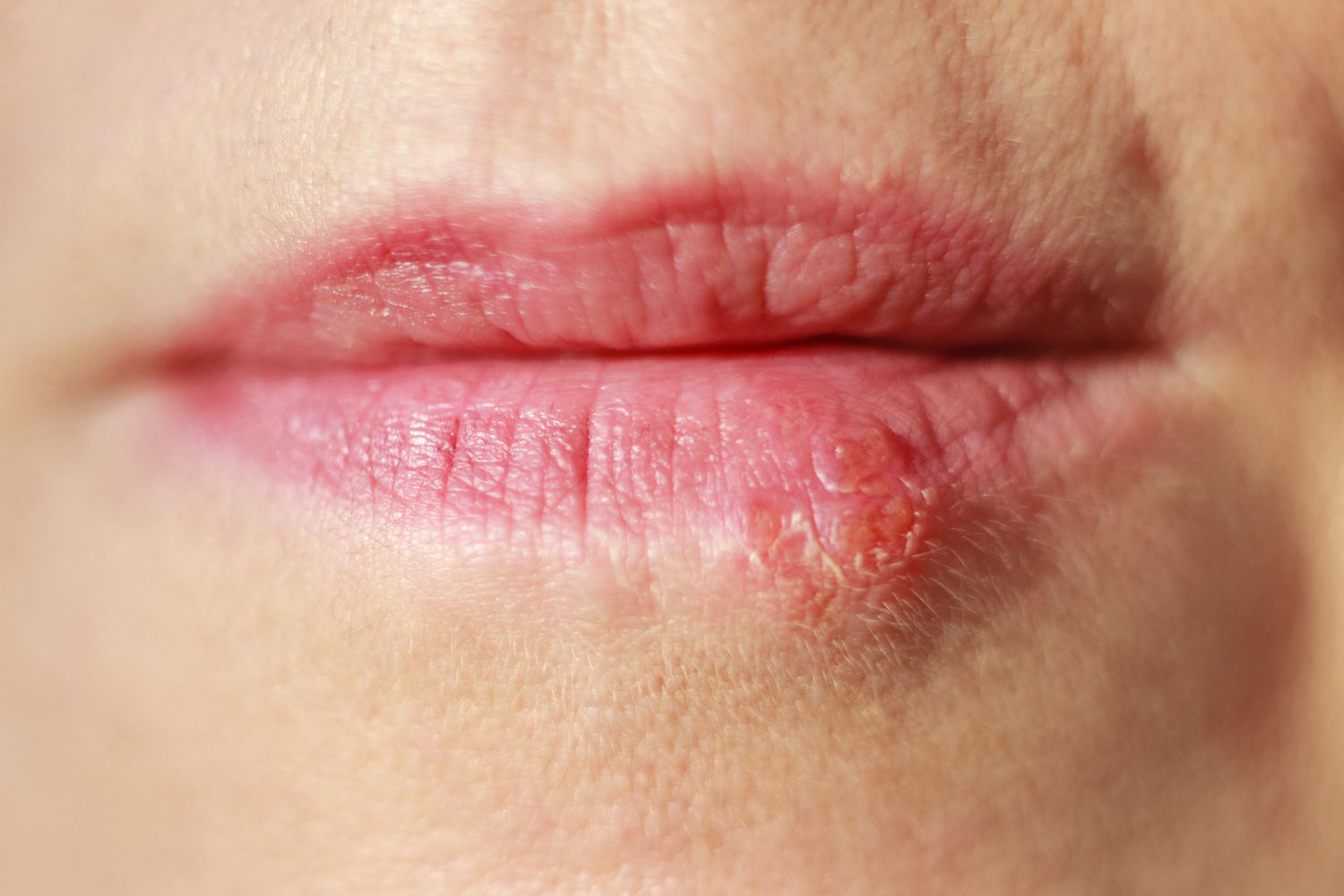
A cold sore, also known as herpes labialis, is a group of tiny fluid-filled blisters that typically appear on one side of the lips. Many people notice a cold sore forming when they experience tingling or itching in the area, which are known as prodromal symptoms.
Cold sores break open easily. When they do, the clear fluid inside oozes out and the blister forms a crust. Most blisters go away after a week or two.
What Is Genital Herpes?
Genital herpes, or herpes genitalis, creates clusters of blisters that can be preceded by pain or tingling. These lesions may appear on or inside the vagina, on the penis or scrotum, and around the anus, thighs, or buttocks.
Can HSV-1 Spread Genitally?
Cold sores and genital herpes are both caused by herpes simplex viruses. Most cold sores are caused by herpes simplex 1 (HSV-1), while genital herpes is usually caused by herpes simplex 2 (HSV-2).
HSV-1 is much more common than HSV-2, with occurrence rates of 47.8% compared to 11.9%. It’s also common for children to have cold sores..
Genital herpes is diagnosed in sexually active adults or adolescents through direct genital contact. People assigned female at birth are more likely to contract genital herpes and are twice as likely to have HSV-2 as those assigned male at birth.
However, sometimes genital herpes infections can be caused by HSV-1. An infection on one person’s lips can spread to another’s genitals during oral sex, resulting in an HSV-1 infection.
In fact, some scientists estimate that more than half of new genital herpes infections are caused by HSV-1 rather than HSV-2.
Although not nearly as common, a genital HSV-2 infection can also be transmitted to the mouth, meaning you could get a cold sore if you perform oral sex on someone with genital herpes.
It’s crucial to know that both cold sores and genital herpes can be passed on even without visible lesions, which is known as asymptomatic shedding.
Symptoms of Oral and Genital Herpes
Both oral herpes and genital herpes are characterized by the outbreak of painful blisters that rupture, leaving an open, concave sore (ulcer).
Both progress in similar ways:
- There may be initial redness, swelling, burning, pain, or itching around the site of an impending eruption. Some people may also experience fatigue or mild flu-like symptoms.
- Painful, fluid-filled blisters will develop rapidly in a tight cluster, rapidly increasing in size and often converging into larger blisters.
- The blisters will typically rupture, leaking fluid and forming a painful ulcer.
- The sore will start to crust over and heal over a period of days or weeks.
Oral herpes tends to heal in four to six days. Genital herpes can take anywhere from one to three weeks to fully heal.
Can You Give Herpes to Yourself?
In theory, if you touch your cold sore and then your genitals, you could possibly transmit the virus to your genitals (referred to as autoinoculation). Even so, this is considered uncommon.
On the other hand, if you touch a herpes sore and then your eye, you can get an infection called HSV keratitis. The infection usually heals without damaging the eye, but severe infections can lead to scarring and vision loss.
How Is Genital Herpes Treated?
Genital herpes is treated with antiviral drugs which don’t cure the disease but may reduce the severity or duration of the infection if started early (ideally within the first 24 hours of the appearance of symptoms).
There are three antivirals approved for the treatment of genital herpes:
- Zovirax (acyclovir): Taken in a 400-milligram (mg) dose three times daily for seven to 10 days
- Famciclovir: Taken in a 250-mg dose three times daily for seven to 10 days
- Valtrex (valacyclovir): Taken in a 1,000-mg (1 gram) dose twice daily for seven to 10 days
If there are frequent recurrences, your healthcare provider may prescribe Zovirax, famciclovir, or Valtrex in a low dose to be taken once daily (a practice known as herpes prophylaxis). Doing so may significantly reduce the risk of repeated outbreaks while lowering your risk of passing the virus to others.
Possible Complications
For most people, genital herpes is a self-limiting infection that poses no long-term harm.
But for people with compromised immune symptoms, such as those with advanced untreated HIV, the virus can sometimes disseminate (spread) to other parts of the body, causing potentially life-threatening complications like:
- Meningitis: Inflammation of the tissues that surround the brain and spinal cord
- Encephalitis: Inflammation of the brain
- Esophagitis: Inflammation of the esophagus (feeding tube)
- Hepatitis: Inflammation of the liver
- Liver failure: Particularly during pregnancy, increasing the risk of maternal and fetal death
Genital herpes also increases the risk of getting HIV. This is not only because the open ulcer allows HIV easier access into the body but also because the infection draws the very immune cells (called CD4 T-cells) that HIV targets for infection.
How Is Genital Herpes Diagnosed?
In most cases, genital herpes can be diagnosed based on the appearance of the characteristic lesions. If there is any doubt about the diagnosis, a swab of fluid from the sore can be sent to the lab for positive confirmation using a genetic test called polymerase chain reaction (PCR).
There are also blood tests that can differentiate between infection by HSV-1 and HSV-2 based on immune proteins, called antibodies, produced in response to the viruses. The test may not be necessary given that the differentiation won’t alter the course of treatment for a first outbreak.
Where the tests may be useful is when there is a recurrence of genital herpes. Because HSV-1 is less likely to cause recur over the long term compared to HSV-2, the differentiation can help determine whether herpes prophylaxis is needed.
The blood test may also be useful in detecting if the person’s partner has herpes. If the partner is uninfected (or does not have the same type of herpes), the findings can support the case for starting herpes prophylaxis.
How to Prevent Genital Herpes
The same measures that help prevent a herpes infection during genital-to-genital contact can help prevent infection of the genitals from a cold sore, including the following:
Abstain
If your partner has a cold sore, the only way to guarantee you won’t get infected is to avoid oral sex until the lesion has cleared up completely.
Someone with a cold sore can pass herpes to you, which means you can pass it back to them. Prevention is key, so it’s best not to kiss or share a toothbrush, coffee cup, water bottle, or eating utensils.
Use a Condom
An external condom that goes on a penis will not completely eliminate the risk of spreading the herpes virus from a cold sore to another person’s genitals. Neither will an internal condom placed into an anus or vagina. But they will provide some protection when used correctly.
Make sure the condom you use is approved by the Food and Drug Administration (FDA) for protection against sexually transmitted infections (STIs).