

Strategies to Improve Strength and Control
We use our hands constantly, from turning on the tap at a sink to sliding a credit card out of a wallet. Bringing back strength and control to your hands can improve your quality of life.
Therapeutic Exercises
Therapeutic exercises can reduce pain and improve coordination, strength, and function. Common exercises for PsA include the following:
- Isometric Exercises These are static exercises during which your muscles stay the same length. “Isometric exercises are safer for the arthritic hand to perform because the joints are not moving,” says Kristin Valdes, a certified hand therapist and professor at Touro University Nevada, in Henderson, Nevada. In this type of exercise, you squeeze an immovable object, and your joints are supported by the object you’re holding. Valdes suggests squeezing a firm racquetball or tennis ball to improve grip strength.
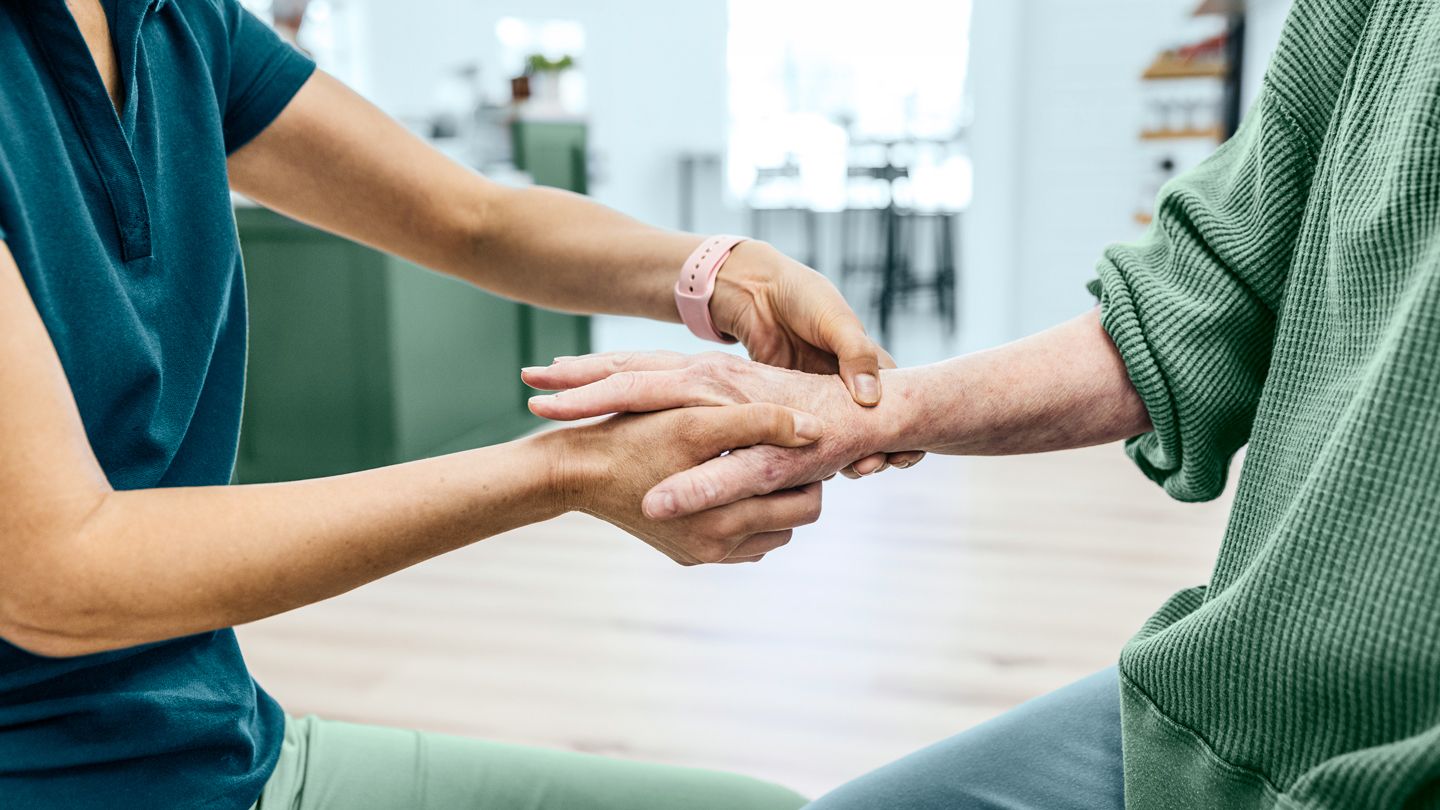
- Passive Range of Motion With psoriatic arthritis, the fingers can flex (or “claw” inward) over time as the skin contracts. Anyone experiencing this “should use the other hand or pull their fingertips over the edge of the table to try to straighten out the fingers daily,” says Valdes.
- Tendon Gliding This set of exercises encourages smooth movement of your finger tendons within their sheath.
Be cautious when starting hand exercises with psoriatic arthritis. “If treatment is too aggressive, it can increase hand pain and cause skin breakdown,” says Valdes.
Consider seeing a CHT for a personalized program of exercises, since everyone’s psoriatic arthritis is different.
Assistive Tools
When your wrist is sore, twisting open a jar can be very painful. And when your fingers are stiff, it can feel near impossible to pick up small items. Assistive devices can help you achieve these everyday tasks with less effort and therefore less pain.
Assistive devices for psoriatic arthritis include these examples:
- Wide-grip pens or utensils
- Electronic jar or can openers
- Ergonomic kitchen tools
- Button hooks
- Elastic shoelaces
- Electric toothbrushes
- Gripping materials (to hold a mixing bowl in place, for example, or grip a lid)
- Tap turners or lever handles (to avoid twisting)
- Tongs
- Adaptive cutting boards
- Motion sensor dish soap or shampoo dispensers
Orthoses
For those seeing a hand therapist for treatment, “The therapist can also fabricate a custom orthosis to rest the joints,” says Valdes. This might look like a ring to keep your finger joint straight or a brace that wraps around your thumb.
Joint Protection and Skin Protection
Joint protection techniques, which are usually taught by a CHT, are ways to perform daily tasks so that less stress is applied to your joints. The following techniques are common:
- Practice the large joint rule. Use larger and stronger joints for tasks instead of smaller ones. Valdes gives the examples of pushing instead of pulling, carrying bags with your forearm instead of hands, and using a shoulder bag rather than a handbag.
- Limit repetitive hand movements. For example, use an electric can opener instead of a hand-operated one. You can still knit or do hobbies involving your hands, but Valdes recommends limiting these to no more than 30 minutes at a time.
- Use a light grip. “Try not to grip so forcefully that the hand fatigues easily,” says Valdes. One way to achieve this is to bulk up the handles of tools or utensils. For example, when cooking, wrap a potholder around a pot handle to make it larger; that reduces the pressure on your hand.
- Don’t forget skin protection. Applying cream to tight skin can help protect both the skin and joints.
Heat and Cold Therapy: Using Paraffin Baths for Stiffness vs. Ice for Acute Inflammation
If your fingers are swollen, try cold therapy with a cold cloth or ice pack. This can help reduce inflammation in the affected joints.
Heat therapy can’t bring down acute inflammation, but it can provide pain relief. If your hands are stiff or painful, consider applying a warm cloth or heating pad.