

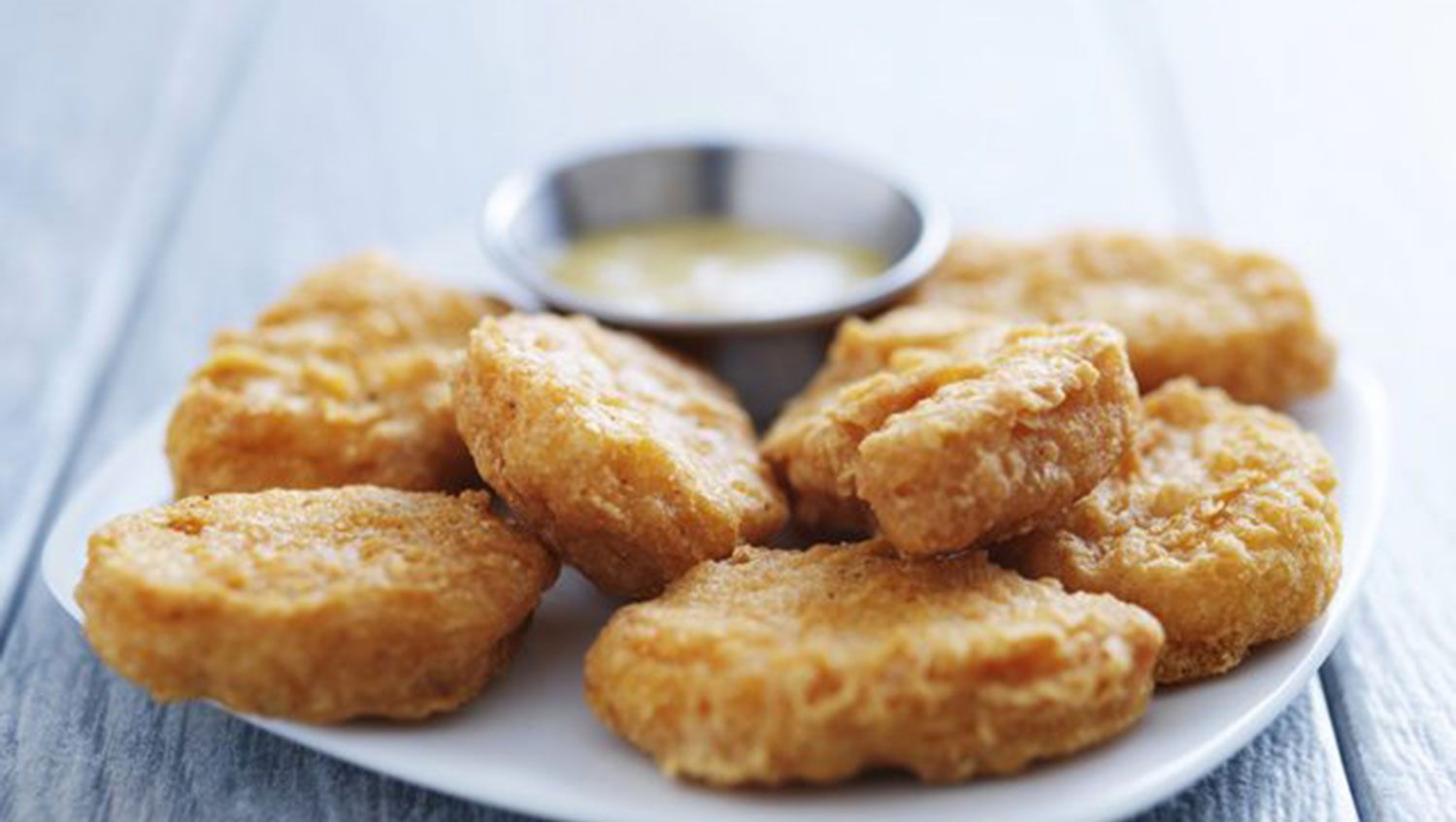
What Are McDonald’s Chicken Nuggets Made Of?
If you’ve ever wondered what’s actually in McDonald’s chicken nuggets, here’s each ingredient and how it can affect your health. The ingredients below are in descending order, so those that McDonald’s uses in the largest amount are first, and those that follow are present in smaller amounts.
1. White Boneless Chicken
The number one ingredient in McDonald’s chicken nuggets is 100 percent white boneless chicken breast meat.
Myths have circulated that the meat contains byproducts, but their current recipe uses only 100 percent chicken breast. As for what percentage of the nugget is white meat chicken, the chicken makes up a portion of the chicken nugget, while the other twelve ingredients make up the rest.
2. Vegetable Oil
The vegetable oil in chicken nuggets is a mixture of canola oil, corn oil, soybean oil, and hydrogenated soybean oil.
While most plant oils are primarily unsaturated fat (except for coconut and palm oils), the process of hydrogenation increases the amount of saturated fat in any oil, according to Consumer Reports.
“A four-piece nugget has 1.5 grams of saturated fat, which is within both the U.S. government and the American Heart Association’s guidelines for saturated fat intake. It’s something to be aware of and limit in the diet, but not stress over in small amounts,” Pflugradt says.
3. Enriched Flour
Part of the breading in chicken nuggets is made from wheat flour that producers have bleached and then enriched with niacin, iron, thiamin mononitrate, riboflavin, and folic acid.
Enriching grain products has helped alleviate some common nutrient shortfalls. Enriched grains are the number one source of folic acid for people assigned female at birth in the United States.
According to a study published in 2024, the risk of unborn babies developing neural tube defects was halved in countries where producers fortified flour with folic acid, compared with countries where folic acid fortification wasn’t in place.
4. Bleached Wheat Flour
Next in line is bleached flour that’s not enriched with nutrients. Flour is bleached to produce a finer, lighter texture and a whiter color. All flour eventually reaches a bleached state as it ages and is exposed to oxygen, but flour that’s been bleached with chemicals is labeled as “bleached,” per the Code of Federal Regulations.
“Bleached flour is a food that gets a lot of attention. It’s impossible to know which type of bleaching agents are used in the flour McDonald’s uses for their nuggets,” says Pflugradt. The U.S. Food and Drug Administration (FDA) allows and regulates the use of nitrogen oxides, chlorine, nitrosyl chloride, chlorine dioxide, benzoyl peroxide, acetone peroxide, and azodicarbonamide as bleaching agents in amounts considered safe.
5. Yellow Corn Flour
Yellow corn flour is a whole-grain flour that producers add to the batter for Chicken McNuggets. It’s a source of carbohydrates but also provides iron, a mineral that helps oxygen travel through the blood, per the Office of Dietary Supplements.
6. Vegetable Starch
McDonald’s chicken nuggets use a blend of vegetable starch from corn, wheat, rice, and peas. Starch is a naturally occurring carbohydrate in plants. Adding vegetable starch to the batter increases the crispiness of the breading during deep-frying, according to a paper published in 2024.
7. Salt
A four-piece McDonald’s chicken nugget serving has 362 milligrams (mg) of sodium. If you sit down to a 10-piece order, you’ll be eating 900 mg of sodium in just one meal.
A high-sodium diet can lead to high blood pressure, heart disease, stroke, and even contribute to osteoporosis by causing calcium to leach out of your bones, per the Harvard T.H. Chan School of Public Health.
The American Heart Association (AHA) recommends less than 2,300 mg of sodium per day. Ideally, the AHA suggests an intake under 1,500 mg, especially for people with high blood pressure.
A four- or six-piece chicken nugget meal does have some sodium, but if you consider the other foods you eat in a day, they can still fit in a sodium-controlled diet.
8. Leavening Agents
To help the chicken nuggets puff up during the heating process, McDonald’s adds a blend of several leavening agents to the batter, including baking soda, sodium aluminum phosphate, sodium acid pyrophosphate, calcium lactate, and monocalcium phosphate.
The Code of Federal Regulations includes leavening agents and authorizes their use in food.
9. Spices
The spices used in McDonald’s chicken nuggets are a closely guarded secret, but producers add them to the batter to enhance flavor.
10. Yeast Extract
Yeast extract is added to enhance foods’ flavor, much like the additive monosodium glutamate (MSG), as it also contains the amino acid glutamate.
Glutamate is a naturally occurring amino acid in the body that producers often add to foods to enhance umami flavor. You need it for neuron and brain function, and it also plays a role in memory and cognition, according to Cleveland Clinic.
While eating too much MSG has been associated with symptoms such as headaches, numbness, tingling, or flushing, yeast extract contains much less glutamate. It’s unlikely to cause any reaction, according to the Center for Science in the Public Interest.
11. Lemon Juice Solids
Dried lemon juice adds freshness to foods. McDonald’s chicken nuggets contain a small amount.
12. Dextrose
Dextrose is a simple sugar that serves as a food sweetener. While diets high in added sugars are associated with weight gain, diabetes, and heart disease, according to the Centers for Disease Control and Prevention (CDC), McDonald’s adds very little sugar to their chicken nuggets.
13. Natural Flavors
According to the Code of Federal Regulations, natural flavors on an ingredient list are flavors derived from:
- Spices
- Fruits and vegetables or their juices
- Edible yeast
- Herbs, bark, buds, roots, leaves, or similar plant material
- Meat, seafood, poultry, egg, or dairy products
- Fermentation products
Producers don’t have to disclose the source of the flavors, so it’s not clear where the natural flavors in McDonald’s chicken nuggets come from.
There are no real health concerns with natural flavors unless you have food allergies or dietary restrictions, which may prompt you to avoid them or inquire with the company about where the natural flavors come from.