

Key Takeaways
- Physical therapy exercises won’t cure pectus excavatum but can help improve heart and lung function.
- Exercises like arm sliders, T-stretch, and push-ups should be done three to five times a week.
- Pectus excavatum may require surgery in some cases.
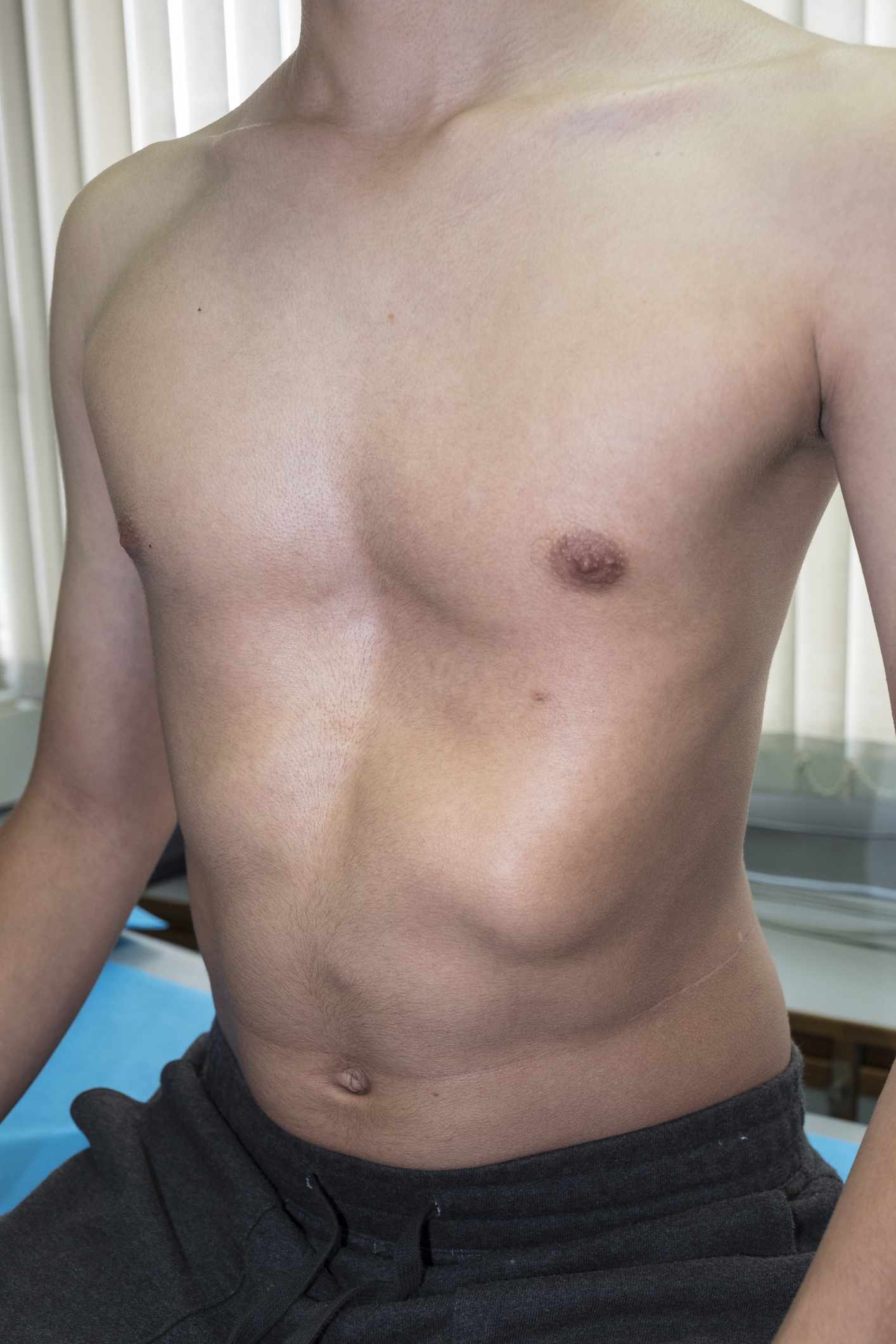
Pectus excavatum is a condition in which your sternum (breastbone) has sunk into your chest cavity. The condition is often not painful, but it occasionally can be. Most often, people with pectus excavatum only suffer from slight disfigurement of their chest cavity.
In severe cases, the caving in of the sternum may compress structures in your chest, causing heart problems or difficulties with lung function. In those cases, surgery may be recommended to correct the problem.
Verywell / Laura Porter
If you have pectus excavatum, you may benefit from the skilled services of a physical therapist. While the therapy you receive will not cure your condition, it can instruct you on what to do to maintain high levels of cardiac and pulmonary (heart and lung) function.
Performing the correct exercises for your condition under the guidance of a physical therapist may help you prevent loss of mobility and loss of cardiac or lung function, and it may prevent the need for surgical intervention.
Exercises That Improve Pectus Excavatum Symptoms
During physical therapy, your therapist will likely recommend exercises to improve your strength, breathing, and mobility. Exercises to help with posture may also be included. The main goal is to maintain good posture and strength, potentially reducing the need for surgery.
Exercises for pectus excavatum should be done three to five times each week, and postural awareness (being conscious of your body posture) and correction should be done daily. Before starting any exercise program for pectus excavatum, discus this with your physician or physical therapist to ensure that exercise is safe for you.
Arm Sliders
Stand with your back against a wall, ensuring your head and hips touch the wall. Raise both arms overhead, keeping your upper arms, elbows, and forearms against the wall. Inhale, then slowly exhale as you slide your arms down the wall.
Keep contact with the wall throughout. Repeat for 10–15 repetitions.
T-Stretch
The T-stretch helps open the chest wall and stretches the pectoral muscles, which connect the chest to the upper arm and shoulder. Stand upright and hold a light resistance band in both hands, behind your thighs. Extend your arms sideways into a “T” shape, allowing the band to gently pull your arms back. Hold for 15–30 seconds and repeat three times.
Push-Ups
Push-ups strengthen the pectoral muscles. Place your palms on the floor under your shoulders and your toes on the floor. Start flat or with extended arms. If starting with extended arms, lower yourself until your elbows are at 90 degrees.
Engage your abdominal muscles and push up into a plank position, exhaling as you rise. Hold for two seconds, then lower slowly. Repeat 10–15 times.
Modification Tip
To make the push-up a little easier, you can start in a modified position, with your knees on the floor instead of your toes.
Chest Fly
To perform the chest fly, lie on your back. Hold two dumbbells in your hands (5 pounds is a good start). Hold the weights up in front of you, and then slowly allow your arms to spread out to the sides of your body, like a “T,” with your palms (and the weights) facing the ceiling. Then breathe out as you slowly lift the weights back to the starting position. Repeat 15 times.
Dumbbell Row
The dumbbell row is a great exercise to strengthen your back muscles. To perform the exercise, hold two dumbbells in your hands. Bend forward slightly at your hips, keeping your back as straight as possible and your head up. Allow the weights to hang down in your arms towards the floor.
Breathe out as you slowly lift the dumbbells up into a rowing position. Squeeze your shoulder blades together. Hold this position for two seconds, and then slowly lower the weights back to the starting position. Repeat 15 times.
Dumbbell Rear Delt Fly
To perform the dumbbell rear delt fly, start by sitting in a chair or on a weight bench with your back straight. Hold two light dumbbells (1–3 pounds for starters), and place both arms out to the side, palms facing down. Bend forward slightly at the waist.
Breathe out as you lift both arms up and back. Hold the position for three seconds, and then return to the starting position. Repeat 15 times.
Superman
To perform the Superman exercise, lie on your stomach with a pillow underneath your pelvis. Reach both arms overhead. Then, lift up your arms and both legs, slightly arching your back, and breathe out. You should look like Superman flying through the air (without the cape). Hold this position for three seconds, and lower slowly. Repeat 10 times.
Seated Twist
The seated twist exercise helps to improve range of motion through your back and thoracic spine (the longest region of your spine). To perform the exercise, sit in a chair with upright posture. Make sure your feet are flat on the floor, and scoot up in the chair so your back is away from the backrest of the chair. Hold your arms out to the side and breathe out as you slowly turn your body to one side.
Hold this position for 15 seconds, and then return to the starting position. Repeat the exercise to the other side. Perform 10 repetitions of the seated twist to each side.
Bow Pose
The bow pose stretches the muscles in the front of your thighs and thorax, opening up your chest wall. To perform the exercise, lie on the floor on your stomach and bend both knees up. Reach back and grab your ankles with your hands, and gently pull until a stretch is felt in the front of your thighs and abdomen. Your body should be bowed up in this position.
Hold the stretch for 15–30 seconds, and then return to the starting position. Repeat three times.
Camel Pose
To perform this stretch that helps the front of your abdomen and chest, kneel on the floor with your shins and the front of your ankles flat. Place both hands on the back of your hips (or the tops of your ankles, if that is more comfortable). Keep your thighs perpendicular to the floor and slowly bend backward, tilting your head back as you bend. Breathe out as you stretch, and hold the position for 15 seconds. Repeat three times.
:max_bytes(150000):strip_icc()/BrettSearsPT_1000-b66602ce9ab7482cb78acf5d2c3de153.jpg)