

Key Takeaways
- There are four types of bones in the human body: long, short, flat, and irregular.
- Long bones are longer than they are wide and help with body movement.
- Short bones are about as wide as they are long and enable movement and strength in wrists and ankles.
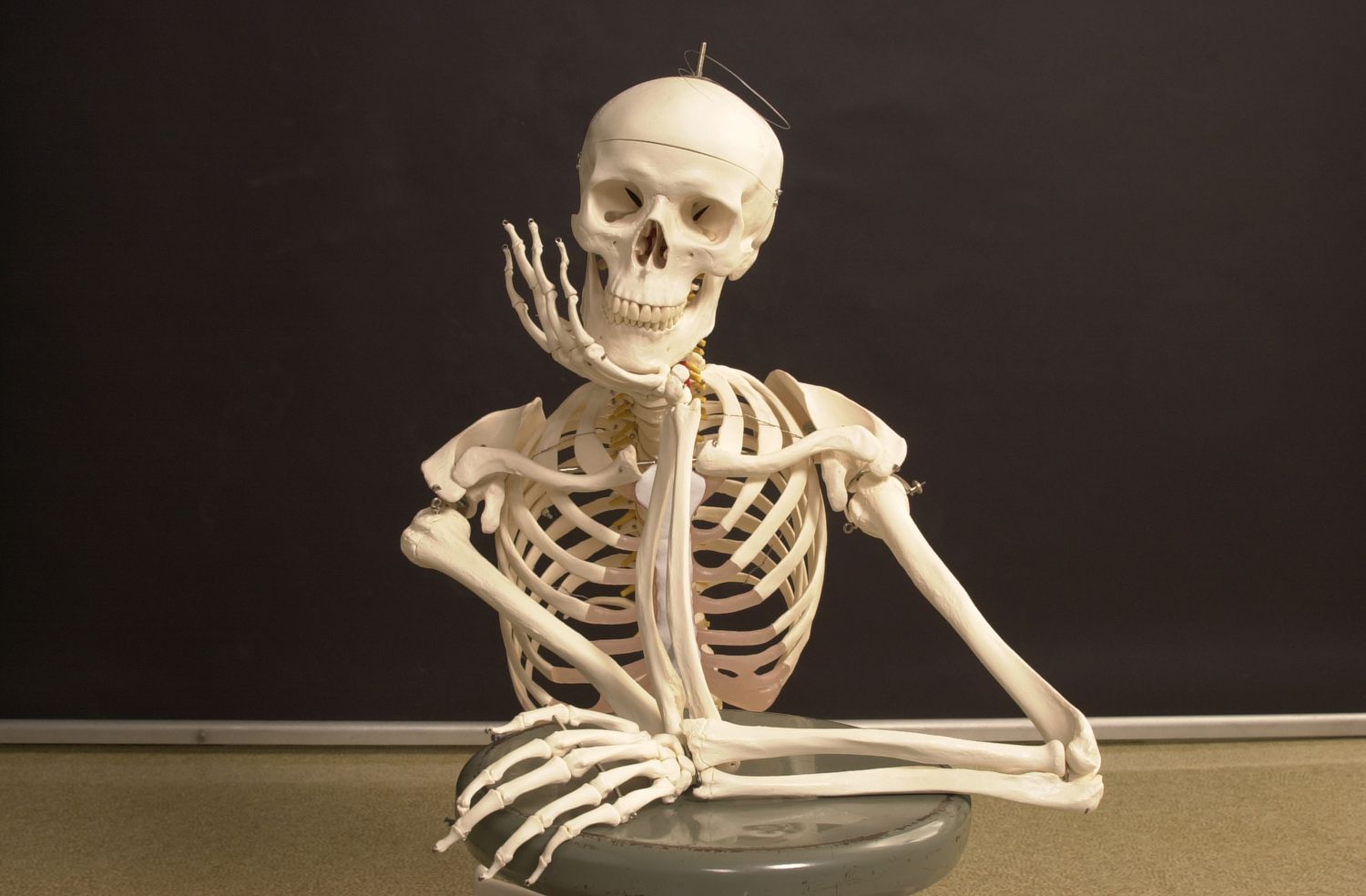
The skeleton is the body’s frame. It provides the foundation to which other structures cling and helps to create our shape. All 206 of the bones of the skeleton can be categorized into four types: long, short, flat, and irregular. Each type of bone serves a particular purpose and some types have more than one function.
Long Bones
The skeleton of the arms and legs are made up of mostly long bones. Long bones are so-called because they are longer than they are wide. Long bones in the arm include the humerus, radius, ulna, metacarpals, and phalanges. Long bones of the leg include the femur, tibia, fibula, metatarsals, and phalanges. The clavicles (collar bones) are also long bones.
Long bones give us the leverage needed for body movement and interacting with our surroundings. Every long bone consists of two main parts: the diaphysis and the epiphysis.
Diaphysis
The diaphysis is the shaft of the long bone, the main body. The diaphysis is a tube with a hollow center called the medullary cavity (or marrow cavity). The wall of the diaphysis is made up of compact bone, which is dense and very hard. For most of the life of a long bone, the center of the diaphysis is filled with yellow bone marrow. Yellow bone marrow is basically fat, also known as adipose tissue.
Epiphysis
Each end of a long bone is called an epiphysis. Each epiphysis is shaped to fit its connecting bone at a junction that is called a joint and the shape of the epiphysis is based on the job of the joint. The proximal (closer to the body) epiphysis of the humerus and the proximal epiphysis of the femur are shaped in a rounded manner, called the head, and look a bit like half of a ball. This shape allows those two long bones to rotate in multiple directions. The head of the femur fits into a socket in the pelvis. The head of the humerus fits into a socket in the shoulder. That type of joint is called a ball-and-socket joint. Joints that only allow movement along one axis are called hinge joints.
The wall of the epiphysis is made of compact bone like the diaphysis and the center contains spongy bone. Spongy bone is made of many small cavities (also called medullary cavities) filled with red bone marrow. Red bone marrow manufactures red blood cells and is very well connected to the circulatory system. There is so much blood flow through the spongy bone, that needles inserted into the spongy bone of the humerus, of the femur, or of the sternum (not a long bone as you’ll see below) can be used to administer fluid or medications just like an intravenous line.
Epiphyseal Plate
The epiphyseal plate is a line visible in images of the epiphysis. It’s where new bone forms to lengthen the bone during growth, a process called ossification. Often referred to as the growth plate, fractures in this area can disrupt normal bone development in children.
Short Bones
Short bones are named for their shape—they are as wide as they are long. Unlike long bones, short bones lack a diaphysis. Instead, they consist of spongy bone encased in compact bone, similar to the epiphysis. They also contain red bone marrow.
There are 32 short bones in the human skeleton. Typically, short bones facilitate movement and strength in the complex joints of the wrist and ankles by sliding and shifting against each other.
The carpals (wrist bones), tarsals (ankle and heel bones), and the patella (kneecap) are all short bones. Some experts consider the patella a sesamoid bone (discussed below) because it primarily provides an anchor point for tendons and ligaments. However, the patella is common to everyone while sesamoid bones develop differently between individual people.
Flat Bones
Flat bones act as the body’s armor, offering structural support for areas like the head, torso, shoulders, and hips. They also protect underlying soft tissues. Like short bones, flat bones have a layer of compact bone surrounding a core of spongy bone filled with red bone marrow.
The cranial bones, scapula (shoulder blade), sternum (breast bone), ribs, and iliac bone (hip) are all flat bones. Of these, the scapula, sternum, ribs, and iliac bone all provide strong insertion points for tendons and muscles.
Skull
The bones of the cranium are the part of the skull that encapsulates the brain. The bones of the cranium are connected together through joints called sutures, which look like they are stitched. Sometimes, additional small bones can develop between sutured bones of the cranium along the suture lines. These small bones are called sutural bones. They develop randomly and are not named bones.
Irregular Bones
Bones that are neither long, short, nor flat are considered irregular bones. The shapes of these bones provide very specific functions. The facial bones and the bones of the spinal column, the vertebrae, are all irregular bones. These bones have complicated shapes that are unique to their function. Most of the irregular bones appear only once in the body along the midline, such as each of the vertebrae. Some of the bones of the face appear in mirror image, such as the zygomatic bones (cheekbones).
Irregular bones often have complicated shapes that are used as insertion points for muscles, tendons, and ligaments. The most common shape is called a process that looks like a protrusion. The vertebrae each have three processes: the spinous process along the posterior (back) in the center (midline), and transverse processes on either side of the spinous process.
Sesamoid Bones
Sometimes, bones will develop due to friction along tendons or ligaments. Usually, these are very small bones and develop randomly between individuals. They are not named. Some anatomists consider the patella an example of sesamoid bone.
:max_bytes(150000):strip_icc()/Rod-Brouhard-EMT-P_1000-85058e33388640c0a9cc5e20427cfe90.jpg)