

Updated March 3, 2026 10:38AM
Yoga Journal’s archives series is a curated collection of articles originally published in past issues beginning in 1975. This article first appeared in the January-February 1991 issue of Yoga Journal.
To a scientist peering through a microscope, a simple drop of water is a complex, intriguing world filled with a myriad of mysteries. What is the drop’s exact volume? What kinds of bacteria inhabit it? How do its atoms interact? The worlds that may be investigated within a drop of water are limited only by the sophistication of the questions we know how to ask.
The same is true of yoga asanas. Any pose is a laboratory, an opportunity to access the deepest streams of life flowing within us. For us to penetrate a pose this deeply, we must know the right questions to ask of it and the right experiments to conduct. But knowledge alone will not take us to the core of an asana. We must also approach it with reverence and absorption.
Yoga demands the state of tapas (literally “heat” or “glow”), which is classically defined as austerity or self-discipline. As B.K.S. Iyengar said in an interview, “Discipline appears in the beginning as a regimentation, but the moment you labor with love, discipline disappears and passion sets in.” The discipline and passion of tapas is the psychological fuel for any investigation. Without it, the scientist will not devote a lifetime to the study of the water drop, nor will the yogi penetrate to the depths of an asana.
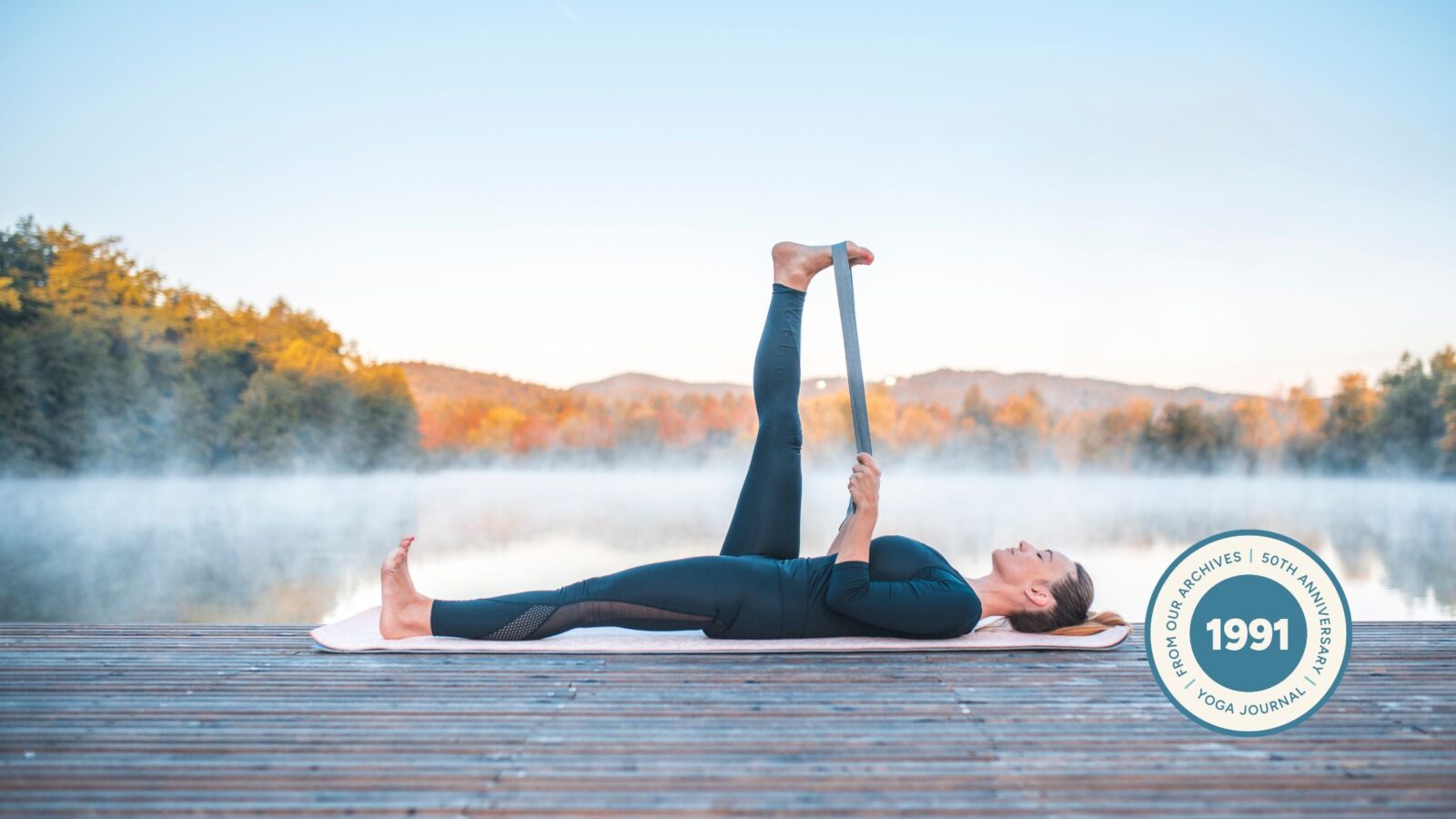
Let’s begin with one of the most basic poses: Supta Padangusthasana (Reclining Hand to Big Toe Pose). I have chosen this pose because it is practiced in many hatha yoga traditions and is accessible to virtually everyone. It is also, I suspect, a pose that many students secretly find boring. Let’s see how close to the essence of yoga we can come, not by ranging out toward the exotic, but by burrowing deep into familiar territory.
How to Practice Supta Padagusthasana (Reclining Hand to Big Toe Pose)
Instructions for this year’s column are divided into three sections, corresponding to three levels of students. One set of instructions is for those who are new to yoga; a second set is for those who have been practicing yoga and have some familiarity with the pose being described; a third offers new perspectives for the experienced practitioner. Although you may find it interesting to read all the commentaries, you will probably find it most valuable to practice the variations suggested for your level.
How to for Beginners
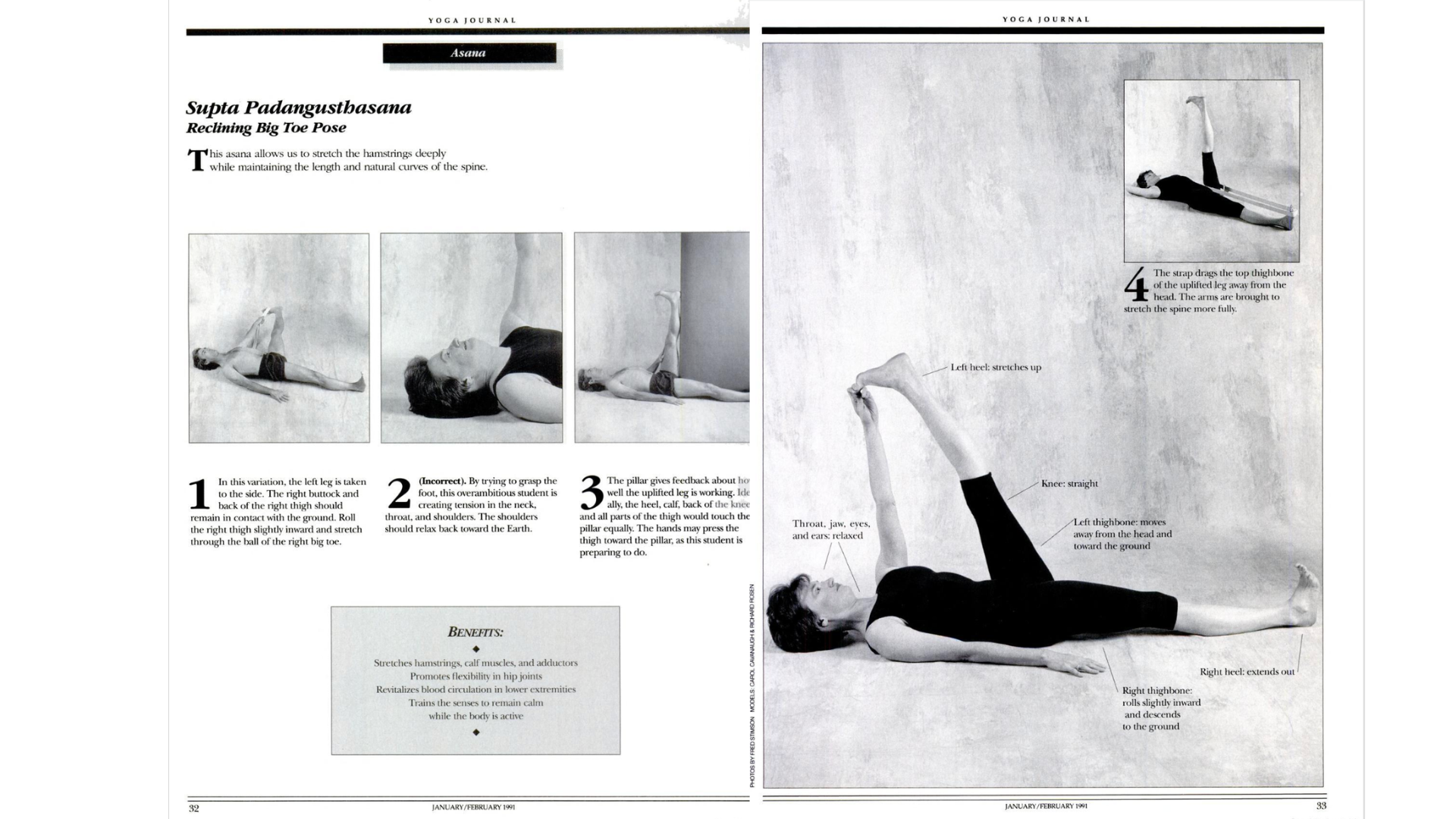
Lie on your back with both buttocks resting on the ground and both legs outstretched. Bend the left knee and bring a strap around the ball of the left foot. (For photographic reasons, the photos show models with the left leg lifted. Classically, however, the asana would first be performed on the right.) Hold both ends of the strap with your left hand and stretch your leg upward as shown in Figure 5. This figure shows the completed pose, in which the hand grasps the foot. I suggest that you use a strap, as shown in Figure 1 to make it easier to hold the foot while working in the pose.)
Completely straighten your left knee. If lying on your back makes your lower back hurt, bend your right knee and place your right foot on the ground while performing this pose.
At first, Supta Padangusthasana seems simple. Just lie on your back and stick your leg up in the air. But examine your body more carefully. First of all, there’s a good chance that when you lifted your left leg, part of your left buttock also came off the ground.
Your pelvis may also have twisted slightly, so that the left side of the pelvis is now closer to your head than the right. These distortions are so subtle that you probably wouldn’t even notice them if your attention weren’t called to them.
But yoga should be a process of removing the body’s distortions, not increasing them. So try again. This time, press your left buttock into the ground as you lift your leg, so the pressure of both buttocks on the ground remains equal.
Just as a rubber band stretches the most when it is pulled from both ends, any stretch is most effective when it is counterbalanced by an opposing stretch. Imagine that your left thighbone is a column of steel weighing hundreds of pounds, while a bouquet of helium-filled balloons has been tied to your left foot. This will help the leg to stretch downward as well as upward.
Between these two opposing extensions, the knee can straighten. Feel the top of your left thigh bone (the end nearest the pelvis) moving away from your head. Finally, spread the toes of your left foot away from one another. How much additional consciousness has been brought into the left leg? (Pssst! You won’t know if you’re sitting on your couch reading this article.)
There’s also a good chance you’ve now forgotten all about your right leg, which a may be sprawled off to the side, foot turning dejectedly outward. Yoga poses should not be done by a single limb while the rest of the body goes out to lunch. Stretch out through the right heel. Can you make the right leg feel as long as the left? Can you spread the toes of the right foot? Can you roll the right leg so the toes point toward the ceiling?
My psychic powers tell me that at this point many of you are crawling your fingers along the strap, thinking that enlightenment will surely occur if you can just hold your foot like the model in the photo. As your fingers sneak up, your left shoulder may be lifting off the ground. Your left knee may be wavering in its intention to remain straight. And your throat may have become tight and hard, so that you are now breathing loudly or even gasping. Some of you might even be bugging your eyes out. (Figure 2 illustrates the gruesome results of wrong practice of this simple pose.)
This observation leads us to one of yoga’s greatest lessons: No matter how difficult the pose, the sense organs should remain as passive as they are in deep relaxation. Relax your jaw; stop gritting your teeth; let your tongue fall away from the upper palate; let your eyes be soft. The brain should be a quiet observer; the ego should be tucked away in a back drawer for the duration of the practice. Trouble arises in asana practice when the brain stops listening to signals from the body and the ego tries to impose some artificial form on the struggling muscles, joints, and ligaments. Since yoga means union, every pose should arise from the core, with body, mind, and spirit all working together.
Hold the pose for a minute or longer, breathing evenly. Then switch sides and take the right leg up, holding the pose for the same length of time as on the left. After completing both sides, try the variation shown in Figure 1. This time, take the left leg out to the side, rolling the left thigh out so the left kneecap faces toward the ground rather than the ceiling. Notice that this time it is the right buttock that wants to roll off the ground. Extending the right hand to the side may help keep that buttock grounded. You may also place the right hand on the right thigh to hold it down as the left leg moves outward. The left foot may not reach the ground in the early years of practice, but eventually it will touch the floor in line with the shoulders. Hold Reclining Hand to Big Toe Pose, breathing evenly; then use the strength of the left arm to lift the leg back to center. Repeat on the right side.
Now reflect on what you’ve experienced. On the physical level, you probably felt an intense stretch in the uplifted leg. which became more acute as further details were added to the pose. Supta Padangusthasana is often the first pose given to lengthen the hamstrings, the long muscles at the backs of the thighs. Many people try to stretch the back body by bending forward from a standing or sitting position. But because the hamstring muscles attach to the pelvis at the sitting bones, tight hamstrings will drag the back of the pelvis down and under. When the pelvis is frozen in this position, virtually the entire forward bend must be done from the back, by bending at the joints in between the vertebrae. This is a potentially harmful movement that can aggravate or even cause a herniated or “slipped” disk.
By contrast, in Supta Padangusthasana, the spine remains lengthened, because you are lying on your back. The stretch of the forward bend is felt in the legs instead. As the hamstrings become longer, they in turn release the pelvis from its bondage. As this pose becomes easier, standing or even seated forward bends may be attempted without injury.
Now consider what went on in your mind as you practiced the pose. Depending upon your psychological bent, this stretch may have made you feel virtuous (“This hurts, but it’s good for me!”), or it may have made you want to abandon the whole process (“I can’t wait till this is over.”) Surprisingly, the ultimate reason to make a pose more challenging is not to feel virtuous, nor even to get that final millimeter’s stretch out of the biceps femoris.
Rather, it is to bring more and more consciousness into what you are doing in this moment. Our minds are normally engaged in a thousand events happening outside of ourselves. By creating a situation in which as much is happening inside the body as outside of it, the yogi learns to draw the mind inward. The strong sensations evoked by asanas should flood the entire being, blocking out speculations about the future and obsessions about the past. Thus an entire universe of events, going on now inside ourselves, can become known with a razor-sharp acuity of mind.
How to for Continuing Students
Many of us who have done yoga for a couple of years think our knees are “straight” in Supta Padangusthasana. If you think so, try doing Reclining Hand to Big Toe Pose with the uplifted leg resting against a pillar, column, or doorjamb (Figure 3). The surface you choose should be level from buttock to heel; avoid walls that have a protruding baseboard. Stretch the other leg alongside the pillar, enabling the buttock of your uplifted leg to press against the pillar. Now, feel which parts of your leg are touching the pillar and which parts aren’t. Like the model in the photograph, most of you will find that your calf muscles easily touch the pillar, while the back of the knee, and perhaps parts of your thigh, are an inch or more away. Use the hands to press either or both ends of the thigh bone into the pillar. (Caution: Don’t push on the kneecap itself and don’t continue if the sensation of stretching changes to pain.)
Notice the new flood of sensation and consciousness in the leg. Observe how, now that you’ve added a new action, the throat may tighten again and the forehead furrow in determination. Can you work the leg dynamically without hardening the sense organs or tensing the shoulders? Perform the pose on the second side as well and note which side finds alignment more easily.
Frequently practiced, this variation will teach you how to work the legs in many asanas, including standing poses and forward bends. Hyperextension of the knees occurs when the shin bones move farther back than the thigh bones. This problem is cured by learning to move the thigh bones and the shin bones back an equal amount. It is not cured by bending the knees for fear of damaging them. This variation of Supta Padangusthasana trains the legs to perform this difficult and important action.
This variation has mental benefits as well. The work we do on this simple pose can teach us that what we think is reality (“My knee is completely straight. My thigh is working maximally.”) is often illusion. Thinking we know something can block us from the potential of learning more about life or discovering more about ourselves.
How to for Experienced Students
B.K.S. Iyengar once said, “Usually when a person has mastered a pose, it becomes uninteresting for him. That is why you can see many people doing mechanically the same thing over and over again, but their mind is elsewhere….People think they attained the end. How can they know? It may be only a beginning…or it may be nothing at all. You must always see if you can go further.”
For those who seek a further challenge, the following variation moves Reclining Hand to Big Toe Pose to a new level of intensity. In this variation, we use a belt (preferably a wide one) to draw the top of the uplifted thigh bone away from the head and simultaneously work the “inactive” leg. If you are taking the left leg up, run a belt from the top of the left thigh to the ball of the right foot (Figure 4). The belt should be quite taut. Hold the left foot with the hand or a second strap. Press out through the right foot. A dramatic new awareness will come into the left leg as the action of the pose becomes more precise. It will be easier to move the top of the left thighbone away from the head and press the left buttock into the ground, and the left side of the lumbar spine will feel longer.
Advanced students may experiment with reaching the arms overhead to bring the stretch into the spine. The hands may be brought to the elbows (Figure 4). Also try interlocking the fingers and stretching the arms fully overhead, straightening the elbows, for a dramatic spinal stretch. Notice how difficult it is to keep the eyes, cars, and throat completely soft as you do this. (Caution: Don’t let go of your uplifted leg until it is strong and flexible enough to remain straight and perpendicular to the ground. Otherwise, this variation could cause strain in the lower back.)
Practicing this variation, you may have learned that your pose was not quite as “finished” as you thought it was. After training in this way, you can try to dispense with the strap but maintain the awareness and sensitivity in the legs. You can also apply what you learned, not only to this pose, but to many other more advanced poses that create the same action. For instance, you can apply the awareness gained in Supta Padangusthasana to Eka Pada Sirsasana and Eka Pada Sarvangasana (Headstand and Shoulderstand with one leg dropped)? The Supta Padangusthasana performed in Figure 4 resembles a reclining Virabhadrasana III (Warrior 3). Can you bring the subtlety and precision you learned in the reclining pose to that dynamic, difficult balancing pose? Can you perform Utthita Hasta Padangusthasana (Extended Hand to Big Toe Pose), virtually the same pose as Supta Padangusthasana, performed standing up rather than lying down, with the same awareness in the legs? By studying one pose, you are really studying many poses. The possible challenges, investigations, and applications are truly endless.
By examining this one pose, we have learned many physical lessons that we can apply to other poses. However, as B.K.S. Iyengar says in Body the Shrine, Yoga Thy Light, “The brain is the hardest part of the body to adjust in asanas.” The strong sensations evoked by an asana should flood the entire being blocking out speculations about the future and obsessions about the past. But even in a simple pose, it is difficult to keep the senses quiet and the brain receptive. Tension tends to accumulate in little gullies of the body when we are not looking. The yoga poses will stretch and strengthen the muscles even if the brain is busy, but mental tension will prevent asanas from doing their deeper work of moving energy through deep channels in the self.
In a real asana, passivity of the brain is not just a good idea; it is integral to the purpose of the pose. Passivity of the brain comes through release of its sense windows: the eyes, ears, tongue, and throat. Only when utmost mental silence meets maximal physical dynamism is yoga achieved. Then all situations, pleasurable or painful, become equal to the yogi, because all are observed from the same vantage point of inner calm.