

Published March 5, 2026 04:23AM
Yoga Journal’s archives series is a curated collection of articles originally published in past issues beginning in 1975. This article first appeared in the May-June 1990 issue of Yoga Journal.
Upavistha Konasana can help us explore some of the inner dimensions of consciousness. In a well-performed Upavistha Konasana, the legs are grounded, the brain is quiet, and the spinal column is relaxed. In this state, we can become aware of subtle planes of consciousness that are normally inaccessible to us. To help us in our exploration, we can use the maps of consciousness provided by ancient sages and yogis, augmented by some Western scientific insights. In traditional yoga philosophy, the human soul is encased in five koshas, or sheaths-layers of interpenetrating “bodies,” each one subtler than the one beneath. Through asana practice, each of these bodies can be awakened and refined.
To the beginning yoga student, this discussion of subtle bodies may seem abstract and confusing. When we first begin to practice, we focus almost exclusively on our physical bodies, developing our flexibility, strength, and sensory awareness. However, as our sensitivity increases, we begin to become aware of other dimensions of our being. Understanding how ancient teachers have experienced these different dimensions can help us in our practice, but we should not be frustrated if our experiences do not precisely match those they have described.
Rather, we can use their descriptions as guides to help us understand our own deepening practice.
5 Subtle Bodies of the Human Soul
The first sheath the sages have described is the anamaya kosha (literally, “food sheath”), the physical body, which is composed of tangible matter and is destroyed at death. From the perspective of Newtonian physics, the anamaya kosha is our inertial mass, which interacts with gravity and resists change. (Newton’s First Law of Motion states that a body in motion tends to stay in motion and a body at rest tends to stay at rest, unless acted upon by an outside force.) The voluntary nervous system has evolved to mediate our interactions with inertia and gravity, and the mastery of this system through asana practice harmonizes these interactions.
The pranamaya kosha, or “breath sheath,” is composed of subtle energies that control the physiological functions of the physical body, including the respiratory, circulatory, excretory, digestive, endocrine, and reproductive systems. From a Western perspective, this “energy body” corresponds to the autonomic nervous system, which alternates between the dynamic sympathetic mode (fight or flight response) and the quieting parasympathetic mode (relaxation response). Breath is the link between the physical body and the energy body, and freeing the breath through asana practice awakens us to this link. The practice of pranayama (control of the breath) leads to the refinement and eventual control of the pranamaya kosha.
The manomaya kosha, or “sense-mind sheath,” assimilates and coordinates information from the sense organs to create a coherent representation of reality, and organizes unconscious actions in response to the information received. (Many of our actions are habitual, conditioned responses to familiar stimuli.) Through asana practice, we experience subtle, unfamiliar sensations; focusing our awareness on these sensations helps to awaken the manomaya kosha. Through the practice of pratyahara (control of the senses), we explore the relationship between the sense organs and the mind, further refining the manomaya kosha.
The vianamaya kosha, or “intelligence sheath,” governs the highest processes of reasoning and judgment. This is the sheath of consciousness, where decisions are made and actions initiated from a fresh, unconditioned state of attunement to the present moment. In asana practice, we make conscious decisions about where to place the bones, how to move the muscles, and where to direct the breath. One action may feel right one day, another action another day, and some days nothing will feel right at all. So we learn, experiment, and grow. In time, through the deepening practices of dharana (concentration), dhyana (meditation), and samadhi (absorption in meditation), our intelligence stops wavering, correct action flows spontaneously, and we gradually master the vijnanamaya kosha.
The anandamaya kosha, or “bliss sheath,” is the subtlest manifestation of consciousness: the plane of transcendent ecstasy. According to the ancient yogis, tiny sparks filtering down from this plane into our normal consciousness give us our feelings of pleasure and well-being, which are trivial compared to the conscious awakening of this level. The higher levels of samadhi allow us to refine and master the anandamaya kosha. Itzhak Bentor, in his essay “Micromotion of the Body as a Factor in the Development of the Nervous System,” gives us a physiological model for awakening this level of consciousness. Bentov describes a series of feedback loops in the body that are activated when the rhythm of the heart is precisely coordinated with the rhythm of the diaphragm, a state that spontaneously arises in deep samadhi. According to Bentor, when this synchronization is achieved, the normally chaotic vibration of the cerebrospinal fluid becomes an even pulse, and an electrical current is triggered that flows over the sensory cortex in a closed loop called the “kundalini circuit,” stimulating “ecstasy centers” in the brain.
In Upavistha Konasana, we have an opportunity to awaken the subtler planes of consciousness and get a taste of divine ecstasy. We must begin, of course, with the anamaya kosha, the physical body. The bones, the densest concentration of matter in the body, are the core of this kosha and are designed to provide an interior form of support and stability. When our awareness is centered in this core, we are grounded and physically stable. However, most humans today do not center their awareness in their bones. Instead we try to derive physical stability by hardening the muscles, or by collapsing the muscles and hanging on the ligaments, cartilage, and tendons.
The skeletal muscles also play a major role in circulation. If they are too hard or too soft, the circulatory process is disturbed. This in turn disturbs the breath (the respiratory, circulatory, and muscular systems are interconnected), which agitates the mind. When the mind is agitated, the subtler bodies cannot awaken.
Therefore, we must begin by establishing our awareness in the bones, thus freeing circulation and respiration and awakening the pranamaya kosha. Then we can begin to experience ourselves as moving energy rather than static flesh.
How to Practice Upavistha Konasana (Seated Angle Pose)
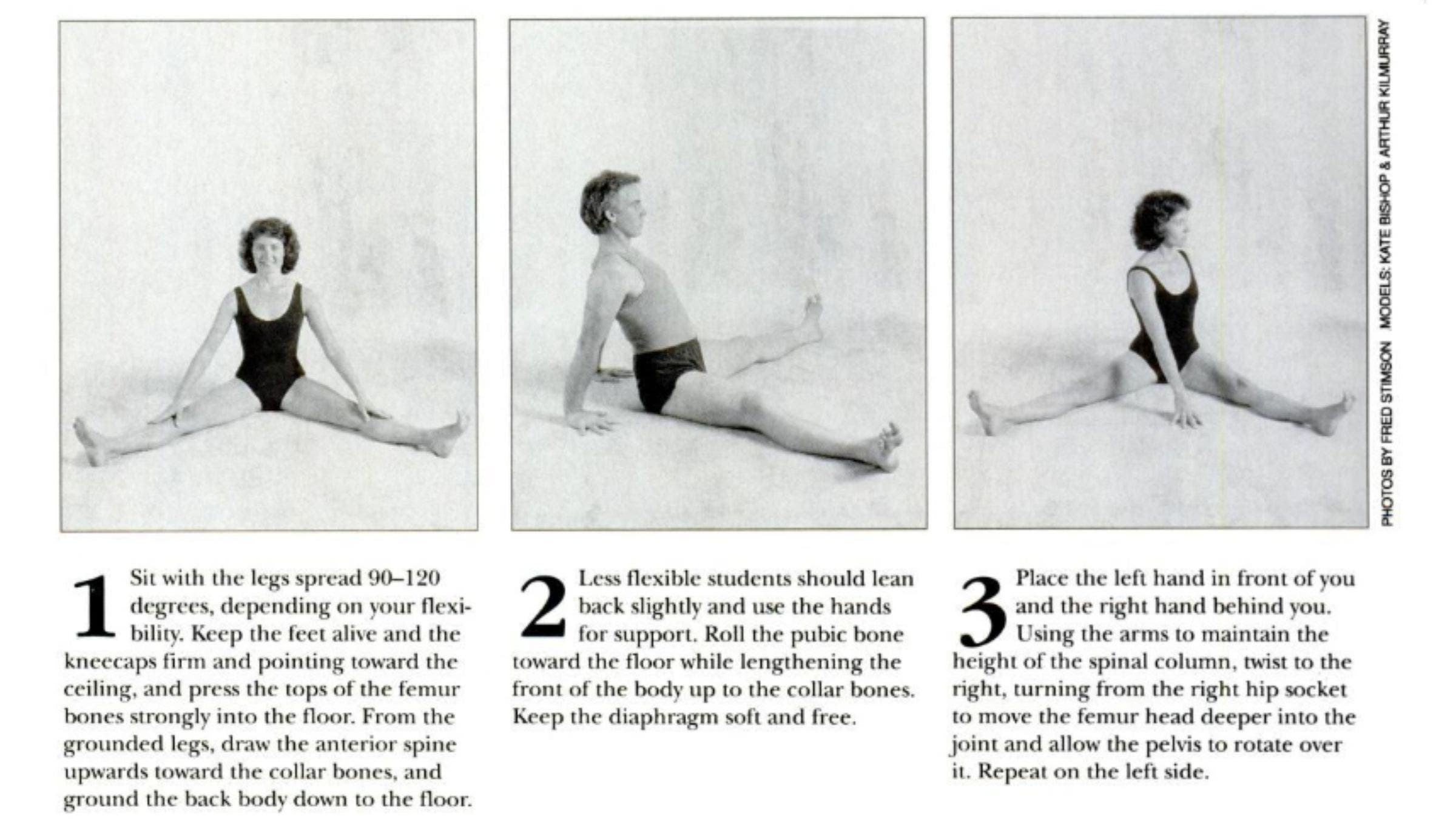
To begin, sit on the floor with the legs extended and spread them to form a 120-degree angle (Figure 1). (Note: Do not confuse Upavistha Konasana with Samokonasana, the side splits, where the legs are separated to 180 degrees and the torso remains upright. The groins are not designed for bending forward with the legs spread that far apart.)
Find the bones of your legs and ground them firmly onto the floor. Let the pelvis be perpendicular to the floor, with the weight distributed as evenly as possible between front and back and between right and left sitting bones. Recreate Tadasana in the torso by elongating the anterior spine upward from the floor to the collarbones and grounding the back body downward from the top back rib cage, along the erector spinae muscles, through the buttocks, into the back femur bones. and into the floor. For students with restricted groins and hamstrings, this action will require leaning back onto the hands and the back of the sitting bones (Figure 2). In this seated position, become aware of the bones and visualize the breath moving from the bones into the skin and back to the bones, especially through the thighs and pelvic region. This will allow the energy body to awaken.
A primary gateway between the physical body and the energy body lies in the groins. Confusion and congestion here can clog the channels and prevent deeper penetration of awareness. Slight misalignment of the femurs can create and perpetuate this confusion. By slightly twisting the pelvis in relation to the femur, you can center the hip joint, releasing tension in the groins and further opening the energy body.
Place the right hand behind you and the left hand in front of you. Do not turn from the head or shoulders, but carefully twist by moving the inner right hip joint into the outer right hip, creating a hollow shape and feeling to the inner right groin. Maintain that feeling as much as possible, and then repeat on the left side (Figure 3). (A variation of Upavistha Konasana can be done by adding a forward bend to the twist, bending first over the right leg and then over the left.)
Less flexible students will not be able to go further until they have prepared themselves by practicing Downward Facing Dog and stretches for the groin and hips. More flexible students will be able to complete the forward-bending part of the pose (Figure 5, below). As in Tadasana, the energy should flow up the front of the torso and down the back, so extremely flexible students should be careful not to drag the coccyx up toward the lumbar region of the back body (Figure 4, below, incorrect). In this common distortion of the pose, the outer femurs become ungrounded, so when the pelvis flexes to the floor, the flesh and bones of the outer thighs are dragged forward with it, and the posterior spine contracts. (In the inflexible student, the inner thighs cannot ground and the anterior spine contracts; thus one is directed to lean back and lengthen the anterior spine.)
In the deepest extension of the completed pose, the chin is taken to the floor. For our purposes, however, it will be sufficient to allow the forehead to rest quietly on the floor. To stay for long periods of time in the pose, a bolster can be used to support the torso, with an optional block for the head. In the completed position, adjust the thigh bones as necessary to maintain the openness of the groins. In a lengthy forward bend, constriction of the groins can lead to a loss of circulation to the legs and a constriction of the breathing, agitating the mind and preventing deeper penetration into the pose. When the bones are grounded and the breath and circulation are moving freely, the mind becomes quiet and undistracted, and the next level, the manomaya kosha, can be activated and refined.
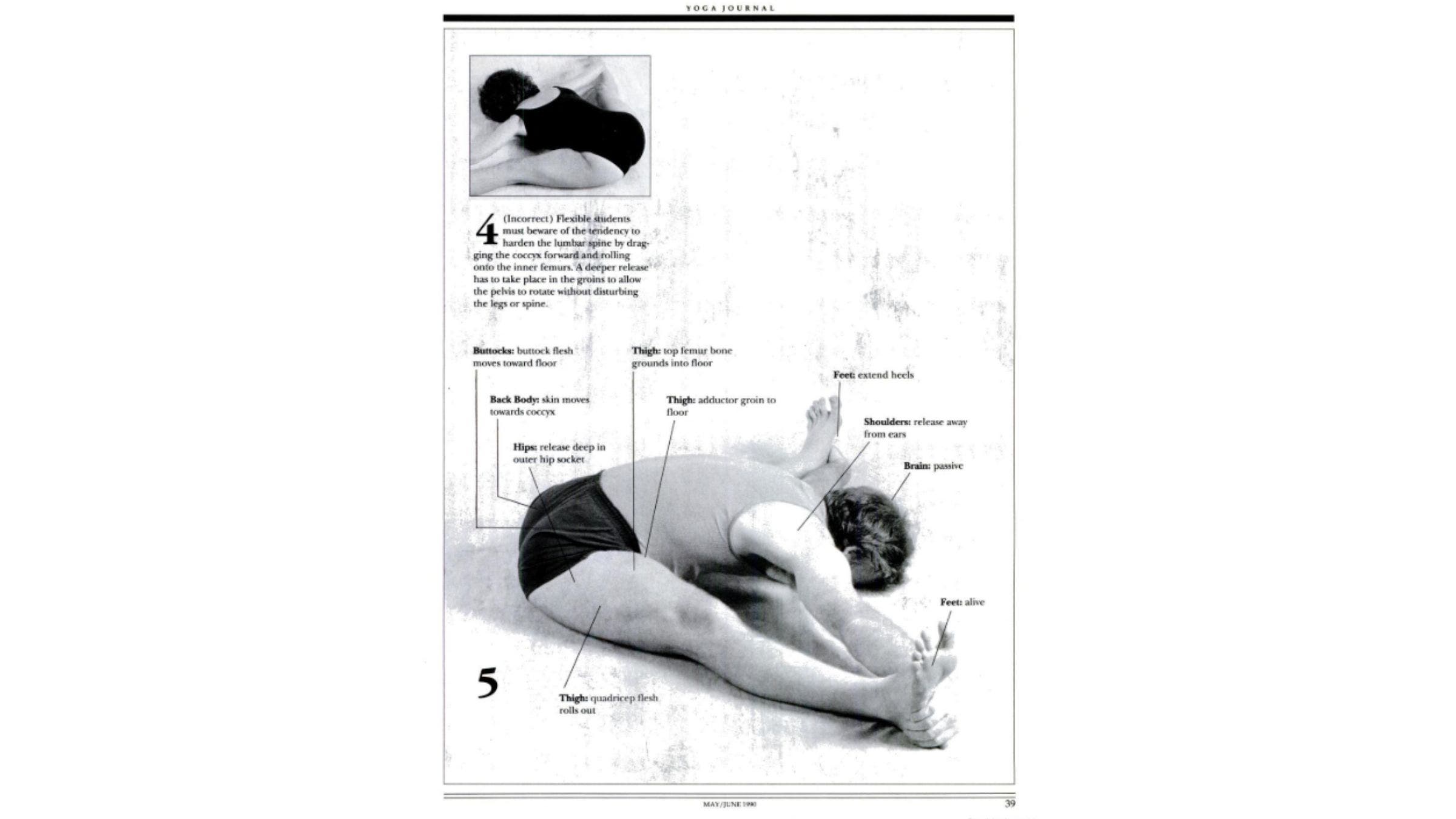
There are several variations of this commonly practiced forward bend. Note that the legs are not to be spread to 180 degrees as in the side splits. The groins are not designed to allow flexion at this extreme angle. When bending forward, the hands should be able to catch the feet.
Benefits
- Stretches hamstring and adductor muscles
- Improves blood circulation in the pelvic region
- Prevents hernia development
- Relieves sciatic pain
- Controls and regulates menstrual flow and stimulates ovaries
1. Sit with the legs spread 90-120 degrees, depending on your flexibility. Keep the feet alive and the kneecaps firm and pointing toward the ceiling, and press the tops of the femur bones strongly into the floor. From the grounded legs, draw the anterior spine upwards toward the collar bones, and ground the back body down.
2. Less flexible students should lean back slightly and use the hands for support. Roll the pubic bone toward the floor while lengthening the front of the body up to the collar bones. Keep the diaphragm soft and free.
3. Place the left hand in front of you and the right hand behind you. Using the arms to maintain the height of the spinal column, twist to the right, turning from the right hip socket to move the femur head deeper into the joint and allow the pelvis to rotate over it. Repeat on the left side.
The manomaya kosha handles sense perception, and the skin is the largest of the sense organs. The inner lining of the skin communicates with the muscles and interior organ systems. The mind must be quiet and undisturbed to feel the subtle signals originating here. As it awakens to the inner skin, the mind can sense any subtle variations in hardness or dullness of the muscle fibers. Thus the manomaya kosha completes a feedback loop: The bones (anamaya kosha) adjust to release the flesh, freeing breath and circulation (pranamaya kosha) and quieting the mind.
The manomaya kosha, in this quiet state, can feel the subtle imprinting on the inner skin of the vibrating muscle fibers, which gives clues about how to adjust the bones more precisely, in order to further release the breath, in order to further quiet the mind, in order to better feel the skin, and so on. This loop can be visualized as a movement of breath from the bones through the flesh into the inner skin, and then reversing as the breath returns to the bones. If the flesh feels thick and dense, the breath will not flow freely. If the flesh has a transparent quality to it, the breath will flow through it unimpeded. Thus the anamaya kosha (bones), the pranamaya kosha (breath), and the manomaya kosha (sensory awareness) can work together.
Now the intelligence of the vijnanamaya kosha can be activated and brought to bear on the pose. The decision-making faculty of this calm, awakened consciousness can be used in the depths of the pose to make adjustments for deepening the opening of the body and breath. The placement of the bones, the vibrancy of the flesh, and the quality of the inner skin can all be controlled from the vijnanamaya kosha. The bones can be subtly adjusted to bring more life to the flesh and to even the tone of the muscles and skin. As one’s sensitivity increases, the spinal column itself can be adjusted from the central canal where the cerebrospinal fluid circulates.
Intelligent adjustments to the pose, therefore, come from deep penetration into the first four koshas, not from some external, abstract idea about the pose; this deep penetration, in turn, brings samadhi. We may get momentary glimpses of this experience early on, but for most of us, the samadhi is unstable in the beginning. Years and years of constant practice are necessary to stabilize this beginning level of samadhi.
However, during those brief experiences of clarity, our awakened intelligence can contact the anandamaya kosha, the body of bliss, and put us in touch with divine ecstasy. Although mastering this practice takes years, glimpses of true joy and peace are available for every level of practitioner. The divine wisdom of the awakening universe is waiting to emerge into human consciousness. Through asana practice we prepare our bodies and minds to receive this wisdom. We begin to experience our own cosmic self and our communion with the evolving universe. We learn our role in the cosmic process and receive guidance about how to proceed with our lives. In the closing years of the 20th century, as humans struggle to reinvent a sane and ecologically healthful society, such wisdom is greatly needed.