

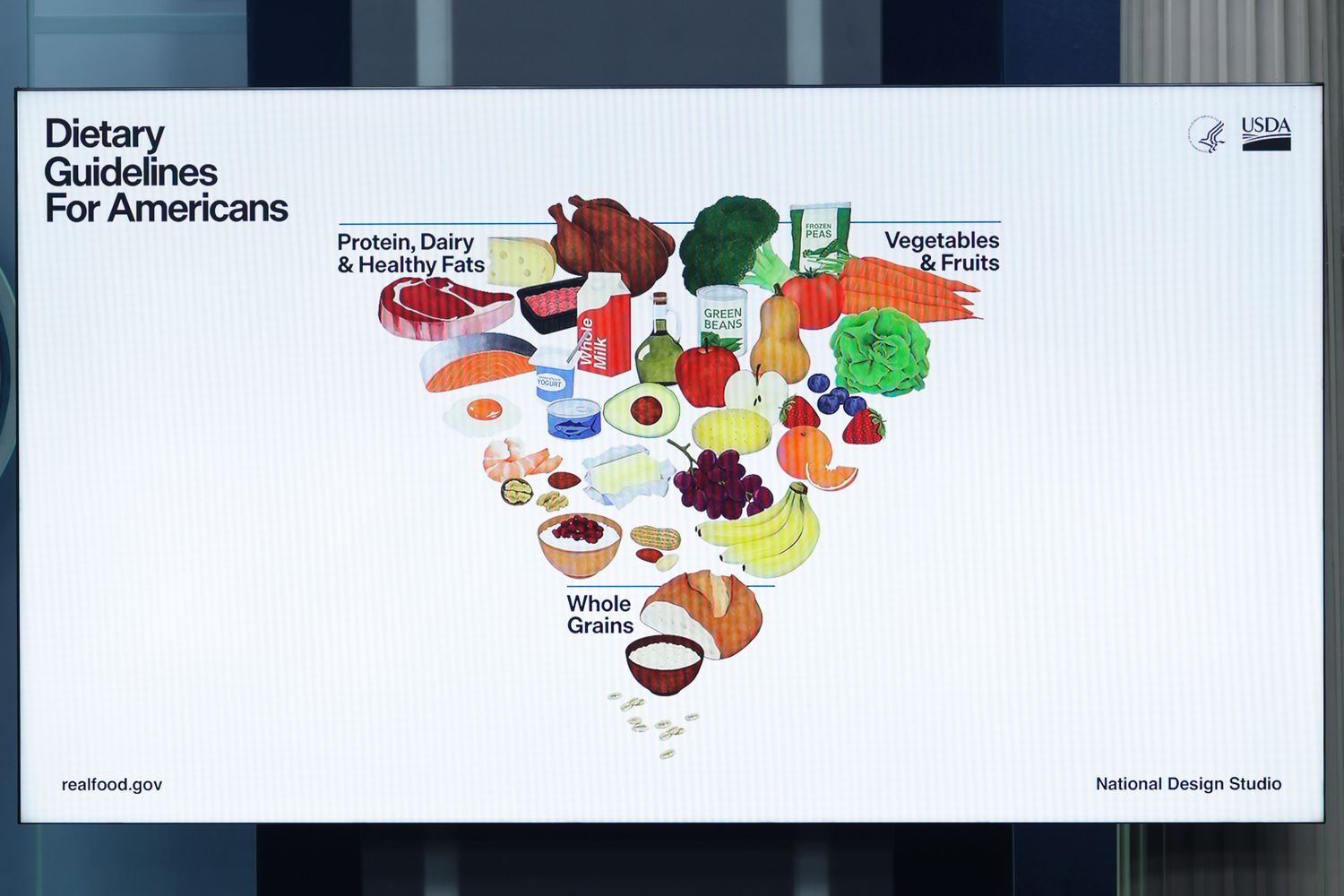
Health Secretary Robert F. Kennedy Jr. announced the updated Dietary Guidelines for Americans, emphasizing “real food,” protein, and saturated fat. A new upside-down food pyramid was released alongside the guidelines, which places protein, dairy, healthy fats, fruits, and vegetables above whole grains.
We asked Jeanette Andrade, RD, PhD, an assistant professor of food science and human nutrition at the University of Florida, what she thinks of the inverted food pyramid.
*This interview has been edited and condensed for clarity.
Q: What do you think about the placement of protein, dairy, healthy fats, fruits, and vegetables at the top of the new inverted food pyramid?
Andrade: The new pyramid graphic is confusing because it gives the same emphasis to proteins, fruits, and vegetables, but the actual guidelines don’t seem to say that.
There is a whole chicken in the protein section of the pyramid. Does that mean I’m supposed to eat a whole chicken every day? It is confusing, and a graphic like this should stand on its own. If you can’t easily interpret what the graphic is trying to tell you, then clearly, we need more work on it.
The previous graphic, My Plate, recommended filling a quarter of your plate with protein. Unless you really read the new guidelines, the new pyramid makes it seem like it’s just up to you to decide how much protein to eat.
The new pyramid also really misses the mark on cultural foods. There are people from very different cultures living in this country, and what is depicted may not represent the diet most Americans eat anyway. There’s no soy, and there’s hardly any differentiation between different types of protein groups, like seafood.
What Counts as ‘Real Food’?
The new guidelines focus on eating “real food,” but what do they mean? Most people eat real food, I mean, French fries are real food. They’re just prepared a little bit differently.
It doesn’t seem realistic to tell people to eat “real food” when companies are making millions of dollars producing chicken nuggets and lattes. Are you going to tell these companies they can’t make these products anymore, because we’re going to go back to real food?
I will say I was glad to see a variety of fruits and vegetables represented in the new pyramid: blueberries, grapes, apples, and bananas. As a dietitian, I encourage people to fill their plates with a mix of colorful produce, and the new pyramid gives people an idea of some potential foods to eat.
However, the recommendations around produce servings might lead to confusion. The new pyramid recommends two servings of fruit and three servings of vegetables per day. I don’t know how beneficial these recommendations are since the pyramid does not show what counts as a serving.
Jeanette Andrade, RD, PhD
Unless you really read the new guidelines, the new pyramid makes it seem like it’s just up to you to decide how much protein to eat.
— Jeanette Andrade, RD, PhD
Do Whole Grains Belong on the Bottom?
The old pyramid used to have distinct steps to make it look like you were walking up the pyramid. The whole grains were the base, because you need a little more energy, and you get most of your energy from the starches and grains.
The new pyramid places whole grains all the way at the bottom, although the guidelines really focus on limiting refined grains, not whole grains.
Honestly, this new pyramid makes it feel like we are going back to the 1990s, to the era of the low-carbohydrate, high-protein Atkins diet. We can argue that the health of the nation was better then, but was it really? We now have better tools to identify if someone actually has heart disease, cancer, and other chronic conditions. Even when we had the previous food pyramid, obesity was becoming a crisis, so I don’t know how this new pyramid is going to reverse everything back to the day when we apparently had no chronic diseases.
:max_bytes(150000):strip_icc()/StephanieBrownnewheadshot-e5ca9ba2a404491384e9300a7871f190.jpg)