

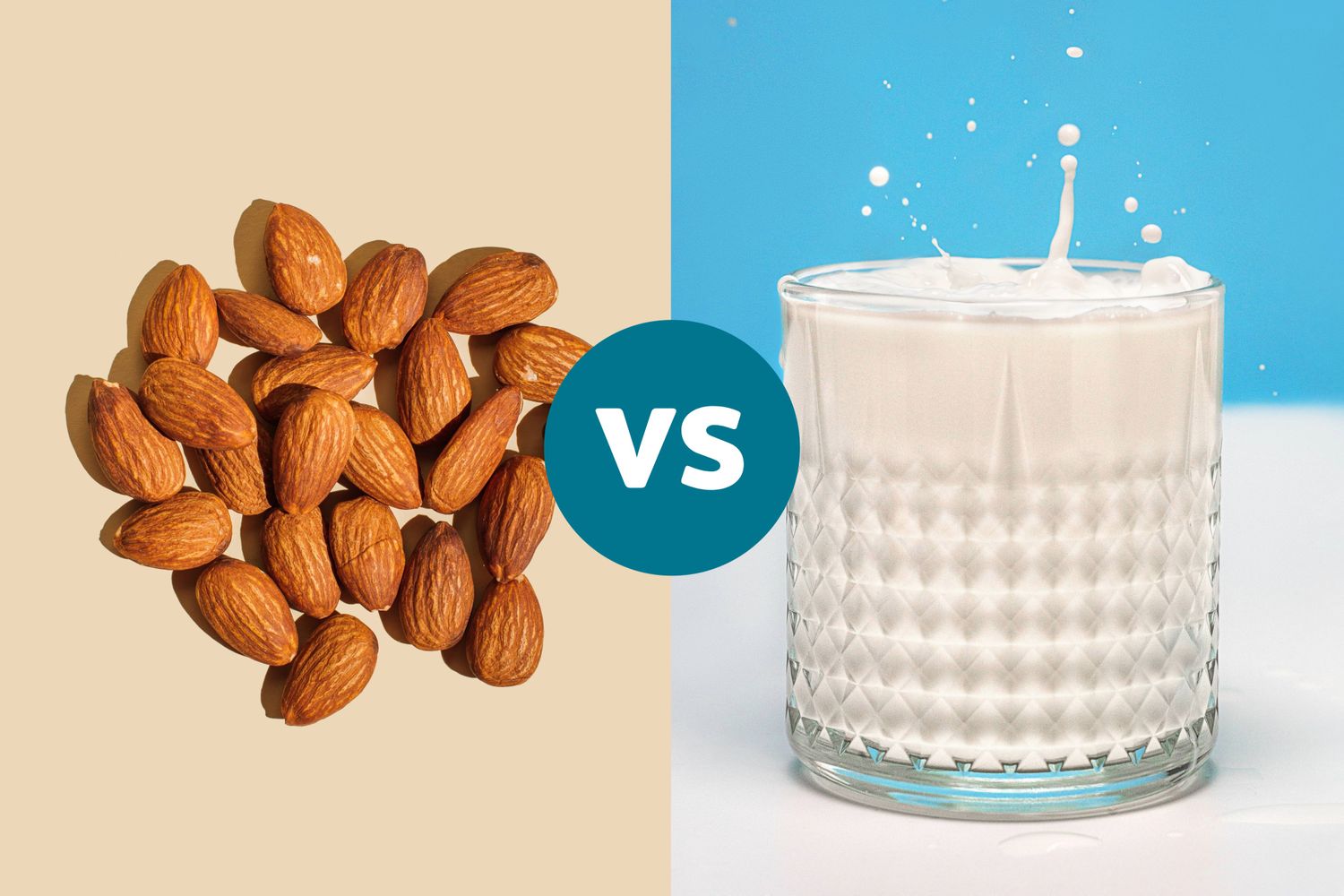
Key Takeaways
- Whole almonds have more healthy fats, fiber, and protein than almond milk.
- Almond milk has fewer calories and more vitamin D and calcium in fortified varieties.
- Be aware of added salt in whole almonds and added sugar in almond milk.
Whole almonds may offer more nutrition overall, but that doesn’t mean almond milk can’t have a place in your diet, too.
Nutritional Comparison
Here’s how a standard serving of whole, raw almonds (30 grams, or a small handful) compares to a standard serving of unsweetened almond milk (one cup).
-
Calories: 39 cals
-
Protein: 1 g
-
Fat: 2.5 g
-
Carbohydrates: 3.4 g
-
Fiber: 0.5 g
-
Calcium: 482 mg
-
Sodium: 189 mg
-
Vitamin D: 107 IU
Where Almonds Win
Almonds Have More Healthy Fats
Almonds are full of healthy fats, which can help reduce the risk of heart disease. A 30-gram serving of raw almonds contains 9.4 grams and 3.4 grams of monounsaturated fats and polyunsaturated fats, respectively.
Almond milk, for comparison, has about 2.2 grams of total unsaturated fat per serving.
Almonds Have More Fiber
Whole almonds are packed with fiber, a nutrient that is critical for healthy digestion and that many people don’t consume enough of. Serving for serving, almonds contain about six times the fiber that almond milk does.
Almonds Have More Protein
If you’re looking to boost your protein intake, reach for the whole almonds. A serving of almonds has six times the protein as a serving of almond milk.
However, because almond milk is flavorful and has few calories, it’s a great option to mix with protein powder when you’re looking to boost your protein intake.
Where Almond Milk Wins
Almond Milk Has More Calcium
Both almonds and almond milk contain calcium, which is critical for bone health. Most adults need at least 1,000 milligrams of calcium each day.
A serving of almonds has about 76 mg of calcium, or about 7% of the recommended daily intake for calcium. A serving of almond milk provides nearly half of the daily calcium needs, with 482 mg, largely added during production.
Almond Milk Has Fewer Calories
Almonds are naturally very dense in calories. That can be beneficial, especially if you’re looking for a light-weight, energy-rich snack for activities like running, hiking, and more. However, it can also be easy to over-consume and take in more calories than intended.
Almond milk, on the other hand, is very low in calories. That’s because the milk is more than 96% water. If you’re looking for an almond taste with fewer calories, almond milk is likely the better choice.
Almond Milk Has More Vitamin D
In the United States, almond milk is often fortified with vitamin D. A glass of almond milk has about 107 international units (IU) of vitamin D. That’s roughly 18% of the recommended 600 IU of vitamin D that most children and adults need per day.
Whole almonds don’t have any reportable levels of vitamin D.
Type of Almond or Almond Milk Matters
Whether you opt for almonds or almond milk, the type that you choose can affect the nutrition it offers.
For example, dry-roasted almonds may taste delicious, but they also tend to have more sodium than raw, unsalted almonds. This can be important if you’re trying to limit your sodium intake.
Some almond milks are unsweetened, relying on almonds’ naturally sweet flavor. Other types use added sugar to enhance taste. If you’re having almond milk or trying to limit how much sugar you eat, be aware of the potential for added sugar and choose unsweetened varieties.
:max_bytes(150000):strip_icc()/BurchHeadshotOutdoor-215a575f7ef34c52a908676f88bd9acb.jpg)