

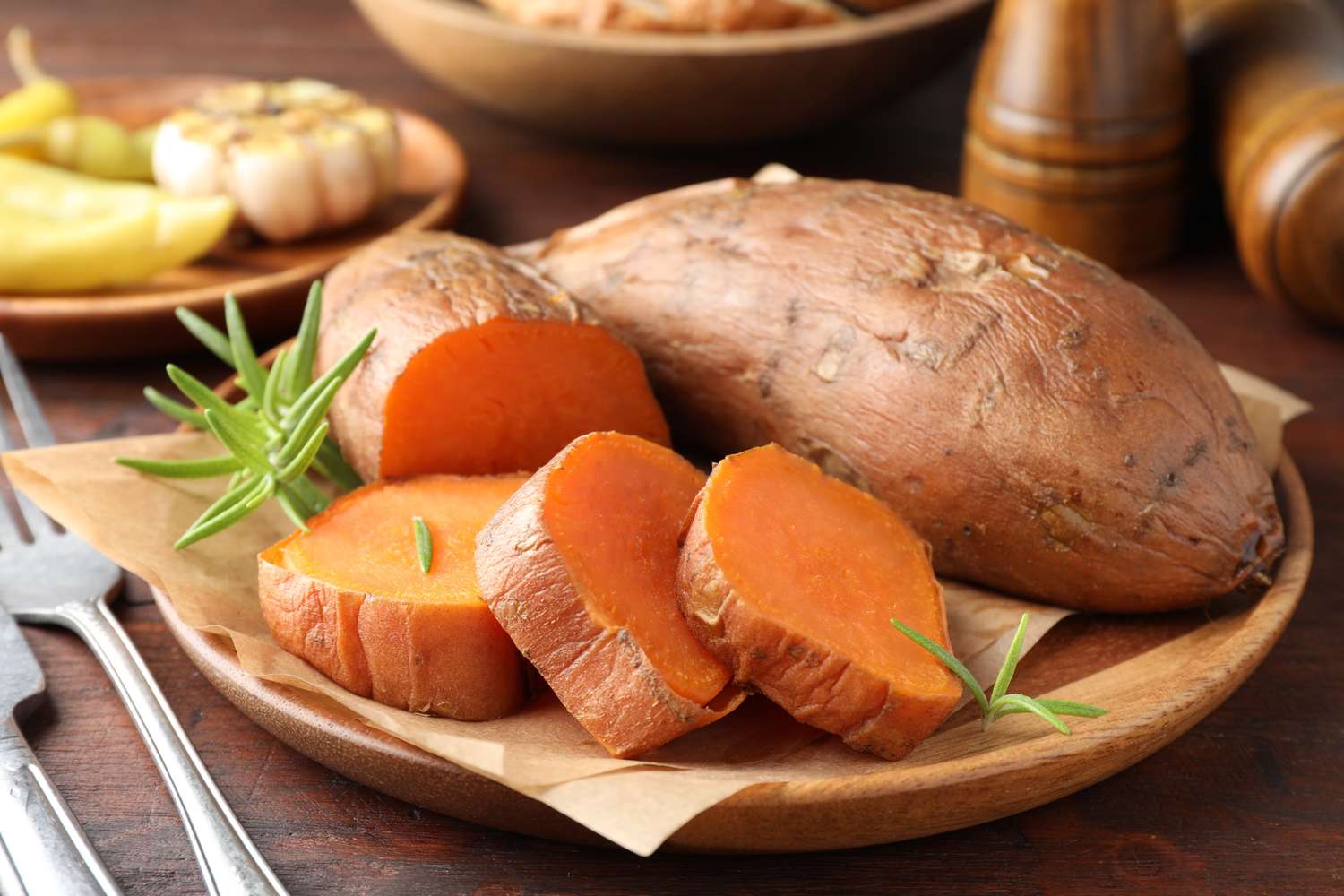
In the United States (U.S.), sweet potatoes are often mistakenly referred to as yams, but they are actually distinct foods that come from different plant families. Yams and sweet potatoes have slightly different nutritional profiles and flavors.
Key Differences Between Yams vs. Sweet Potatoes
Yams and sweet potatoes are not the same, despite often being mistaken for each other.
| Yams | Potatoes | |
|---|---|---|
| Origin | Native to Africa and Asia | First cultivated by Native Americans |
| Plant Family | Lily family | Morning Glory family |
| Availability in the U.S. | Less common, may need to be purchased at an international store | More common, readily found in grocery stores |
| Plant Type | Perennial (dies in the fall/winter and comes back in the spring) | True root vegetable |
| Appearance | -Very dark, rough, scaly skin -Flesh can range from white to red to purple |
-Has smooth skin that is beige, orange, or purple -Flesh can be light yellow to orange or purple |
| Taste | Starchy | Sweeter |
Sometimes sweet potatoes are labeled as yams, but the U.S. Department of Agriculture requires them to be dual labeled as sweet potatoes in this case. For example, a can of potatoes might be marketed as yams, but list sweet potatoes as the first ingredient.
Nutrition Comparison
The nutritional values for 100 grams (g) of raw yams versus 100 g of raw sweet potato (orange flesh) are as follows.
| Yams (100 g) | Sweet Potato (100 g) | |
|---|---|---|
| Calories | 118 | 79 |
| Protein | 1.53 g | 1.58 g |
| Total fat | 0.17 g | 0.38 g |
| Carbohydrates | 27.9 g | 17.3 g |
| Fiber | 4.1 g | 4.44 g |
| Sugar | 0.5 g | 6.06 g |
| Calcium | 17 mg | 22 mg |
| Iron | 0.54 mg | 0.4 mg |
| Magnesium | 21 mg | 19.1 mg |
| Phosphorus | 55 mg | 37 mg |
| Potassium | 816 mg | 486 mg |
| Vitamin C | 17.1 mg | 14.8 mg |
Which Is More Nutritious?
Yams and sweet potatoes share similar nutritional profiles, with some notable differences. For example:
Yams:
- Are starchier
- Have more vitamin C
- Have more potassium
- Have more carbohydrates
- Have more phosphorus
Sweet potatoes:
- Are sweeter
- Have more vitamin A
- Have fewer calories
- Have more total sugars
Both yams and sweet potatoes contain amylase, an enzyme that helps the body break down starch into a sugar that it can readily use.
Sweet Potato’s Main Advantage
One advantage sweet potatoes have over yams is that they are high in beta-carotene, whereas yams are not.
Orange-fleshed sweet potatoes are loaded with beta carotene, an antioxidant that converts to vitamin A. Vitamin A is especially helpful in supporting eye, skin, and hair health.
Shared Benefits
Yams and sweet potatoes both contain:
- Fiber: Fiber can help promote healthy digestion and regular bowel movements, reduce cholesterol levels, and trap potential cancer-causing substances and agents.
- Calcium: Calcium can help with bone and teeth formation and strength, muscle function, blood clotting, maintaining a regular heartbeat, and conducting nerve impulses.
- Magnesium: Magnesium can help strengthen bones, support muscles, and maintain optimal blood pressure and cardiac tempo.
- Phosphorus: Phosphorus is necessary for energy metabolism, bone mineralization, and the DNA and RNA framework.
- Potassium: Potassium helps to regulate fluid balance, maintain normal heart rhythm, and support nerve signals and muscle functions.
- Vitamin C: Vitamin C is important for the synthesis of collagen and neurotransmitters, the formation and maintenance of bone material, and combating oxidative stress.
- Bioactive components: The bioactive components in yams and sweet potatoes can help with antioxidant capacity, anti-inflammatory activity, and immune system support.
Ways to Include Yams and Sweet Potatoes in Your Diet
Yams are typically eaten cooked as starchy vegetables, similar to potatoes. They may be:
- Boiled then mashed to make a sticky paste or dough
- Fried
- Roasted
- Baked
- Steamed
Sweet potatoes are quite versatile. They may be:
- Boiled
- Steamed
- Roasted
- Fried
- Sautéed
- Grilled
- Substituted for potatoes in potato-based recipes, such as scalloped potatoes, mashed potatoes, or baked potatoes
- Used in soups, stews, curries, or chili
- Served as a side for meat, fish, or poultry
- Peeled and grated raw into salads
- Thinly sliced raw and served with veggies and dip
- Used in baked goods, such as breads, muffins, cookies, brownies, pie, and puddings
- Added to wraps and burritos
- Made into sweet potato fries or chips
- Spiraled into noodles
:max_bytes(150000):strip_icc()/PicsArt_09-20-02.40.06-13db387d22de4949b3d6c887bcc884cd.jpg)