


Updated April 3, 2026 02:06PM
Yoga Journal’s archives series is a curated collection of articles originally published in past issues beginning in 1975. This article about Ujjayi Breath first appeared in the November-December 1996 issue of Yoga Journal.
Hold a hand in front of you, level with the lower ribs, palm down and fingers gently curled—as if you were holding a large ball—and exhale all the way. As you inhale, gradually lift and spread the fingers apart—letting go of the imaginary ball—so that at the top of the breath the hand is fully open and parallel to the floor. Slowly curl the fingers again with the following exhale. Then repeat the entire sequence a few more times, opening and closing the hand in unison with your inhales and exhales.
You’re probably wondering what this is all about. Well, you’ve just made a working model—a rather crude one I’ll admit—of your diaphragm, the primary muscle of respiration. (Since by some estimates there are five physical, and at least that many subtle, diaphragms in your body, “diaphragm” will refer to the thoracic or respiratory diaphragm in this column.)
“Diaphragm” literally means “fence through,” an allusion to its position in the torso as a partition between the abdomen below and the thorax above. It might have been just as appropriate, though, to christen the muscle something that suggests its unique appearance—variously compared to a double dome, an umbrella, the lopsided cap of a mushroom, a jellyfish, and the curved surface of the Earth—or, even better, its primary occupation, which is to pump air in and out of the body about 15 times a minute (during normal, quiet breathing), or 21,600 times a day.
The yogis teach that the resemblance of our diaphragm’s shape to the contour of the Earth is more than just an interesting coincidence; it’s further confirmation of their belief that each of us is a miniature “working model” of the universe. “In this body,” reports the Shiva Samhita, “there are rivers, seas, mountains, fields… all the stars and planets as well…. Agents of creation and destruction also move in it.” Our belly is counterpart to the underworld, wherein resides all the dark, instinctual, sensual forces, while the heart and head are the celestial realms, home to “shining ones” (devas) of light, reason, and spirit.
These forces of darkness and light often seem to be playing tug-of-war, with us as the rope. From one side, we’re pulled to incarnate, to celebrate embodiment; from the other, we’re equally drawn to transcend the material plane, to realize our affinity with the Absolute. The yogis resolve this conflict not by renouncing the “lower” in favor of the “higher,” but instead by asserting that the two are necessary complements. Without the body, they declare, there’s no yoga practice, and without practice, there’s no liberation; without liberation the body remains “unbaked,” like an unfired clay pot, subject to disease, decay, and death.
The diaphragm is the literal and figurative “go-between” for these two realms. It’s a bit misleading to characterize it as a “fence,” because it doesn’t really divide the torso, as if abdomen and thorax were two distinct territories—like my neighbor’s backyard and mine—separated by a rigid wall. Rather, with its up-and-down, piston-like motion, the diaphragm rhythmically integrates (just as the beat of a drum marks time for a band) the vital organs, both subtle and gross, that inhabit the worlds below and above.
This pulse goes on ceaselessly day and night. While most of us are largely unaware of all but a few of each day’s breaths, the yogis, amazingly enough, are reputed to be conscious, even while asleep, of each “entering air”—in the words of Edwin Arnold’s poetic rendering of the Bhagavad Gita—”Lest one sigh pass which helpeth not the soul.” Such persistent awareness is not easy; for example, here we are talking about breathing. Quick: Are you conscious of your breath right at this moment? The yogis have discovered that the breath itself provides a means that absorbs and sustains their awareness. They call it the “silent prayer” (ajapa mantra)—the “universal melody,” writes Heinrich Zimmer, “of God’s life-breath, flowing in, flowing out,” which is effortlessly recited by every creature with every breath throughout its life. This prayer is composed of two syllables said to be produced by the breathing cycle: the sibilant of inhalation, sa, and the aspirate of exhalation, ha.
There are two “mirror” versions of the prayer, depending on the arrangement of the syllables, each with its own message about the import of our breath. The first is hamsa, which in Sanskrit means “swan” (or more precisely, “wild gander”).
To the yogis, the hamsa is a vehicle of spiritual knowledge, linked with both the life force (prana) and the soul (atman).
Our breath is thus a manifestation of this vehicle, and so, continues Zimmer, “by constantly humming his own name, ham-sa, ham-sa, the inner presence reveals itself to the yogi-initiate.” The second version is sa’ham, or “This (sa) am I (aham).” Here the divine nature of all breathers is proclaimed—that the “I,” the small soul (jiva-atman) is in essence identical to This, the great soul (param-atman). The hemispherical diaphragm attaches all around the bottom rim of the rib cage and, through a pair of long, thin muscles, down along the vertebrae of the lower back (the lumbar). These muscles are formally called the crura, but I like to think of them as the “roots” of the diaphragm. According to Mabel Todd, they are the “active and primary agents” in breathing.
How to Practice Ujjayi Breath
I always begin my breathing practice by tapping into the roots, which drops my awareness into the “breathing brain” of the diaphragm and helps quiet the other, often chattering brain in my skull. My students report that, by controlling the diaphragm from its source, their breathing becomes fuller, stronger, more centered. This preliminary exercise will help you get in touch with the general neighborhood of the roots, in the lumbar, and lay a foundation for building your own breathing practice.
You’ll need two blanket rolls (if blankets aren’t available, two large bath towels will do) to serve as tactile aids. Each of mine measures about four feet by six, so I first triple-fold them, that is, lap them three times, each time matching the shorter sides of the rectangle, so that they finally measure about a foot-and-a-half by two feet. Then I roll each blanket lengthwise (the axle of the roll is parallel to the long edges of the blanket) one or two turns, so that the roll is about four inches in diameter with maybe a foot of blanket width left unrolled.
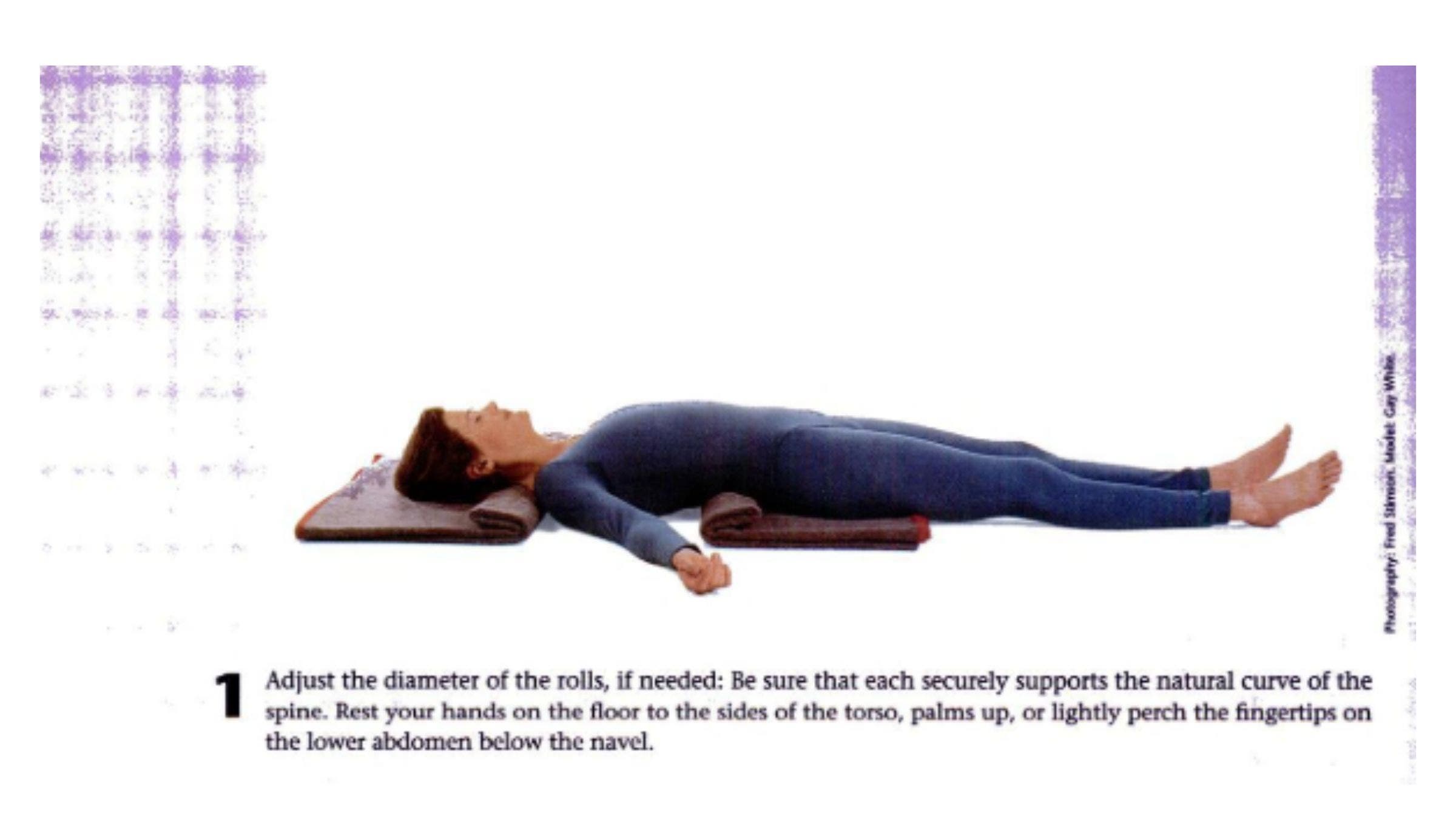
Lie on your back. Slide one roll under the neck or cervical curve (padding the back of the head with the unrolled portion of the blanket), the other under the lumbar curve (with the unrolled portion under the buttocks) (Figure 1).
The entire spine is now in contact with something—the two forward curves with the rolls and the two backward curves, at the thorax and sacrum (the back of the pelvis, with the floor. You can use this contact to get a feel for the length of the spine and its contour: Leisurely walk your awareness up along its undulating route, from the tailbone (coccyx) to the first cervical vertebra, appropriately dubbed the atlas, which, like its mythical namesake, shoulders the base of your skull. And stay alert for the other scenery of the interior landscape, those “rivers, seas, and mountains,” described by our yogi tour guides. You might have to meander from the coccyx to the atlas and back again a few more times before you can closely track each section of the path.
Now recall your model of the diaphragm—the closing and opening hand—and apply it to the operation of the actual muscle. Watch, as you inhale, the diaphragm flatten. This expands the thoracic cavity and sucks fresh air into the lungs; at the same time, the contracting muscle pushes down against the abdominal organs and the intestinal plumbing, ballooning the belly. The reverse occurs on the exhale: Watch again as the diaphragm relaxes. This domes the muscle up into the thorax—urged on by the firming abdominals, which are now pressing in and up against the guts—and pushes out our exhaust.
Zero in on the lumbar (lower spine): We usually have some awareness that the front of the abdomen seesaws during breathing but very little awareness that the back of the abdomen (and the sides) does too. For a few minutes, observe how the lumbar flattens and lengthens on the inhale, rounds and shortens on the exhale, in rhythm with the diaphragm. When you can picture all this, finish an exhale and, to initiate the next inhale, recreate the sensation of the inhale in the lumbar, but slightly prior to the inhale itself, so that the action triggers the descent of the diaphragm.
Then, when the lungs are almost topped off, slowly soften the lumbar and exhale. Continue in this way for a few more minutes, rooting the breath in the breathing brain. I breathe from the roots as much as l can, not only during yoga practice but also throughout my day, especially on freeways, opening mail from the IRS, and at the dentist.
Conqueror’s breath is, of course, called pranayama. The word neatly encapsulates the business of the discipline, which is to “stretch” and “grasp” (ayama) the “vital air” (prana). Our survey of the spine, the diaphragm and its roots is a preparation for the first stage of a pranayama called Ujjayi (pronounced “oo-jai-ee”), which means “to win, conquer,” and so is usually translated as the”conqueror’s breath.” This name is prompted by the way the breather holds the chest, “thrust out like that of a mighty conqueror,” as Iyengar notes, in order to maximize the air capacity of the lungs. I also suspect it hints that we can, with constant and conscious practice of this technique, conquer our own limitations and win the great victory of self-liberation.
The full practice of Ujjayi involves deep breathing, sundry muscular “locks” (bandha) and “seals” (mudra), and periodic retention (kumbhaka) of the breath. We won’t go that far: Our focus will be simple breath awareness—”choiceless awareness,” to borrow a phrase from J. Krishnamurti—of spontaneous breathing, which is the basis of all the many pranayamas.
How to Fold the Blanket Before Practicing Ujjayi Breath
Pranayama is traditionally practiced in a sitting posture—Lotus Pose (Padmasana) is probably the best known.
Most beginning and a good many intermediate students, however, sit in ways that fall short of one or both of the classical criteria—steady and comfortable—for a proper seat. So the initial stage of Ujjayi is practiced lying on the floor, where the embrace of gravity encourages the relaxation of habitual muscle tension and we can concentrate with less distraction on the breath. But we won’t lie completely flat on the floor; instead we’ll fashion a narrow bolster with a folded blanket and use it to boost the torso (and head) off the floor in a modest imitation of the mighty conqueror.
Unfold one of your triple-folded blankets once, so it measures about two by three feet, lay it on the floor and kneel at one of the long edges. Draw an imaginary line down the middle of the blanket, parallel to the long edges. Pick up the edge closest to you by the corners, and fold it over to the imaginary line, then do the same with the far edge: Your blanket is now half its original width but double in thickness, with a groove down the middle. Now simply take the half-blanket closest to you and fold it over the groove, so that you have a bolster one-fourth the width of the original but four times thicker.
Shanmukhi Mudra: The Six-Mouths Seal
Now it’s time to wrap yourself up. In traditional pranayama, the yogis employ the “locks” and “seals” —one old text lists 25 of them—to help contain and channel the breath and restrict the fluctuations (vritti) of consciousness and turn it inward for meditation. We’ll work with a variation of the “six-mouths seal” (shan-mukhi mudra) in which the yogi blocks the six “mouths” of the head— the ear holes, the eyes, and the nostrils with the fingers and thumbs. Geeta Iyengar asserts that this seal “calms the brain and the nervous system and is excellent for removing irritation, tension, loss of temper, dizziness, burning of the eyes, blurred vision, and brain fatigue due to intellectual work.”
Our variation doesn’t use the hands; rather, we’ll approximate the seal by wrapping the forehead and eyes (but not the nose) with an ace bandage. The one I have measures about four-and-a-half feet long and four inches wide. The wrap lightly squeezes the forehead, base of the skull, and eyes, and so helps quiet the consciousness by blocking light and tranquilizing tension in the face and eyes. (Incidentally, the wrap and a long Corpse Pose are recommended as a headache remedy.)
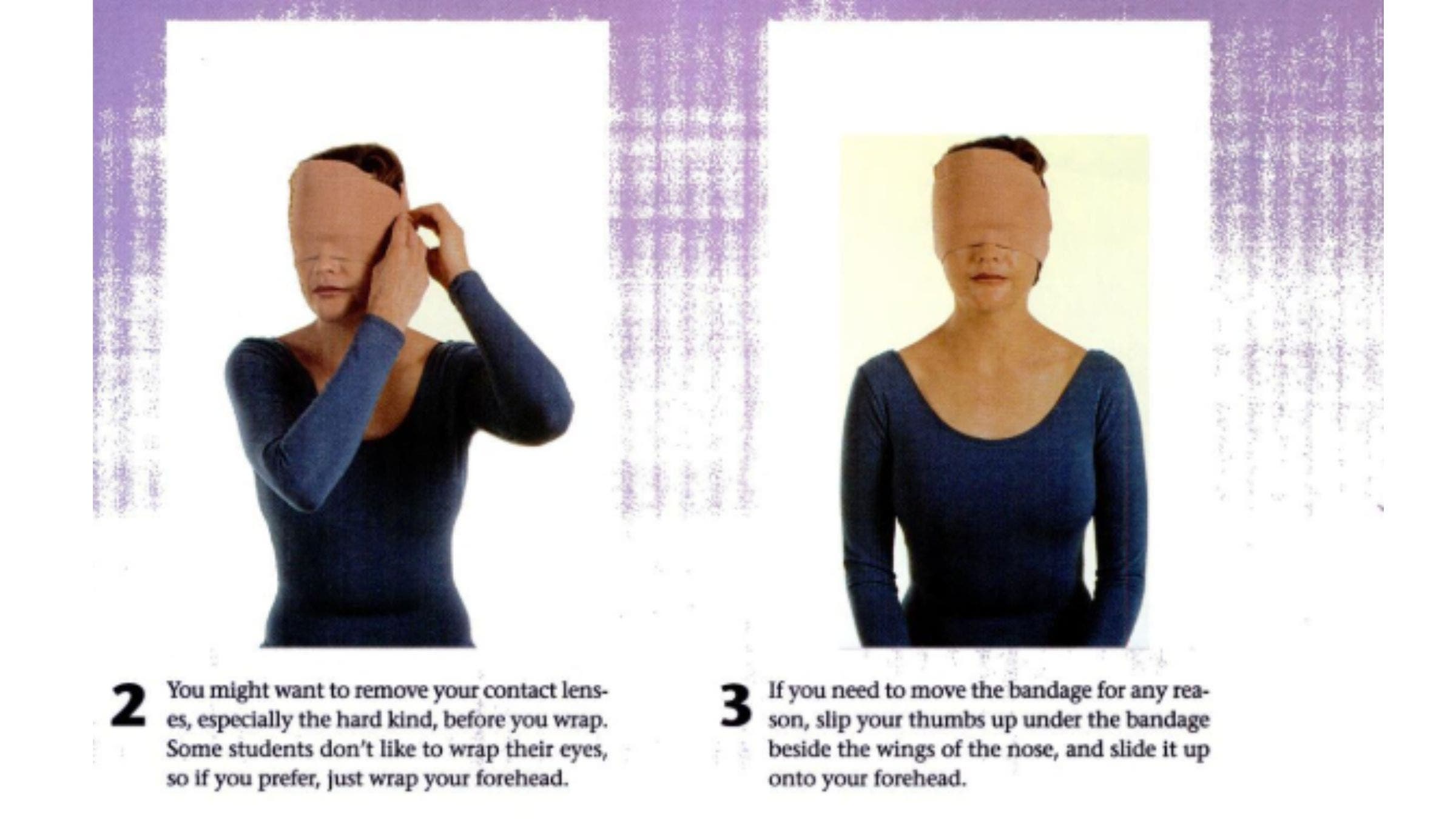
Start with the bandage rolled up. Since I’m right-handed I routinely hold the roll in my right hand and wrap my head counter-clockwise, but you might want to experiment with the direction of the wrap. With your left thumb, press the free end of the roll against that little bump at the back base of your skull. Stretch the bandage out slightly and bring it around your right ear, across your forehead (above the bridge of the nose), and down across your left ear to the back of the head again. like the bandage fairly snug against my forehead, but you may not, so experiment with the tautness of the wrap. Now wrap another layer: From the bump again, bring the bandage over the right ear, up diagonally across the cheek, over the closed eyes (but again above the bridge of the nose), diagonally down the left cheek, and over the left ear to the back of the head. Be careful not to wrap this second layer too tightly. You’ll probably have enough bandage left now for one more wrap, and I’ll leave it up to you how to do it. When you’re done, take the free end of the bandage and slip it under one of the layers to hold the “seal” in place (Figures 2 and 3).
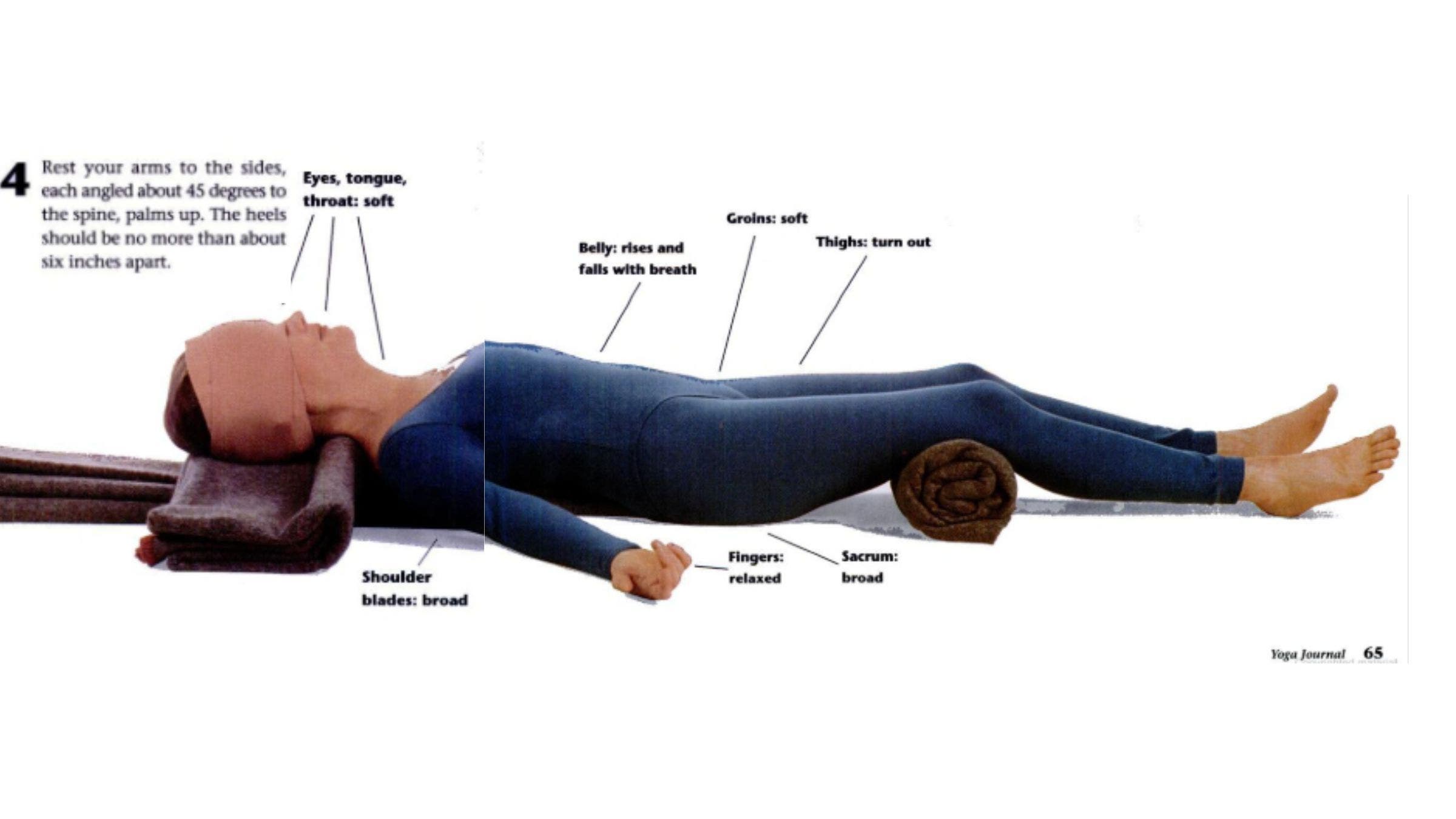
Notice that one end of the bolster is lapped or hard-edged, while the other end is open or soft-edged. Sit up against the hard edge, buttocks on the floor, and lie back. Pillow your neck and head, as you did in the diaphragm-roots exercise, with a small blanket roll (Figure 4).
If you have any low back problems, the bolster might cause some discomfort: First try elevating your knees on a thickly rolled blanket (or two; if that doesn’t work, get off the bolster and lie flat on the floor—knees still supported—for the practice. Ask your regular teacher to help you devise a more suitable bolster.
Now, at last, you’re ready to breathe.
There are any number of things to monitor during beginning Ujjayi, including the roots of the diaphragm and the “silent prayer,” but I usually tell my students to ask three questions in particular:
- What is the speed of the breath? Is it slow or fast, deliberate or hurried?
The Hatha Yoga Pradipika, written perhaps 600 years ago, devotes two-and-a-half times as many verses to pranayama as it does to asana. - Is the breath steady? Is it smooth and constant from beginning to end, or are there rough spots, jerks, pauses? Also, do the two lungs seem to fill and empty evenly, or does one move more quickly or slowly than the other?
- What are the relative lengths of the inhales and exhales? Is one noticeably longer or shorter than the other?
The important elements of the practice include regularity, proper posture—whether sitting or reclining—an alert mind, and surrender: the willingness to yield our self-imposed self-limitations to the intelligence of the breath and trust it to guide us compassionately toward our goal of self-liberation. This last element is fostered with a positive attitude and faith (shraddha) in the efficacy of the practice, contentment (samtosha), and patience (kshana).
Pranayama has lots of physical and psychological benefits; for example, according to the Hatha Yoga Pradipika, it stimulates our digestion and increases our strength, rescues us “from all diseases,” and extends our life. But the yogis are mainly interested in the practice because it purifies and feeds the countless energy currents (nadi) and six energy “wheels” (chakras) of the body, readies the consciousness for meditation, and ultimately encourages the freest possible expression of our authentic self.
Start by practicing Ujjayi 10 to 15 minutes a day. I use a watch with a beeper to keep track of time. In addition to the exercise with the roots of the diaphragm, other good practice preparations include passive chest openers, such as lying over a thick blanket roll, and groin openers like Bound Angle Pose (Baddha Konasana). Ask your regular teacher for specific warm-up ideas, or look at the positions in Relax and Renew by Judith Lasater, many of which can be effectively adapted to pranayama.
There’s not much you can do to hurt yourself at this level of pranayama, but you should be cautious of light-headedness, irritability, tension, and frustration—stop immediately for the day if you encounter any of these. The biggest problem you’ll probably have is staying focused on the breath. We’re all inclined to wander off into the past or the future and lose the thread of the present. If you find yourself slipping off, bring yourself back to the breath without force or violence. Let your consciousness float gently on the breath, like a boat rocking to and fro on the ocean waves. Be sure to spend a few moments at the end of your practice flat on the floor in Savasana.