

Animals
Wild-type and Er1Lyz2/− mice were generated as previously described by intercrossing Lyz2–cre (C57BL/6 background), Ercc1fl/fl (FVB background) and Ercc1+/− (C57BL/6 background) mice. This breeding strategy produced wild-type mice carrying a floxed and a wild-type Ercc1 allele (Ercc1fl/+) and Er1Lyz2/− mice carrying one floxed and one knockout allele in conjunction with the Lyz2–cre transgene (Lyz2–cre;Ercc1fl/−). Similarly, Atg5fl/fl mice (C57BL/6) were used to achieve the conditional knocking out of both Atg5 and Ercc1 genes in the same background. Eleven-month-old male F1 mice exhibiting lupus-like disease resulted from the cross of NZB × NZW mice. Mice were housed in a specific pathogen-free facility at the Institute of Molecular Biology and Biotechnology-Foundation for Research and Technology (IMBB-FORTH) where the light/dark cycle (12 h) and temperature were controlled. Mice were fed a normal chow diet and were provided water ad libitum. This work received ethical approval by an independent animal ethics committee at IMBB-FORTH. All relevant ethical guidelines for the work with animals were adhered to during this study. For the duration of all in vivo experiments, mice were monitored daily.
Isolation of mouse sera and adoptive transfer in young hosts
Mice were initially anesthetized using ketamine/xylazine. For the acquisition of serum, the blood was centrifuged twice at 10,000g for 10 min at 4 °C. The supernatant was kept, and pellets were discarded. For the adoptive transfer of mouse sera to young hosts, sera from 10-month-old wild-type and Er1Lyz2/− mice were diluted 1:3 in 1× PBS and injected intravenously once per week for a total of 5 weeks.
Primary BMDM culture, lentiviral transfection and treatments
Bone marrow was harvested from the tibias and femurs of mice, and precursor cells were differentiated in DMEM supplemented with 10% FBS, antibiotics (50 μg ml−1 streptomycin, 50 U ml−1 penicillin from Sigma-Aldrich, 2 mM l−1 glutamine from Gibco) and 30% L929 conditioned media for 6 days. On the seventh day, 30% L929 media were replaced with fresh DMEM containing 10% FBS, antibiotics and 10% L929. All treatments were performed on the seventh day of differentiation. In more detail, etoposide (ETO; Sigma-Aldrich, E1383) was added at the concentration of 25 μM for 1 h, and cells were recovered for 24 h before MHC-II flow cytometry analysis. Inhibitors targeting ATM kinase signaling (10 μM ATMi; KU 60019; Sigma-Aldrich, 531978), ATR kinase signaling (10 μΜ ATRi; Millipore, 189299) and DNAPK kinase signaling (2.5 μΜ; NU7441; STEMCELL Technologies, 74082) were added for a 6-h duration. N-acetylcysteine (Sigma-Aldrich, A9165) and Mito-TEMPO (Sigma-Aldrich, SML0737) were added at the concentration of 1 mM and 20 μM, respectively, for 24 h. Autophagy inhibitors 3-MA (Sigma-Aldrich, 189490), 10 mM, and chloroquine (Sanofi Aventis), 50 μM, were added for a duration of 3 h. For the inhibition of endocytosis, cells were treated with 80 μM Dynasore (Sigma-Aldrich, 324410) for a total of 3 h, including a 2-h chloroquine treatment in the case of autolysosome−nuclear protein co-localization studies. LPS-induced activation of BMDMs was carried out at a concentration of 100 ng ml−1 for a 16-h timeframe. For the determination of the cells’ autophagic flux, FUW mCherry−GFP−LC3 lentivirus (Addgene, plasmid no. 110060; http://n2t.net/addgene:110060; RRID: Addgene_110060) production was performed in HEK293T cells with helper plasmids psPAX2 and pMD2.G. The supernatant was collected 72 h later, filtered using a 45-μm filter and precipitated with polyethylene glycol before immediate use or storage at −80 °C until use. Viral transfection of BMDMs with the mCherry−GFP–LC3 plasmid was performed in 10% L929 conditioned media on day 6 of differentiation. Cells were fixed 48 h later, permeabilized with 0.1% Triton in 1× PBS and stained with DAPI for the detection of nuclei.
THP-1 monocyte cell line
Cells were purchased from the American Type Culture Collection (no. TIB-202) and cultured in RPMI 140 (Gibco). Approximately 2 × 10⁵ cells were treated with 25 μM ETO for 1 h or left untreated and recovered in fresh RPMI medium for 24 h before flow cytometry analysis or 4% formaldehyde fixation for immunofluorescence staining. Cells analyzed with immunofluorescence were treated with chloroquine for 3 h beforehand.
Primary CD4+ T cell isolation and co-culture with BMDMs
CD4+ T cells were isolated from spleens of mice. Single-cell suspensions of splenocytes were obtained by mushing spleens in 40-μm strainers, collecting cell pellets by centrifugation at 300g for 5 min at room temperature, removing red blood cells (RBCs) by resuspending the pellets in RBC lysis buffer for 2 min at room temperature and, finally, centrifuging again at 300g for 5 min at room temperature. MACS MicroBeads (CD4 L3T4; Miltenyi Biotec, 130-117-043) were used for positive selection of the desired cell population, as per the manufacturer’s instructions. For the T cell−BMDM co-culture, isolated BMDMs were seeded on a 96-well plate with CD4+ T cells in a ratio of 1:1 in the presence of 0.5 μg ml−1 CD28 (Invitrogen, 16-0281-86), in RPMI 140 medium (Gibco).
Adoptive transfer experiments
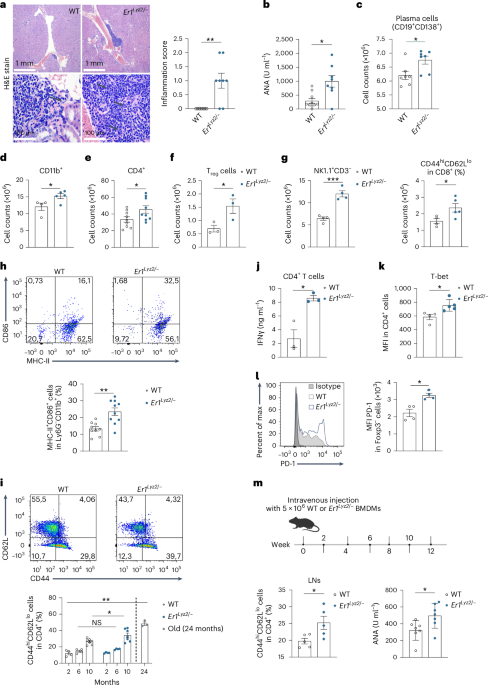
BMDMs were differentiated as described, and 5 × 10⁶ cells were injected intravenously at the timepoints indicated. CD4+ T cells were isolated as described, and 2 × 10⁶ cells were injected intravenously once per week for a total of 8 weeks in young NSG hosts.
In vivo MHC-II blockade
Intraperitoneal injections of 70 μg of anti-MHC-II (I-A/I-E, M5/114 monoclonal antibody by Bio X Cell) blocking or isotype control antibodies were administered weekly, for 4−6 weeks.
In vivo depletion of CD4+ T cells
Intravenous injections of 150 μg of anti-CD4 (Bio X Cell) blocking or isotype control antibodies were administered weekly, for 6 weeks.
Immunofluorescence of cells and indirect detection of antinuclear antibodies
BMDMs, TEMs, THP-1 monocytes, CD11b+Ly6G− monocytes from NZB/NZW F1 mice or MEFs were fixed in 1× PBS/4% formaldehyde for 10 min at room temperature. Cells were washed three times in 1× PBS, blocked and permeabilized using 1% BSA and 0.1% Triton X-100 in 1× PBS. Primary antibodies or mouse sera were incubated in 1% BSA/0.1% Triton X-100/PBS for 1 h at room temperature or overnight at 4 °C. Afterwards, cells were washed three times with 0.1% Triton/PBS, and fluorochrome-conjugated secondary antibodies were added in 1% BSA/0.1% Triton X-100/PBS for 1 h at room temperature, followed by three more washes in 0.1% Triton X-100/1× PBS. Mounting was done with 80% glycerol, and samples were imaged with a Leica SP8 confocal microscope.
8-oxoG staining preparation
Cells were fixed in methanol, on ice, for 10 min and washed three times with 1× PBS. After fixation, the coverslips were air dried and incubated in 0.05 N HCl for 5 min, on ice, washed three times in 1× PBS and then incubated in a 100 μg ml−1 RNase A (Macherey-Nagel, 740397), 150 mM NaCl and 15 mM sodium citrate solution for 1 h, at 37 °C. A 1× PBS wash was performed for 3 min, followed by sequential ethanol dehydration steps: 35%, 50% and 75% ethanol for 3 min. Then, 0.15 N NaOH in 70% ethanol was added for 4 min; two PBS washes were performed; and cells were fixed with 4% formaldehyde in 70% ethanol for 2 min. The fixation buffer was exchanged with 50% and then 35% ethanol, and cells were again washed with 1× PBS for 2 min and treated with 5 μg ml−1 proteinase K in Tris-EDTA buffer for 5−10 min, at 37 °C. After a PBS wash, blocking and primary antibody incubation was performed as described before. An 8-oxoG antibody (Millipore, MAB3560) was used, at a 1:100 concentration, overnight.
Immunofluorescence of kidney cryosections
Kidneys were fresh frozen in OCT compound and stored at −80 °C until further analysis. Kidneys were sliced using a Leica CM1850 UV cryostat (7 μm). Tissue sections were fixed in 4% formaldehyde for 15 min, washed three times with 1× PBS and blocked with 1% BSA/0.1% Triton X-100/PBS for 1 h at room temperature. A similar protocol as the one for immunofluorescence of fixed cells was followed. Kidneys were stained for IgM (dilution 1:500; Invitrogen, A21042), IgA (dilution 1:800; BioLegend, 407001) or C3 (dilution 1:300; Invitrogen, PA5-21349).
Paraffin preparations for tissue histological analysis
Skins, kidneys and spleens were dissected from mice, fixed overnight in 4% formaldehyde, washed three times with 1× PBS and then embedded in paraffin blocks. Tissue sections were used for H&E or PAS staining.
Flow cytometry analysis and antibodies
For surface protein staining, cells were stained with fluorochrome-conjugated antibodies diluted in staining buffer (1× PBS/5% FBS or 1× HBSS/5% FBS) for 20 min on ice, using the concentrations indicated by the manufacturer. Cells were washed by staining buffer and centrifuged at 300g for 5 min at 4 °C. For the staining of intracellular proteins, True-Nuclear Transcription Factor Buffer Set (BioLegend, 424401) was used, and cells were centrifuged at 400g for 5 min at room temperature, after fixation. Staining for the detection of granulocyte−monocyte progenitors in the bone marrow was as follows. Bone marrow was collected by flushing the femur, and cells were incubated with RBC buffer for the removal of erythrocytes. Then, 1 × 10⁶ cells were stained with Pacific Blue anti-mouse lineage antibody cocktail (1:10), PE anti-mouse CD34 (1:50), FITC anti-mouse c-Kit (1:100), APC anti-mouse CD16/32 (1:50) and PerCP anti-mouse SCA-1 antibody (1:100) for 3 h at 4 °C, before a PBS/5% FBS wash and flow cytometry analysis. Antibodies and isotype controls were purchased from BioLegend and Proteintech: anti-CD19 (BioLegend, 152410; clone 1D3/CD19), anti-CD138 (BioLegend, 142503; clone 281-2), anti-CD11b (BioLegend, 101212; clone M1I70), anti-CD4 (BioLegend, 100406, 100412 and 100432; clone GK1.5), anti-CD25 (BioLegend, 102012; clone PC61), anti-FOXP3 (Proteintech, PE-65089; clone 3G3), anti-MHC-II (BioLegend, 107606, 107636 and 107631; clone M5/114.15.2), anti-CD86 (BioLegend, 105026; clone GL-1), anti-Ly6G (BioLegend, 127654 and 127607; clone 1A8), anti-CD62L (BioLegend, 104412; clone MEL-14), anti-CD44 (BioLegend, 103036; clone IM7), anti-T-bet (BioLegend, 644812; clone 4B10), anti-PD-1 (BioLegend, 135214; clone 29F.1A12), anti-CD69 (BioLegend, 104507; clone H1.2F3), anti-F4/80 (BioLegend, 123110; clone BM8), anti-CD115 (BioLegend, 135512; clone AFS98), anti-mouse Lineage Cocktail with Isotype Ctrl (BioLegend, 133305; clones 17A2, RB6-8C5, RA3-6B2, Ter119 and M1/70), anti-mouse CD34 antibody (BioLegend, 119307; clone MEC14.7), anti-mouse Ly-6A/E (Sca-1) (BioLegend, 108123; clone D7), anti-mouse CD16/32 (BioLegend, 101325; clone 93), anti-mouse c-Kit (BioLegend, 105815; clone 2B8), anti-mouse CD170 (Siglec-F) antibody (BioLegend, 155523; clone S17007L), anti-mouse NK-1.1 (BioLegend, 108705; clone PK316), anti-mouse CD3a (Proteintech, PE-65060), anti-mouse FoxP3 (BioLegend, 126409; clone MF-14), i-mouse CD8a (BioLegend, 100712; clone 53-6.7), PerCP rat IgG2a (BioLegend, 400529; clone RTK2758) and FITC rat IgG2a (Proteintech, FITC-65209; clone 2A3) were used as isotype control antibodies. Lysosomal dyes were purchased from Thermo Fisher Scientific: LysoTracker Red DND-99 (L7528) and LysoSensor Green DND-189 (L7535). For Annexin V/propidium iodide staining in BMDMs, the FITC Annexin V Apoptosis Detection Kit (BD Pharmingen, 556547) was used. Cell analysis was eventually performed in a FACSCanto II flow cytometer or a FACSCalibur (BD Biosciences), and data analysis was performed using FlowJo software (Tree Star). The gating strategies were as follows: forward scatter/side scatter (FSC/SSC) for live cell selection and debris removal; forward scatter area/side scatter area (FSC-A/SSC-A) for the subsequent removal of cell aggregates; and then fluorophore-conjugated specific antibodies for the next gates.
FACS and treatment of NZB/NZW F1 monocytes
Spleens were obtained from NZB/NZW F1 mice, and single-cell suspensions were either cryopreserved and thawed for analysis or directly stained with PE anti-mouse Ly6G (1:200) and APC anti-mouse CD11b (1:100) for 20 min, at 4 °C, in 1× PBS/5% FBS and 2 mM EDTA. Cell sorting was performed in a FACSAria III flow cytometer, and monocytic-origin cells were identified as Ly6G−CD11b+. Cells were seeded on poly-l-lysine-coated coverslips, in 48-well plates (105 cells per well), and cultured for 24 h in RPMI 1640 and recombinant M-CSF (250 ng ml−1 working concentration; PeproTech, 315-02). Cells were treated with chloroquine for 3 h prior to fixation. The splenocytes that were not separated through cell sorting were seeded on 48-well plates (105 cells per well), in RPMI 1640 and recombinant M-CSF, and treated with an ATM inhibitor for a duration of 16 h. Cells were collected and stained with DAPI for dead cell exclusion, CD11b and Ly6G for monocyte labeling and MHC-II antigen presentation protein.
qPCR
Quantitative qPCR was performed using a CFX Duet Real-Time PCR system device (Bio-Rad), and data were analyzed as previously described34. The Hprt1 (hypoxanthine phosphoribosyltransferase 1) gene was used for normalization. Primers: Ccl2: forward: TGATCCCAATGAGTAGGCTGGAG, reverse: ATGTCTGGACCCATTCCTTCTTG; Ccl7: forward: TCCCTGGGAAGCTGTTATCTTC, reverse: TGGAGTTGGGGTTTTCATGTC; Ccl24: forward: AATTCCAGAAAACCGAGTGG, reverse: TGGCCCCTTTAGAAGGCTGG; Cxcl1: forward: CCACACTCAAGAATGGTCGC, reverse: GTTGTCAGAAGCCAGCGTTC; Cxcl5: forward: TGCCCCTTCCTCAGTCATAG, reverse: GGATCCAGACAGACCTCCTTC; Cxcl10: forward: ATGACGGGCCAGTGAGAATG, reverse: CATCGTGGCAATGATCTCAACA.
Lysosome purification
At least 30 × 106 BMDMs or TEMs pooled from four mice were collected for the isolation of lysosomes using the Lysosome Isolation Kit (Abcam, ab234047). Lysosomes were then lysed using RIPA, and their protein content was detected through immunoblotting analysis.
Western blot analysis and antibodies
Cells or lysosomes were lysed with RIPA buffer, containing 50 mM Tris-HCl (pH 8.0), 150 mM NaCl, 0.5% sodium deoxycholate, 1% Nonidet P-40 and 0.1% sodium dodecyl sulfate and protease and phosphatase inhibitors. For IFNβ detection from BMDMs, culture supernatants from the same amount of cells were concentrated using Amicon Ultra Centrifugal Filter, 10-kDa molecular weight cutoff (Merck Millipore, UFC901024). The concentrated supernatants were mixed with equal volumes of 2× Laemmli and boiled at 80 °C for 10 min before being loaded into the gel for SDS−PAGE. For cell and lysosome lysates, protein concentration was determined using Bradford protein assay, and equal amounts of protein were loaded (50−80 μg for cells and 5−8 μg for lysosomes) for SDS−PAGE. Equal parts of concentrated supernatant proteins were loaded. Proteins were transferred to nitrocellulose membranes (Amersham Hybond), blocked using 5% skim milk diluted in 1× PBS with 0.1% Tween 20 (PBS-T) for 1 h and probed with antibodies. β-tubulin or actin was used for the normalization in the case of cell lysates and supernatants and Ponceau staining for the normalization in the case of lysosomal lysates. An ECL (Thermo Fisher Scientific and Amersham) development was performed, and results were imaged using ImageBlot (Bio-Rad). Quantification was performed using Fiji (ImageJ). Antibodies against the following proteins were used: MHC-II (Bio X Cell, clone M5/114; western blot: 1:800), ERCC1 (Santa Cruz Biotechnology, clone D-10; western blot: 1:500), Ki-67 (Cell Signaling Technology, 9129S, clone D3B5; FACS: 1:500), γH2AX (Millipore, 05-636; immunofluorescence: 1:12,000), 53BP1 (NB100-304; immunofluorescence: 1:200), IFNβ (Cell Signaling Technology, 97450; immunofluorescence: 1:500, western blot: 1:1,000), pSTAT1 (Cell Signaling Technology, 9167; western blot: 1:250) and STAT1 (Cell Signaling Technology, 14994; western blot: 1:500), β-tubulin (Abcam, ab6046; western blot: 1:1,000), IRF5 (Proteintech, 10547-1-AP; western blot: 1:500), actin (Cytoskeleton, BK037; western blot: 1:5,000), H1 (Santa Cruz Biotechnology, sc-8030; immunofluorescence: 1:50, western blot: 1:200), LAMN A/C (Proteintech, 10298-1-AP; western blot: 1:2,000), lamin B1 (Abcam, ab16048; immunofluorescence: 1:500, western blot: 1:1,000), cGAS (Proteintech, 26416-1-AP; immunofluorescence: 1:200), EEA1 (Proteintech, 28347-1-AP; western blot: 1:200), LAMP1 (Santa Cruz Biotechnology, sc-19992; immunofluorescence: 1:100), LAMP1 (Developmental Studies Hybridoma Bank; western blot: 1:200), p62 (Abnova; immunofluorescence: 1:1,000), p62 (Cell Signaling Technology; immunofluorescence: 1:500), GAPDH (Abcam, ab8245; western blot: 1:2,000), FAU (Proteintech, 13581-1-AP; western blot: 1:200), ATG5 (Proteintech, 10181-2-AP; western blot: 1:1,000) and γH2AX (Cell Signaling Technology; immunofluorescence: 1:500, FACS: 1:500).
MHC-II immunoprecipitation and peptidomics analysis
Approximately 3 × 10⁸ BMDMs, derived from a pool of isolated cells from four mice of the same genotype, were used per each MHC-II immunoprecipitation sample. Cells were initially lysed using a buffer containing 0.5% NP-40, 50 mM Tris (pH 8.0), 150 mM NaCl and protease inhibitors. After rotating the lysates for 1 h at 4 °C, the samples were centrifuged at 2,000g for 10 min at 4 °C, and supernatants were again centrifuged at 51,200g for 50 min at 4 °C. Native MHC-II−peptide complexes were purified using InVivoMAb anti-mouse MHC-II (I-A/I-E, M5/114 monoclonal antibody by Bio X Cell) along with Protein G Sepharose beads (Millipore). Immunopeptides were purified using Sep-Pak tC18 columns containing 100 mg of sorbent (Waters Corporation). The elution of peptides from the tC18 sorbent was conducted with 32% acetonitrile (ACN) in 0.1% trifluoroacetic acid (TFA). Eluates were volume reduced using a vacuum evaporator until almost all liquid was evaporated. The peptides were then resolved with 2% ACN in 0.5% TFA and stored at −80 °C until further analysis103.
LC−MS/MS and quantitative analysis
An LC−MS/MS analysis was performed on a Q Exactive HF-X mass spectrometer (Thermo Fisher Scientific) online coupled to an UItiMate 3000 RSLC nano-HPLC (Dionex/Thermo Fisher Scientific). The peptides were automatically injected and loaded onto a C18 trap column (300-µm inner diameter × 5 mm, Acclaim PepMap100 C18, 5 µm, 100 Å, LC Packings; Thermo Fisher Scientific) at a 30 µl min−1 flow rate prior to performing C18 reversed-phase chromatography on the analytical column (nanoEase MZ HSS T3 Column, 100 Å, 1.8 µm, 75 µm × 250 mm; Waters Corporation) at a 250 nl min−1 flow rate in a 95-min nonlinear ACN gradient from 3% to 40% in 0.1% formic acid. Profile precursor spectra from 300 m/z to 1,650 m/z were recorded at 60,000 resolution with an automatic gain control (AGC) target of 3 × 10⁶ and a maximum injection time of 100 ms. The 15 most abundant peptide ions of charges 1 to 4 were selected from the mass spectrometry scan and fragmented using higher-energy collisional dissociation (HCD) with a normalized collision energy of 28, an isolation window of 1.6 m/z and a dynamic exclusion of 15 s. MS/MS spectra were recorded at a resolution of 30,000 with an AGC target of 1 × 10⁵ and a maximum injection time of 100 ms. Proteome Discoverer 2.5 software (version 2.5.0.400; Thermo Fisher Scientific) was used for peptide and protein identification via a database search (Sequest HT search engine) against the SwissProt murine database (release 2020_02; 17,070 sequences). Furthermore, the workflow for the identification of the immunopeptidome included the INFERYS rescoring node104. The database search was performed with an unspecified peptide cleavage. The precursor mass tolerance was 10 ppm, and the fragment mass tolerance was 0.02 Da. The carbamidomethylation of cysteine was set as static modification. Dynamic modifications included the deamidation of asparagine and glutamine, the oxidation of methionine and a combination of methionine loss with acetylation on the protein N terminus. Peptide spectrum matches (PSMs) and peptides were validated with the Percolator algorithm105. Only the top-scoring hits for each spectrum were accepted with a false discovery rate (FDR) < 1% (high confidence).
The mass spectrometry data for Fig. 6 were acquired in DDA-PASEF mode on a timsTOF Ultra 2 mass spectrometer (Bruker). Peptides were loaded on Evotips (one Evotip for each injection). They were placed in an Evosep autosampler until analysis. The 40 samples per day whisper method employing a 27-min gradient with solvents A (0.1% formic acid, water) and B (0.1% formic acid, MeCN) was chosen, and a 15-cm column (PepSep C18, 1.9-µm beads, 75-µm inner diameter) was used for separation of peptides. Column was heated to 50 °C. The DDA-PASEF method (‘MHC class II’) covered a mass range from 100 m/z to 1,700 m/z and a mobility range from 0.64 to 1.45 1/K0. A duty cycle of 100% was achieved by setting the ramp time and accumulation time to 100 ms each. Collision energy for 0.6 1/K0 was set to 20 and for 1.6 1/K0 to 59. Estimated cycle time was 0.6 s.
PEAKS Studio 12.5 software (Bioinformatics Solutions) was employed for peptide identification using the DeepNovo algorithm for de novo peptide sequencing against the SwissProt Mouse database (release 2020_02; 17,061 entries). Mass spectrometry data were searched without enzymatic specificity constraints, with precursor mass error tolerances set to 10.00 ppm and 20.00 ppm for different experiments, and fragment mass error tolerance was maintained at 0.02 Da. Peptide length was constrained between 6 and 30 amino acids to accommodate the broader range typical for MHC-II immunopeptidomics applications. Variable post-translational modifications included N-terminal acetylation (+42.01 Da), asparagine and glutamine deamidation (+0.98 Da) and methionine oxidation (+15.99 Da), with a maximum of three variable modifications permitted per peptide. PSMs were filtered using stringent criteria including DeepNovo confidence scores ≥70.00% and PSM significance thresholds of −log10(P) ≥ 20.0, with confident amino acid assignment requiring ≥2.00% threshold. Label-free quantification was performed using identification-directed quantification with feature intensity thresholds ranging from 300 to 100,000. Ion mobility tolerance was set to 0.05 (1/K0) where applicable. Data refinement included mass correction and chimera association algorithms to improve spectral quality. No normalization methods were applied to preserve the inherent biological variance in the quantitative data.
ELISAs
Co-culture supernatants were collected after two centrifugations: 300g, 5 min, room temperature, for the removal of cells and 2,000g, 15 min, 4 °C, for the removal of cell debris. Protease inhibitors were added, and the samples were stored at −80 °C until use. Mouse IFNγ protein levels were quantified using Mouse IFNγ ELISA MAX Deluxe Set (BioLegend, 430804). Antinuclear autoantibodies were quantified using Mouse Anti-Nuclear Antigens (ANA/ENA) Ig (total (A + G + M)) ELISA Kit (Alpha Diagnostics International, 5210). Albumin levels in the urine were detected using Mouse Albumin ELISA Kit (Bethyl Laboratories, E99-134).
IFNγ ELISpot assay
ELISpot assays were performed according to the manufacturer’s instructions (Mabtech, 3321-4APT-2). In total, 200.000 splenocytes were stimulated for 48 h in the presence of 3 μg of the indicated synthesized peptide (Macrogen) and 30 U ml−1 recombinant interleukin-2 (rIL-2; PeproTech, 0717108). rIL-2-stimulated splenocytes derived from Er1Lyz2/− mice were used as a negative control. For the T cell−macrophage co-cultures, T cells and BMDMs were mixed in a 1:4 ratio for 48 h, in the presence of 0.5 μg ml−1 anti-CD28 and 30 U ml−1 rIL-2. BMDMs were pretreated with 10 mM 3-MA for 3 h and 20 μg ml−1 anti-MHC-II (I-A/I-E, M5/114 monoclonal antibody by Bio X Cell) or 20 μg ml−1 anti-IFNβ (BioLegend, 508107) for 24 h where necessary. Samples were imaged with a Leica M205 FA dissection microscope, and spots were counted using ImageJ. The peptides used for the assays were as follows: H1-1: KKPKVVKAKKVAKSPA, RPL30: PGDSDIIRSMPEQTGEK, COL1A: TPAKNSYSRAQANKH, HRNRPL: YGNVEKVKFMKSKPG, EXOSC4: GPHEIRGSRSRALPD.
Autophagosome profiling coupled to mass spectrometry
U2-OS cells constitutively expressing APEX2−Flag−LC3B were subjected to autophagosome content profiling as described in Le Gerroué et al.62. Quantification of the proteasomal content of autophagosomes via mass spectrometry was based on SILAC. In brief, APEX2−Flag−LC3B proximal proteins were biotinylated in ‘medium’ and ‘heavy’ labeled cells by inducing APEX2 activity after incubation with biotinphenol (500 mM) for 2 hat 37 °C and a 1-mimpulse with H2O2 (1 mM). Biotinphenol was also added to ‘light’ labeled cells, but biotinylation was not induced by omission of H2O2 application. In heavy labeled cells, autophagy was induced with genotoxic stress for 16 h of etoposide treatment (10 µM), whereas medium and light labeled cells were treated with DMSO. Autophagosome enrichment was induced by adding BafA (200 nM) to all cells for 2 h simultaneously to the biotinphenol treatment. Quenching solution (1 mM sodium azide, 10 mM sodium ascorbate and 5 mM Trolox in DPBS) was added to all cells to stop remaining biotinylation reactions, followed by three washing steps with PBS.
Cells were collected from 15-cm dishes by trypsinization (3 min, 37 °C). Afterwards, cells were washed twice in PBS prior to mixing them in a 1:1:1 ratio based on cell numbers.
An autophagosome-enriched fraction was recovered from the cells by the steps below performed at 4 °C prior to a streptavidin pulldown. Cells were washed and incubated in homogenization buffer I (10 mM KCl, 1.5 mM MgCl2, 10 mM HEPES-KOH and 1 mM DTT (pH 7.5)) for 20 min in an overhead shaker. Afterwards, cells were transferred into a dounce homogenizer and lysed with tight-fitting pestle B. The lysate was transferred into a new reaction vessel and diluted in homogenization buffer II (75 mM KCl, 22.5 mM MgCl2, 220 mM HEPES-KOH and 0.5 mM DTT (pH 7.5)). After centrifugation, the autophagosome-rich supernatant was treated with proteinase K (30 µg ml−1) and 1 mM CaCl2 for 30 min. Then, 5 mM PMSF was added to inactivate proteinase K. The fraction was cleared by centrifugation at 17,000g for 15 min, and the pellet was resuspended and incubated in RIPA buffer (50 mM Tris-HCl (pH 7.4), 1% Triton X-100, 0.5% sodium deoxycholate, 0.1% SDS and 150 mM NaCl) for 30 min. Afterwards, the lysate was cleared by centrifugation at 20,000g for 15 min. The supernatant was incubated overnight with pre-equilibrated NeutrAvidin beads. Beads were washed four times with RIPA buffer, and proteins were eluted by boiling in 3× sample buffer supplemented with 1 mM DTT for 20 min at 95 °C. Proteins were incubated with CAA (4.5 mM) in the dark and resolved on SDS-PAGE. In-gel digestion using trypsin followed prior to subjection of the peptides to LC−MS/MS analysis.
Differential protein analysis was performed using rule-based (frequency of identification, fold change) and statistical tests (t-test). Uniquely identified proteins were marked as those identified in all three biological repeats of the group and in none of the repeats of the comparing condition. Commonly identified but differentially abundant proteins between the two conditions were reported as those with greater than or equal to 1.75-fold change of average protein abundance between groups and t-test P < 0.05, for proteins identified in all three biological repeats in each of the comparing conditions. The rest of the proteins were considered non-significant. The t-test was performed on log2-transformed protein intensity values between the heavy and medium isotopically labeled conditions. Analysis was performed in Python programming language using common libraries (scipy, statmodels, numpy, pandas and matplotlib).
Data visualization
Plots were created by a free online platform for data visualization, SRplot (https://www.bioinformatics.com.cn/en), and GraphPad Prism 8.0.
Statistics and reproducibility
All statistical analyses were performed in GraphPad Prism 8.0. Error bars indicate s.e.m. among replicates. Asterisks indicate the significance set at P value: *P ≤ 0.05, **P ≤ 0.01, ***P ≤ 0.001 and ****P < 0.0001 (two-tailed Student’s t-test). No statistical methods were used to predetermine sample sizes, but our sample sizes are similar to those reported in previous publications34. No data were excluded from the analyses. Data distribution was assumed to be normal, but this was not formally tested. The investigators were not blinded to allocation during experiments and outcome assessment. Samples were allocated to experimental groups according to genotypes or treatments. No method of randomization was used to assign samples to experimental groups.
Reporting summary
Further information on research design is available in the Nature Portfolio Reporting Summary linked to this article.