

Bayry, J. et al. Intravenous immunoglobulin: mechanism of action in autoimmune and inflammatory conditions. J. Allergy Clin. Immunol. Pract. 11, 1688–1697 (2023).
Schwab, I. & Nimmerjahn, F. Intravenous immunoglobulin therapy: how does IgG modulate the immune system? Nat. Rev. Immunol. 13, 176–189 (2013).
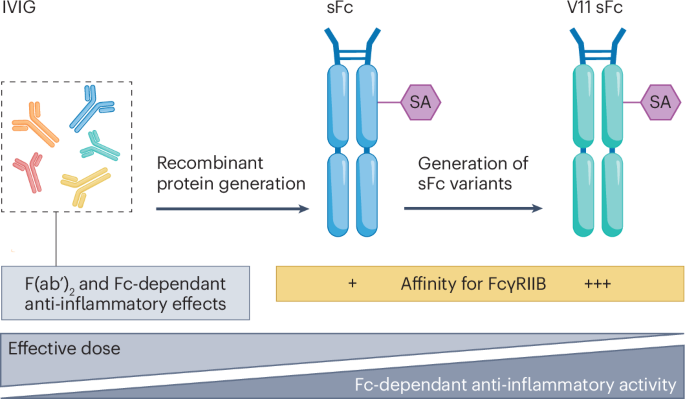
Jones, A. T., Marino, A. E., Martynyuk, T., Bournazos, S. & Ravetch, J. V. The anti-inflammatory activity of IgG is enhanced by co-engagement of type I and II Fc receptors. Science 390, eadv2927 (2025).
Schwab, I. et al. Broad requirement for terminal sialic acid residues and FcγRIIB for the preventive and therapeutic activity of intravenous immunoglobulins in vivo. Eur. J. Immunol. 44, 1444–1453 (2014).
Pincetic, A. et al. Type I and type II Fc receptors regulate innate and adaptive immunity. Nat. Immunol. 15, 707–716 (2014).
Temming, A. R. et al. Human DC-SIGN and CD23 do not interact with human IgG. Sci. Rep. 9, 9995 (2019).
Samuelsson, A., Towers, T. L. & Ravetch, J. V. Anti-inflammatory activity of IVIG mediated through the inhibitory Fc receptor. Science 291, 484–486 (2001).
Spirig, R. et al. rIgG1 Fc hexamer inhibits antibody-mediated autoimmune disease via effects on complement and FcγRs. J. Immunol. 200, 2542–2553 (2018).
Abdeldaim, D. T. & Schindowski, K. Fc-engineered therapeutic antibodies: recent advances and future directions. Pharmaceutics 15, 2402 (2023).
Rambabu, N. et al. Regulation of immune cell metabolism by therapeutic normal IgG intravenous immunoglobulin. J. Allergy Clin. Immunol. 156, 418–432 (2025).