

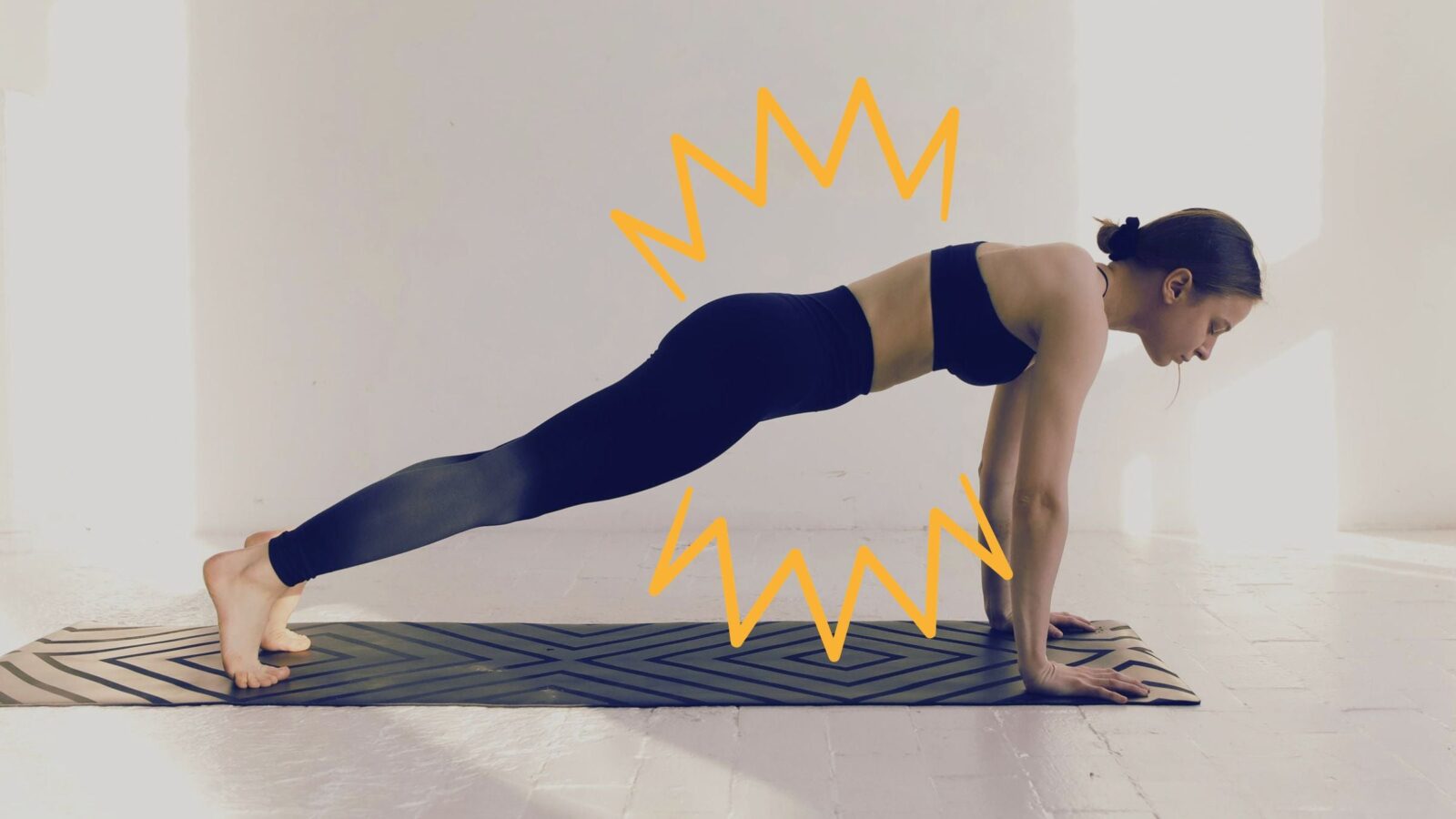
There’s strength in surrendering your expectations.
(Photo: Polina Tankilevitch | Pexels)
Published April 5, 2026 11:42AM
I’ve heard a lot of people’s opinions about muscle shaking during physical movement through my decades at various gyms, Pilates studios, and yoga classes. “That’s how you know it’s working,” I once heard a Pilates teacher advise me while I was holding a Bird Dog variation, balancing my bodyweight on three limbs, my core flopping like a fish out of water against the reformer pulleys. (I’m still not sure what was supposed to be working—my muscles or the diabolical exercise routine?)
Shaking in response to tremendous effort has also been normalized in a lot of the yoga classes I’ve taken, albeit without the gritty “pain is gain” subtext. Many yoga teachers have nodded their heads approvingly as I’ve struggled to stay upright in Boat Pose. So much so that I reminded myself of the ship in The Perfect Storm—fighting to hang on but destined to sink.
So yes, I’ve received the message many times that trembling during a physical challenge is (mostly) safe. I wasn’t experiencing pain and my muscle shaking didn’t continue once I released the pose. My issue was much more…superficial. I’ll admit it. I was reeeeeally not okay with the public quaking of my body. Particularly when I was practicing in yoga studios with mirrors, I could feel the reddening of my cheeks as my core shuddered while keeping my knees off the mat in Plank or my entire body balanced in Triangle Pose.
I tried to assuage my embarrassment by reminding myself what several teachers had repeatedly assured me—that shaking means I’m getting stronger. Besides, my practice isn’t supposed to be perfect.
Still, I couldn’t help comparing myself to others in class whose bodies looked as solid and unmoving as boulders compared to my quivering like a leaf in the wind or flapping like butterfly wings or, well, you get the point.
On top of all this self-consciousness, I couldn’t reconcile another commonly issued piece of yoga teacher advice—to find ease in a pose—with the experience of battling my body into position. Ease? Never met her.
Recently, though, my perspective changed. Stationed safely toward the back of a three-student yoga class (with no mirrors in the room!), I was quietly savoring the privacy of having the back row all to myself. The teacher cued us into my aforementioned nemesis, Bird Dog. I begrudgingly assumed all fours and reached one arm and the opposite leg off the mat. Immediately, my muscles started rippling, pulling me off balance toward one side, then the other, in quick little spurts and shakes.
I almost called it quits and retreated to Child’s Pose, but I decided to hold out for a few more seconds. In a sense, I did give up—but not on the pose. I gave up fighting the shaking. Assured that no one else’s eyes were on me, I let myself succumb to the very thing I’d been staving off—the fact that I couldn’t remain still in a pose. I assumed my body would start flailing even worse than before and that I’d fall or flop onto the mat with a dramatic thunk. But neither of those things happened.
I didn’t realize it until that moment, but by resisting my shaking, I was making it worse. My body felt restricted within the couple inches of range I gave it. When I accepted my shaking? When I told my body it was allowed to shake? That was a different story. Instead of my limbs wobbling frenetically and my muscles flinching as if they were cramping up, my movement became more easeful. No, I wasn’t in the technically “correct” position for very long. But I felt stronger and more solid than I had when I was trying so hard.
The best part? I didn’t have any thoughts like “I’m not strong enough for this pose.” I appreciated the fact that my body was creating its own version of the position, that I could trust my limbs to perform their impromptu dance, and that my core was strong enough to support this fluidity.
Now, I think about muscle shaking very differently. Instead of framing it as a sign that I’m getting stronger or weaker, or even letting it trigger my perfectionism, it brings up a different set of ideas. What happens when my reality doesn’t live up to expectations? Can I meet myself where I am and not fight it so much? Could it be that there’s something deeper, truer, and more authentic to me underneath all the fear? Sure, that might be a lot to attribute to muscle shaking. But then again, that’s why I show up to the mat.