

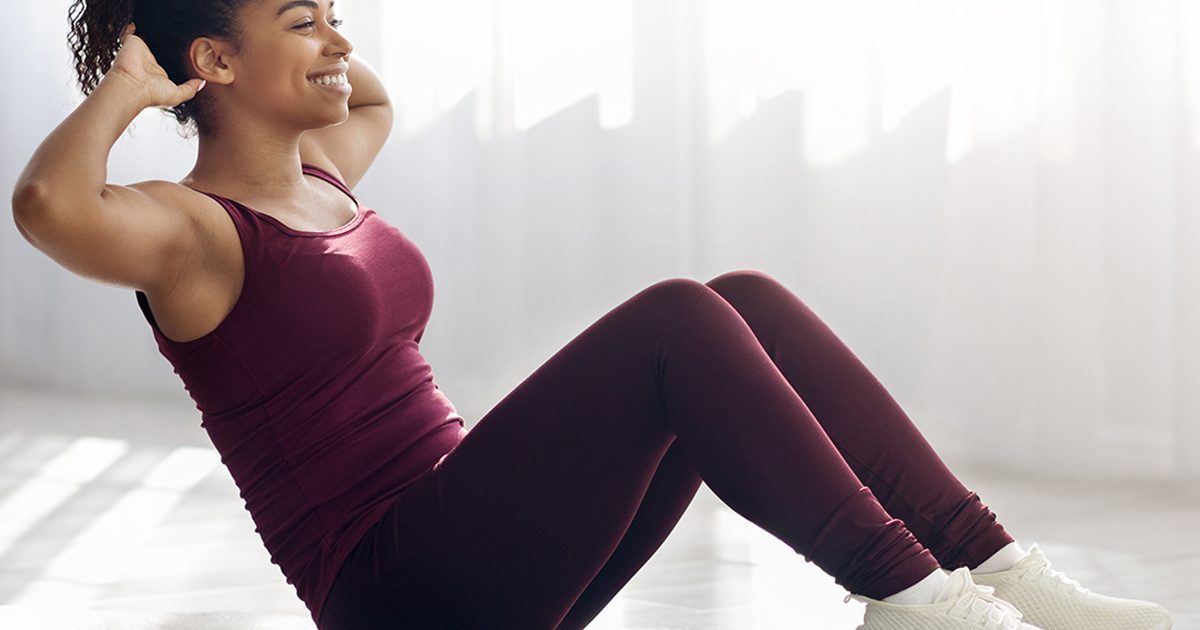
In the fitness world, you often hear “abs are made in the kitchen”. But that’s not entirely true. Abs are revealed in the kitchen, but they’re built in the gym. The abdominal muscles are like any other and develop through resistance training. However, if your body fat levels aren’t low enough, you’re less likely to see those hard-earned muscles. You can’t spot-reduce body fat, which is why a sustainable calorie deficit created through balanced nutrition is the best way to lose body fat. Bear in mind, however, that genetics play a role in where we store fat. Women are more likely to have fat around their lower stomachs than men and also experience fluctuations due to the menstrual cycle. Regardless of your body fat levels, having a strong core and abs are important for good posture, mobility and spine support.
Whether you’re working out at home or in the gym, building muscle requires resistance training with progressive overload, meaning gradually increasing the weights or reps, or decreasing rest between sets. You don’t need to train every day — in fact, allowing your muscles enough recovery time between workouts is key for growth. Make sure to fuel your workouts and help your body recover by eating a balanced diet with plenty of protein.
What are lower abdominal muscles and why are they important?
Personal trainer Luke Worthington thinks of the core as being like a corset that keeps your upper and lower body together. Its role is to provide stability to the lumbar spine, almost like an inbuilt brace, as well as to transmit force between the upper and lower body. The core isn’t just the abs but is actually a group of muscles including the pelvic floor, obliques and back. It’s important to train all parts of the core and think about resisting movement in all directions: side to side, forwards and backwards, and rotation. “Your core should be able to keep you upright or neutral against forces in all three of those planes,” Worthington said.
How to prepare for a lower ab workout
Before a workout, set yourself up with enough space, a comfortable temperature, unrestrictive clothing and a gym mat. If you have any specific health conditions, consult a doctor before starting a new workout routine.
5 best lower ab exercises for a home workout
Whatever exercise you’re doing, perform controlled, smooth movements and focus on maintaining your form and engaging your core.
The first two exercises below are designed for alignment, making sure your ribs and pelvis are stacked so you can get the most out of the main exercises. If you’re out of alignment, for example with your ribs flaring, you might find your hip flexors or lower back muscles take over rather than the lower abs. With all the exercises, the goal is control, not fatigue. “Fewer exercises, done well, are more effective than long lists of movements,” Worthington said.
Alignment exercise 1: 90-90 hip lifts

- Lie on your back with your feet flat on a wall. Hips and knees at roughly 90 degrees and feet hip-width apart. Arms relaxed by your sides.
- Place a rolled towel or soft ball between the knees. Lightly squeeze the towel/ball with the knees to engage the inner thighs.
- Gently lift the tailbone off the floor so the lower back rounds slightly.
- Slowly exhale through the mouth, letting the ribs come down. Pause briefly at the end of the exhale. Inhale through the nose, maintaining the position.
- Repeat for slow, controlled breaths.
This exercise is about position, not strain, so avoid aggressive bracing. Engaging the hamstrings and inner thighs help orient the pelvis and thus allow the lower abs to fire.
Alignment exercise 2: All-fours belly breathing

- Start on your hands and knees with hands under shoulders and knees under hips. Keep your spine neutral – no sagging or rounding. Head relaxed, eyes looking down.
- Inhale slowly through the nose, directing the breath into the belly. Feel the abdomen gently expand without the ribs flaring or the spine moving.
- Exhale fully through the mouth, allowing the abdominal wall to draw back in. Maintain the same spinal position throughout.
- Repeat for slow, controlled breaths.
Avoid bracing, aggressively pushing the belly out or shifting your weight backwards or forwards.
Deadbugs

- Start by lying on the floor with as much of your spine in contact with the ground as possible.
- Raise your arms straight upwards towards the ceiling and raise your legs so that your hips and knees are both bent at 90 degrees. Your shins should be parallel to the ground and the ceiling.
- From the starting position, lower one arm to the ground above your head (keeping it straight) while extending and lowering the opposite leg until it’s stretched out and hovering above the floor. Push the heel away from you and exhale as you do.
- Slowly return both limbs to the starting position before repeating on the other side.
- Don’t lose contact between your spine and the floor and think about maintaining the rib and pelvic positions as the arms and legs move. When you can no longer maintain good form, stop.
Wall-press deadbugs

This slightly more challenging version of a deadbug increases the demand on the abs, reduces hip-flexor dominance and makes it easier to feel the lower abdomen working.
- Set yourself up on your back like a normal deadbug but position your head adjacent to a wall with your hands pressing into a wall.
- Hold that position with your upper body while you lower one leg at a time and return to the table-top position, like a regular deadbug.
The harder you push into the wall, the more activation is required from the lower abs.
Reverse crunches

This is the most challenging variant for more advanced levels.
- Set yourself up in the same starting position as for wall-press deadbugs.
- Pull your knees towards your elbows by tilting the pelvis towards you and lifting your tail bone off the floor.
- Lower and repeat.
It’s a tiny movement – make sure you’re using the lower abdominals to tilt the pelvis. If you’re lifting your bum all the way off the floor, you’re using the weight of your legs to roll backwards. Think about curling the pelvis rather than lifting your feet.
Enjoyed this? Read more of our fitness guides
The best home gym equipment to buy
How to winter-proof your workout
How long does it take to build muscle?
How much exercise should I do each day?
How to fuel your body like an athlete
All health content on goodfood.com is provided for general information only, and should not be treated as a substitute for the medical advice of your own doctor or any other health care professional. If you have any concerns about your general health, you should contact your local health care provider. See our website terms and conditions for more information.