

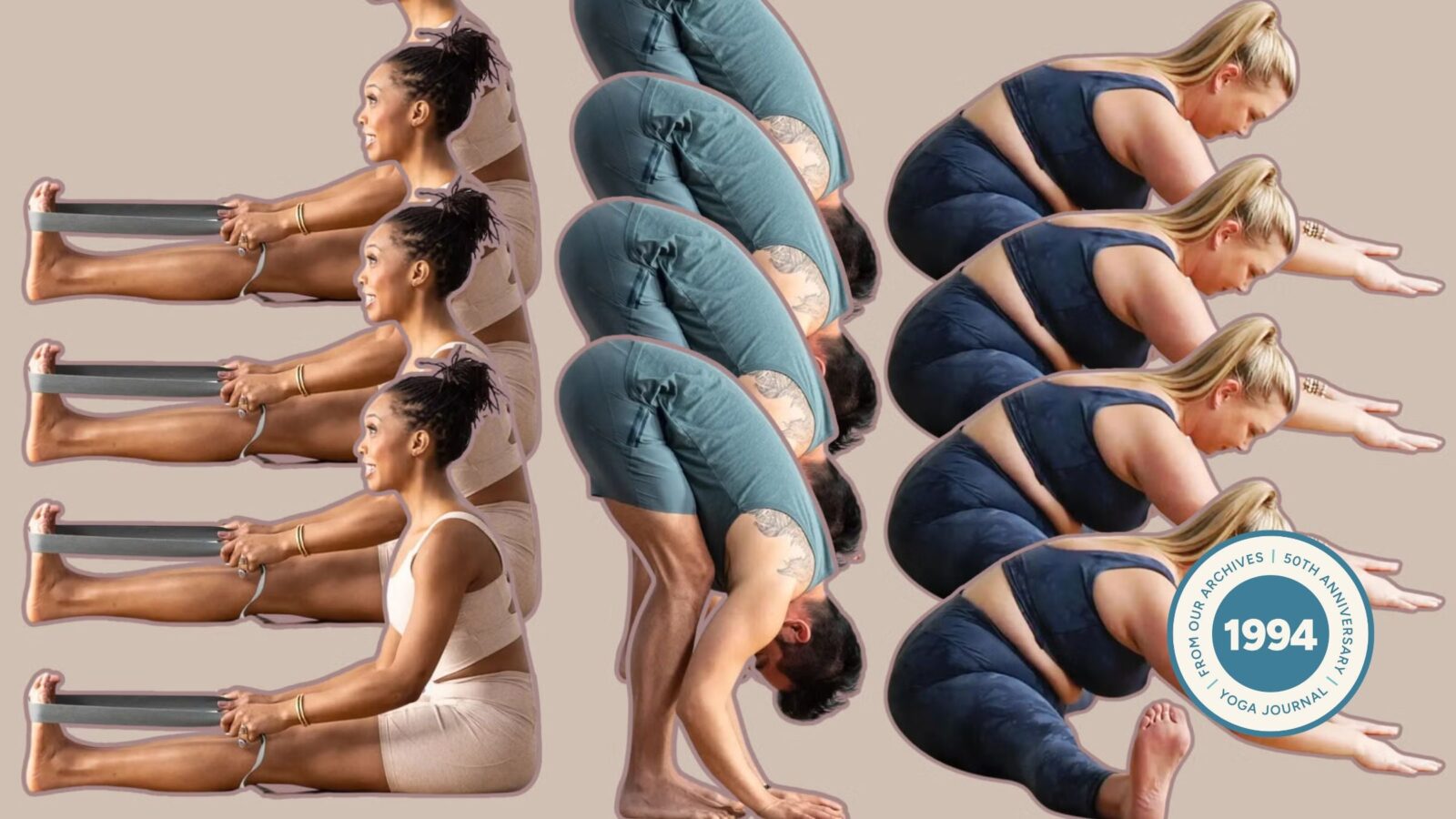
These postures strengthen the spine and soothe the nervous system.
(Photo: Andrew Clark; Design in Canva)
Updated April 22, 2026 05:32PM
Yoga Journal’s archives series is a curated collection of articles originally published in past issues beginning in 1975. This article about forward bends first appeared in the May-June 1994 issue of Yoga Journal.
In the sitting forward bends, the torso and head close over the legs, inviting our awareness to turn inward toward the Self. Physically, poses like forward fold stretch and strengthen the legs, hips, back, and spine; emotionally, they soothe the brain and nervous system.
For many beginners, forward bends are limited by tightness in the hamstring muscles at the back thighs. When moving into a forward bend, the pelvis needs to rotate on the thigh bones, an action that can’t happen if the hamstrings are unforgiving.
Never try to force your pose by bending from the waist and shortening the distance from navel to sternum—your back won’t like it. Always keep the front torso long, even if it means staying relatively upright. Don’t expect to fold the torso onto the legs like an accomplished yogi until your practice is more established.
How to Practice Forward Bends
Have a firm, thickly folded blanket and a long strap ready for your practice. The blanket raises the sitting bones off the floor and helps release the pelvis to protect the lower back. The strap guides your movement forward and extends your reach, since most beginners can’t comfortably hold the feet in a forward bend.
The following routine of three basic postures can be done as a short practice session or integrated into a longer one. The first posture is a warm-up stretch for the legs; the second will teach you how to work the legs and lengthen the spine in sitting forward bends; and the third will prepare you for all of your deeper work with forward bends. You might want to release the spine after each posture with a simple twist.
1. Warm-Up Wall Stretch
Lie on your back with legs straight and heels pressed firmly into a wall. Exhaling, bring the right knee toward the chest, wrap the hands around the shin, and, for a few breaths, gently squeeze the thigh toward the abdomen. Keep the left leg active by pushing the heel into the wall.
Then bring the strap around the ball of the right foot, exhale, and stretch the leg upward, walking your hands along the strap until the arms are straight. Hold the strap lightly to challenge the muscles of the thigh and hip to keep the leg in place.
Stretch evenly along the back of the leg from heel to sitting bone, and protect the knee by keeping the front thigh firm.
Begin with a pleasant stretch of the back of the raised leg and only gradually increase the work as you feel the muscles accept the posture. Hold for one to two minutes, then exhale the leg onto the floor and pause to compare the feeling in the two legs. Repeat for an equal time on the left.
2. Seated Forward Bends
Now roll to your side and sit near the front edge of the folded blanket with legs straight. Loop the strap around the balls of both feet and hold it firmly, hands separated and arms long. Press the legs down and lift the front torso—and thus the spine—vertically, belly soft and shoulder blades descending to the waist. Stay for a minute or two.
If you’d like to go further, release the strap and press the hands onto the floor beside the hips, without losing the lift of the torso or the strength of the legs. Hold for another 30 seconds.
3. Deepening Your Forward Bends
Next bend the left knee and draw the heel to the right groin, dropping the knee outward onto the floor. If the knee doesn’t rest on the floor, don’t force it down, but prop it on a folded blanket. If you feel any pain in that knee, raise it even higher and unbend it a little.
Loop the strap around the ball of the right foot and, breathing softly and evenly, move forward on an exhalation by walking the hands lightly along the strap, arms long, lengthening the torso forward from the hips, until you feel a satisfying stretch.
When you feel confident in these postures, you might gradually prolong the time you spend in each from three to five minutes and also experiment with a few of the more challenging forward bends.