

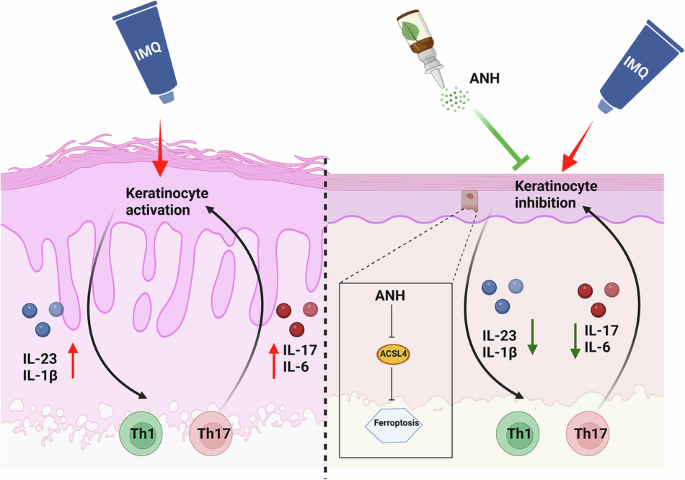
Kong, Y. et al. Narciclasine inhibits phospholipase A2 and regulates phospholipid metabolism to ameliorate psoriasis-like dermatitis. Front. Immunol. 13, 1094375 (2022).
Garzorz-Stark, N. & Eyerich, K. Psoriasis pathogenesis: keratinocytes are back in the spotlight. J. Invest. Dermatol. 139, 995–996 (2019).
Chen, W. Y. et al. Annoying psoriasis and atopic dermatitis: a narrative review. Int. J. Mol. Sci. 23, 4898 (2022).
Stoffel, E. et al. Analysis of anti-tumour necrosis factor-induced skin lesions reveals strong T helper 1 activation with some distinct immunological characteristics. Br. J. Dermatol. 178, 1151–1162 (2018).
Raiol, T. K. et al. Leprosy associated with psoriasis. Lepr. Rev. 86, 368–373 (2015).
Weng, Z. et al. Shikonin promotes ferroptosis in HaCaT cells through Nrf2 and alleviates imiquimod-induced psoriasis in mice. Chem. Biol. Interact. 27, 110788 (2023).
Puig, L. et al. Generalized pustular psoriasis: a global Delphi consensus on clinical course, diagnosis, treatment goals and disease management. J. Eur. Acad. Dermatol. Venereol. 37, 737–752 (2023).
Parisi, R. et al. National, regional, and worldwide epidemiology of psoriasis: systematic analysis and modelling study. BMJ 369, m1590 (2020).
Lu, H. et al. Effect of traditional chinese medicine on psoriasis vulgaris: a meta-analysis and systematic review. Complement. Med. Res. 30, 63–77 (2023).
Feng, W. et al. Immunoregulatory effects of traditional Chinese medicine and its ingredients on psoriasis. Int. Immunopharmacol. 159, 114896 (2025).
Ding, J. et al. Cancer-related therapeutic potential of epimedium and its extracts. Nutr. Cancer. 76, 885–901 (2024).
Zhang, X. et al. Advancements in the biotransformation and biosynthesis of the primary active flavonoids derived from epimedium. Molecules 28, 7173 (2023).
Wang, H. et al. Anhydroicaritin suppresses tumor progression via the PI3K/AKT signaling pathway in hepatocellular carcinoma. Aging (Albany, NY) 15, 7831–7843 (2023).
Li, F. et al. Anhydroicaritin inhibits EMT in breast cancer by enhancing GPX1 expression: a research based on sequencing technologies and bioinformatics analysis. Front. Cell Dev. Biol. 9, 764481 (2021).
Zheng, Z. G. et al. Anhydroicaritin, a SREBPs inhibitor, inhibits RANKL-induced osteoclastic differentiation and improves diabetic osteoporosis in STZ-induced mice. Eur. J. Pharmacol. 809, 156–162 (2017).
Shi, Y. et al. Identifying the anti-metastasis effect of Anhydroicaritin on breast cancer: Coupling network pharmacology with experimental validation. J. Ethnopharmacol. 293, 115326 (2022).
Hao, M. et al. Schisandrol A-loaded mesenchymal stem cell exosomes modulate FTO/miR-21/WNT5A axis to promote skin healing. Phytomedicine 146, 157088 (2025).
Shao, Y. et al. MSC-EVs alleviate sepsis-induced acute lung injury through inhibiting NET-triggered damage to adherens junctions of endothelial cells. Mol. Immunol. 185, 6–17 (2025).
Li, L. et al. Epigenetic mechanism of iPSC-MSC-EVs in colonic epithelial cell pyroptosis in ulcerative colitis cell models via modulation of ELF3/miR-342-3p/KDM6B axis and histone methylation. Int. Immunopharmacol. 157, 114704 (2025).
Zhao, R. et al. Inhalation of MSC-EVs is a noninvasive strategy for ameliorating acute lung injury. J. Control. Release. 345, 214–230 (2022).
Li, R. et al. MSC-EVs and UCB-EVs promote skin wound healing and spatial transcriptome analysis. Sci. Rep. 15, 4006 (2025).
Zhou, X. et al. Engineered mesenchymal stem cell-derived extracellular vesicles scavenge self-antigens for psoriasis therapy via modulating metabolic and immunological disorders. Adv. Sci. 12, e2410067 (2025).
Gao, Y. et al. CAR T Cells Engineered to secrete ifnkappa induce tumor ferroptosis via an IFNAR/STAT1/ACSL4 axis. Cancer. Immunol. Res. 12, 1691–1702 (2024).
Yang, L. et al. Calcipotriol inhibits the proliferation of psoriasis HaCaT cells by activating the ferroptosis pathway. Acta. Histochem. 127, 152274 (2025).
Doll, S. et al. ACSL4 dictates ferroptosis sensitivity by shaping cellular lipid composition. Nat. Chem. Biol. 13, 91–98 (2017).
Quan, J. et al. ACSL family: the regulatory mechanisms and therapeutic implications in cancer. Eur. J. Pharmacol. 909, 174397 (2021).
Liu, L. & Kang, X. X. ACSL4 is overexpressed in psoriasis and enhances inflammatory responses by activating ferroptosis. Biochem. Biophys. Res. Commun. 623, 1–8 (2022).
Zhou, X. et al. Paris saponin VII attenuates psoriasiform inflammation by regulating STAT3/NFkappaB signaling pathway and Caspase-1-induced pyroptosis. Mol. Med. 31, 200 (2025).
Zhu, Y. et al. Celastrol directly targets LRP1 to inhibit fibroblast-macrophage crosstalk and ameliorates psoriasis progression. Acta. Pharm. Sin B 15, 876–891 (2025).
Wang, Z. et al. Targeting the transcription factor HES1 by L-menthol restores protein phosphatase 6 in keratinocytes in models of psoriasis. Nat. Commun. 13, 7815 (2022).
Liu, X. Q. et al. Circulating inflammatory cytokines and psoriasis risk: A systematic review and meta-analysis. PLoS ONE 18, e0293327 (2023).
Tashiro, T. & Sawada, Y. Psoriasis and systemic inflammatory disorders. Int. J. Mol. Sci. 23, 4457 (2022).
Filho, J. M. T. D. A. et al. Flavonoids as photoprotective agents: a systematic review. J. Med. Plants Res. 10, 848–864 (2016).
Leng, H. et al. Effects of aloe polysaccharide, a polysaccharide extracted from Aloe vera, on TNF‑alpha‑induced HaCaT cell proliferation and the underlying mechanism in psoriasis. Mol. Med. Rep. 18, 3537–3543 (2018).
Li, Y. et al. Benzoylaconitine alleviates progression of psoriasis via suppressing STAT3 phosphorylation in keratinocytes. Molecules 28, 10 (2023).
Guo, D. et al. Liquiritin targeting Th17 cells differentiation and abnormal proliferation of keratinocytes alleviates psoriasis via NF-kappaB and AP-1 pathway. Phytother. Res. 38, 174–186 (2024).
Mota, C. M. D. & Madden, C. J. Neural control of the spleen as an effector of immune responses to inflammation: mechanisms and treatments. Am. J. Physiol. Regul. Integr. Comp. Physiol. 323, R375–R384 (2022).
Sangaraju, R. et al. Galangin ameliorates Imiquimod-Induced psoriasis-like skin inflammation in BALB/c mice via down regulating NF-kappaB and activation of Nrf2 signaling pathways. Int. Immunopharmacol. 96, 107754 (2021).
Chen, Y. H. et al. Lactobacillus pentosus GMNL-77 inhibits skin lesions in imiquimod-induced psoriasis-like mice. J. Food. Drug. Anal. 25, 559–566 (2017).
Sugumaran, D. et al. Advances in psoriasis research: From pathogenesis to therapeutics. Life. Sci. 355, 122991 (2024).
Song, C. et al. Deciphering the mechanism of Fang-Ji-Di-Huang-Decoction in ameliorating psoriasis-like skin inflammation via the inhibition of IL-23/Th17 cell axis. J. Ethnopharmacol. 281, 114571 (2021).
Lin, Y. et al. Keratin 17 in psoriasis: current understanding and future perspectives. Semin. Cell. Dev. Biol. 128, 112–119 (2022).
Shannon, E. et al. Thalidomide suppressed IL-1beta while enhancing TNF-alpha and IL-10, when cells in whole blood were stimulated with lipopolysaccharide. Immunopharmacol. Immunotoxicol. 30, 447–457 (2008).
Wu, R. et al. MicroRNA-210 overexpression promotes psoriasis-like inflammation by inducing Th1 and Th17 cell differentiation. J. Clin. Invest. 128, 2551–2568 (2018).
Tang, R. et al. ErbB4 affects Th1/Th17 cell differentiation and promotes psoriasis progression. Cell. Mol. Biol. (Noisy-le-grand) 69, 1–5 (2023).
Lu, Y. et al. Polyethylene glycol ointment alleviates psoriasis-like inflammation through down-regulating the function of Th17 Cells and MDSCs. Front. Med. (Lausanne) 7, 560579 (2020).
Ci, X. et al. Regulation of inflammatory mediators in lipopolysaccharide-stimulated RAW 264.7 cells by 2”-hydroxy-3”-en-anhydroicaritin involves down-regulation of NF-kappaB and MAPK expression. Int. Immunopharmacol. 10, 995–1002 (2010).
Alshahrani, M. Y. et al. A comprehensive insight into the immunomodulatory role of MSCs-derived exosomes (MSC-Exos) through modulating pattern-recognition receptors (PRRs). Cell. Biochem. Funct. 42, e4029 (2024).
Xu, Y. et al. Multiple strategies enhance the efficacy of MSC-Exos transplantation for spinal cord injury. Exp. Neurol. 383, 115038 (2025).
Zhao, J. et al. Erratum: Human gingiva tissue-derived MSC ameliorates immune-mediated bone marrow failure of aplastic anemia via suppression of Th1 and Th17 cells and enhancement of CD4+Foxp3+ regulatory T cells differentiation. Am. J. Transl. Res. 12, 1167 (2020).
Tang, D. et al. Thermally engineered MSC-derived extracellular vesicles ameliorate colitis in mice by restoring the imbalanced Th17/Treg cell ratio. Int. Immunopharmacol. 125, 111077 (2023).
Shou, Y. H. et al. Inhibition of keratinocyte ferroptosis suppresses psoriatic inflammation. Cell Death Dis 12, 1009 (2021).
Xie, L. et al. Protective effects of Wenqingyin on sepsis-induced acute lung injury through regulation of the receptor for advanced glycation end products pathway. Phytomedicine 129, 155654 (2024).
Gao, Y. et al. GPR97 depletion aggravates imiquimod-induced psoriasis pathogenesis via amplifying IL-23/IL-17 axis signal pathway. Biomed. Pharmacother. 179, 117431 (2024).