

Mice and immunizations
Mice
PTPMT1 floxed (RRID: IMSR_JAX: 020775) mice were purchased from The Jackson Laboratory. cGAS−/− mice were generated in-house by ivRF CECAD and kindly donated by M. Pasparakis. CHOP−/− (RRID: IMSR_JAX: 005530) were kindly donated by A. Trifunovic. PTPMT1 floxed mice were crossed to CD4-Cre mice as previously described43 or to Foxp3-YFP-Cre (RRID: IMSR_JAX: 016959) kindly donated by M. Beyer (DZNE). TAZ floxed mice74 were kindly donated by D. Strathdee (Cancer Research UK Beatson Institute) and crossed in-house with CMV-Cre mice (RRID: IMSR_JAX:006054) to generate TAZ KO mice. Mice were maintained at the ivRF CECAD Research Institute (ivRF A) or Max Planck Institute of Immunobiology and Epigenetics (ivRF B) under specific-pathogen-free conditions and cared for according to the Institutional Animal Use and Care Guidelines and under a 12-h dark–12-h light cycle in individually ventilated cages (Greenline GM500, Tecniplast) at 22 °C ± 2 °C and a relative humidity of 55% ± 5%. All mice had unlimited access to water and fed a standard chow diet (Sniff, V1554-300 or V1185-300) ad libitum. The health monitoring programme followed FELASA recommendations. Briefly, germ-free NMRI mice are used as bedding sentinels receiving dirty bedding from up to 100 other cages weekly for 3 months before being tested for all pathogens and opportunists recommended in the guidelines. Breeding of the animals was approved by Landesamt für Natur, Umwelt und Verbraucherschutz Nordrhein-Westfalen (LANUV NRW). EAE, L. monocytogenes, CD4+ T transfer studies and ISRIB treatment were approved either by the Regierungsprasidium Freiburg or by LANUV NRW. H. hepaticus infection was conducted at University of Oxford in accordance with the UK Scientific Procedures Act of 1986, and by persons holding a personal license. The project license governing the mouse studies was reviewed by the University of Oxford’s Animal Welfare and Ethical Review Board and approved by the Home Office of His Majesty’s Government. All mice were used for experiments between 9 and 12 weeks of age or at 12 months of age unless otherwise indicated. For L. monocytogenes and H. hepaticus experiments male mice were used, for EAE female mice were used, and for in vitro studies both sexes were used interchangeably (no influence or association of sex on the results was observed). Animals were randomly assigned to experimental group, and cages contained mice of all different experimental groups.
Human cells
Fresh buffy coats from healthy donors were kindly provided by the Uniklinik Köln under approval by the ethics committee. PBMCs from healthy donors and patients with Barth syndrome were collected at University of Bristol in accordance with the Helsinki Declaration with approval from the UK NHS Research Ethics committee (permit number 09/H0202/52). Age and sex of healthy donors provided by the Uniklinik Köln were blinded to the authors. Patients with Barth syndrome were males (Barth syndrome group average age 13 years, minimum 6 years, maximum 28 years; healthy donor group average age 28 years, minimum 22 years, maximum 39 years). Informed consent was provided by all patients, or by their parents, in the case of children. Human CD4+ T cells were isolated using CD4+ T cell kits (Stem Cell Technologies, 17952) and treated with DMSO or alexidine dihydrochloride (1 μM). Researchers were blinded to the identity of the donors, and age or sex matching was not performed. Sample size is indicated in the figure legends.
H. hepaticus culture and oral gavage
H. hepaticus NCI-Frederick isolate 1A (strain 51449) was grown on blood agar plates containing 7.5% laked horse blood (Thermo Scientific) and Skirrow Campylobacter supplement (Oxoid) under microaerophilic conditions at 37 °C with agitation. Cultures were expanded for 48 h in Tryptone Soy Broth (Fisher) containing 10% FCS (Gibco) and the above antibiotics. The concentration of bacteria was determined by optical density (OD) analysis at 600 nm. Mice were fed 1 × 10⁸ colony-forming units of H. hepaticus (equivalent to 1 OD unit) by oral gavage using a curved 22-gauge needle for a total of two doses 24 h apart.
L. monocytogenes immunization
Age- and sex-matched mice were injected intravenously (i.v.) as previously described43 with a sublethal dose of 1 × 10⁶ colony-forming units of recombinant L. monocytogenes expressing OVA deleted for actA (LmOVA ΔActa) for primary immunizations.
Mouse EAE model
EAE was induced by immunizing mice subcutaneously with 200 μg of myelin oligodendrocyte glycoprotein peptide (MOG35–55: MEVGWYRSPFSRVVHLYRNGK) emulsified in complete Freund’s adjuvant (supplemented with killed Mycobacterium tuberculosis strain H37RLa) and intraperitoneal injections of 200 ng pertussis toxin (Hooke Labs) at the time of immunization and 24 h later. The disease was scored daily on a scale of 0–5 as follows: 0, no overt signs of disease; 1, limp tail; 2, limp tail plus hindlimb weakness; 3, hindlimb paralysis; 4, hindlimb and forelimb paralysis; 5, moribund. At the end of experiment, the mice were euthanized for analysis of the T cells infiltrated into the brain and spinal cord. Mice that did not develop symptoms of EAE were not excluded from the analysis.
T cell transfer colitis model
For experiments involving the co-transfer of naive CD4+ T cells with Treg cells, we adoptively transferred into 12-week-old Rag2−/− recipient mice (Jackson) by intravenous injection 4 × 10⁵ naive CD4+ T cells (CD45RbhiCD25−CD44loCD62L+) from CD45.1 mice with 1.5 × 10⁵ Treg cells (day 4 after CD4+ T cell isolation and Treg cell differentiation) from either PTPMT1 ΔT mice or their WT littermate controls.
In vivo ISRIB treatment
Mice were administered 5 mg per kg per day ISRIB (SIGMA), dissolved with heat in 40% saline, 50% polyethylene glycol, 10% DMSO or vehicle alone intraperitoneally daily for 4 weeks.
Mouse cell isolation and culture
Isolation of lymphocytes from the spleen and mLNs
Spleens and lymph nodes were collected from 8–12-week-old mice and mashed with a syringe plunger in a Petri dish with 5 ml of T cell medium (TCM; 1640 RPMI with 10% FCS, 4 mM L-glutamine, 1% penicillin–streptomycin, 55 mM β-mercaptoethanol). The cell suspension was filtered through a 70-μm strainer, centrifuged at 400g for 5 min at 4 °C and resuspended in 1 ml of LCK (Thermo Fisher Scientific, A1049201) to lyse red blood cells. After 3 min TCM was added, and the cell suspension was centrifuged at 400g for 5 min at 4 °C. The pellet was resuspended in 1 ml of TCM and filtered through 40-μm cell strainers.
Isolation of lymphocytes from the small intestine
Following collection, fat tissue bordering the small intestine and Peyer’s patches was removed. Small intestines were cut open, washed with ice-cold 1× PBS + 25 mM HEPES (Sigma-Aldrich, 83264-100ML-F), cut into 2-cm-long pieces and collected in medium containing RPMI 1640 (Thermo Fisher Scientific, 21875158), 25 mM HEPES (Sigma-Aldrich, 83264-100ML-F), 3% FCS (Gibco, 26140079), 4 mM glutamine (Life Technologies, 25030-024), 1% penicillin–streptomycin (Life Technologies, 15140-122) and 55 μM β-mercaptoethanol (Thermo Fisher Scientific, 21985023; hereafter named 3% FCS medium). Small intestines were incubated in 3% FCS medium supplemented with 5 mM EDTA (Thermo Fisher Scientific, 15575020) and 1 mM dithiothreitol (DTT; Sigma-Aldrich, 10197777001) for 25 min, at 37 °C, 5% CO2 and agitation (first incubation). After the incubation, cells in suspension were collected, consecutively strained through 100-μm and 40-μm strainers, washed and kept as the intraepithelial lymphocyte (IEL) fraction. The leftover small intestine pieces were thoroughly washed (four times) by shaking with ice-cold medium containing RPMI 1640, 25 mM HEPES (Sigma-Aldrich, 83264-100ML-F), 4 mM glutamine, 1% penicillin–streptomycin and 55 μM β-mercaptoethanol (hereafter named serum-free medium) added with 2 mM EDTA. Washed small intestine pieces were then finely chopped and incubated in serum-free medium added with 100 μg ml−1 Liberase TL (Roche, 05401020001) and 50 μg ml−1 DNase I (Sigma-Aldrich, 10104159001) for 35 min, at 37 °C, 5% CO2 and agitation (second incubation). After digestion, suspensions were strained through 70-μm strainers, washed and kept as the lamina propria fraction. Lamina propria and IELs were enriched for leucocytes using a three-layered Percoll (Merck, 17089101) gradient (Percoll 75%, 40% and 30%), centrifuged for 20 min at room temperature, at 680g, without any centrifuge acceleration and brake. The leucocyte layer between Percoll 75% and 40% was collected as the enriched lamina propria or IEL fraction, extensively washed and suspensions used for downstream applications.
Isolation of lymphocytes from the colon
Colons were isolated, cleaned, cut into small pieces, washed twice in RPMI 5% FCS supplemented with 5 mM EDTA and then once in RPMI 5% FCS containing 15 mM HEPES in a shaking incubator at 200 rpm for 20 min at 37 °C (IECs). Tissue digestion was performed in RPMI 5% FCS containing 1 mg ml−1 type VIII collagenase (Sigma-Aldrich, C2139-500MG) and 40 mg ml−1 DNase I (Sigma-Aldrich, 10104159001) at 37 °C for 60 min on a shaker at 200 rpm. Supernatants were then filtered on a 70-μm strainer, and a three-layered Percoll gradient (Percoll 75%, 40% and 30%) was used to obtain an enriched leucocyte fraction (layer between Percoll 75% and 40%).
Isolation of lymphocytes from liver, lung, kidney and brain
Whole liver was collected in ice-cold complete medium, finely chopped and incubated in RPMI 1640 supplemented with 1 mg ml−1 collagenase IV (Sigma-Aldrich, C2139-500MG) and 50 μg ml−1 DNase I (Sigma-Aldrich, 10104159001) for 45 min, at 37 °C, 5% CO2 and agitation. After digestion, suspensions were strained through 70-μm strainers, washed and enriched for leucocytes using Percoll 33% and centrifuging them for 20 min at room temperature, at 680g. The leucocyte pellet was collected, extensively washed, red blood cell lysis was performed and suspensions used for downstream applications. Lungs and kidneys were collected in ice-cold complete medium, finely chopped and incubated in complete medium added with 2 mg ml−1 collagenase IV (Sigma-Aldrich, C2139-500MG) and 50 μg ml−1 DNase I (Sigma-Aldrich, 10104159001) for 45 min, at 37 °C, 5% CO2 and agitation. Brains were collected in ice-cold complete medium, finely chopped and incubated in complete medium added with 2 mg ml−1 collagenase II (Sigma-Aldrich, C2139-500MG) and 50 μg ml−1 DNase I (Sigma-Aldrich, 10104159001) for 1 h, at 37 °C, 5% CO2 and agitation. After digestion, lung, kidney and brain suspensions were strained through 70-μm strainers, washed and enriched for leucocytes using a three-layer Percoll gradient (Percoll 75%, 40% and 30%), centrifuged for 20 min at room temperature, at 680g, without any centrifuge acceleration or brake. The leucocyte layer between Percoll 75% and 40% was collected, extensively washed and suspensions used for downstream applications.
CD4+ T cell isolation and differentiation
Lymphocytes were isolated from spleen and peripheral lymph nodes as described above. Purification of CD4+ T cells for cell culture was performed using the mouse CD4+ T cell isolation kit (Stem Cell Technologies, 19852), following the manufacturer’s instructions. Isolated CD4+ T cells (1 × 10⁶ per ml) were activated using a 48-well plate (Polycarbonate cell culture insert in multi-well plates; Falcon, 353078) coated with aCD3 (5 mg ml−1; Bio X Cell, BE0002) and soluble aCD28 (0.5 mg ml−1; Bio X Cell, BE0015-1) in TCM (described above) supplemented with 100 U ml−1 human recombinant IL-2 (10 ng ml−1; PeproTech, 200-02), TGF-β (10 ng ml−1; Thermo Fisher Scientific, 100-21-100UG), anti-IFNγ (4 μg ml−1; Bio X Cell, BP0055), anti-IL-4 (4μg ml−1; Bio X Cell, BP0045) to differentiate CD4+ T cells into Treg cells. Cells were supplemented with 100 U ml−1 human recombinant IL-2 (10 ng ml−1; PeproTech, 200-02), IL-12 (10 ng ml−1; PeproTech, 210-12) and anti-IL-4 (4μg ml−1; Bio X Cell, BP0045) to differentiate CD4+ T cells into TH1 cells. Cells were supplemented with 100 U ml−1 human recombinant IL-2 (10 ng ml−1; PeproTech, 200-02), IL-4 (10 ng ml−1; PeproTech, 214-14) and anti-IFNγ (4 μg ml−1; Bio X Cell, BP0055) to differentiate CD4+ T cells into TH2 cells. Cells were supplemented with TGFβ (5 ng ml−1; Thermo Fisher Scientific, 100-21-100UG), IL-6 (10 ng ml−1; PeproTech, 216-16-100), IL-1β (10 μg ml−1; PeproTech, 100947), anti-IFNγ (10 μg ml−1; Bio X Cell, BP0055) and anti-IL-4 (10 μg ml−1; Bio X Cell, BP0045) to differentiate CD4+ T cells into TH17 cells. Cells were cultured under 5% CO2, atmospheric oxygen, at 37 °C in a humidified incubator for 4 days following activation. Where indicated cells were treated with vehicle control (DMSO), 1 μM (24 h) or 4 μM (6 h) alexidine dihydrochloride (Sigma, A8986), 1 µM ISRIB (Merk, SML0843), 1 μM oligomycin (Merck, O4876), 100 nM rotenone (Merck, R8875), 1 μM antimycin A (Merck, A8674), 50 μg ml−1 cycloheximide (Merck, C4859), 0.1 mM L-HPG (Sigma, 900893) and 50 μg ml−1 puromycin (Sigma, P9620).
CRISPR–CAS KO generation
The following gRNA was used to target the gene Pgs1: Mm.Cas9.PGS1.1.AA. The following guide was used as non-targeting control: Mm.Cas9.GCGAGGTATTCGGCTCCGCG. All guides were purchased from IDT. To prepare the targeting gRNA–Cas9 complex, equimolar amounts (180 pmol) of Alt-R CRISPR–Cas9 tracrRNA (IDT) and gene-specific crRNA (indicated above) were mixed, incubated for 5 min at 98 °C and cooled at room temperature for 20 min. In total, 60 pmol of recombinant Cas9 (IDT) was mixed and incubated for another 20 min. Naive CD4+ T cells (5 × 10⁶) isolated from PTPMT1 WT and PTPMT1 ΔT mice were electroporated using the P4 Primary Cell 4D-Nucleofector X Kit and the prepared gRNA–Cas9 complexes.
Suppression assay
After spleen processing, 50 × 103 cells per well in triplicate were irradiated at 35 Gray and were used as feeder in culture. CD4+CD25+ Treg cells (Stem Cell Technologies, 18783A) and CD8+ (target population; Stem Cell Technologies, 19853) were isolated from the total splenocytes with the corresponding T Cell Isolation Kit according to the manufacturer’s instructions. After cell count, to monitor the proliferation, CD8+ cells were incubated with 10 mM CFSE dye (Thermo Fisher Scientific, C34554) in complete RPMI medium, for 15 min at 37 °C (up to 15 × 106 cells in 1 ml of medium), whereas Treg cells were labelled in the same conditions with 10 mM Cell Trace Violet dye (Thermo Fisher Scientific, C34557). Following the incubation, an isovolume of FBS was added to both cell suspensions to stop the labelling, after centrifugation at 450g for 5 min, cells were washed in PBS 1× by centrifugation in 1600 RPMI for 10 min. Finally, CD8+ cells, Treg cells and feeders were resuspended at a concentration of 50 × 103 cells in 50 ml. Treg cells and CD8+ cells were cultured at a constant 1:1 ratio with aCD3 (1 mg ml−1; Bio X Cell, BE0002). Cells were cultured for 4 days at 37 °C in a humidified 5% CO2 atmosphere. After culture, a multiparametric flow cytometry analysis was performed. The magnitude of proliferation was analysed by the dilution of the proliferation dyes in the gated Treg/CD8+ population.
Proliferation assay
Freshly isolated CD4+ T cells were stained with Cell Trace Violet (Thermo Fisher, C34557) according to manufacturer’s protocol. Briefly, cells were stained for 20 min in PBS with Cell Trace Violet. The reaction was stopped by adding a volume of RPMI + 10% FBS. Cells were then activated according to the CD4+ T cell activation and differentiation protocol. Four days after activation proliferation was measured as dye dilution by flow cytometry.
Flow cytometry
Fluorochrome-conjugated antibodies were purchased from eBioscience, BD Bioscience and BioLegend. Cells were detected using Fortessa flow cytometers and analysed using FlowJo software (BD Bioscience). Cell viability was quantified by flow cytometry using LIVE/DEAD aqua or near-IR dyes (Invitrogen) following the manufacturer’s instructions. For intracellular cytokine staining, cells were reactivated with 50 ng ml−1 phorbol 12-myristate 13-acetate + 500 ng ml−1 ionomycin (all Sigma) and cultured in the presence of Brefeldin A for 4 h before fixation using Cytofix Cytoperm (BD Bioscience).
Metabolic phenotyping
OCRs and ECARs were measured in XF media (non-buffered RPMI 1640 containing 25 mM glucose, 2 mM L-glutamine and 1 mM sodium pyruvate) under basal conditions and in response to 1 μM oligomycin, 1.5 μM FCCP and 100 nM rotenone + 1 μM antimycin A, using a 96-well XF or XFe Extracellular Flux Analyzer (EFA; Seahorse Bioscience). Around 2 × 10⁵ T cells per well were spun onto poly-D-lysine-coated Seahorse 96-well plates and preincubated at 37 °C for a minimum of 45 min in the absence of CO2.
Western blot
Cells were washed with ice-cold PBS 1× and lysed in RIPA lysis buffer 20 mM Tris-HCL (pH 7.5), 150 mM NaCl, 1 mM Na2EDTA, 1 mM EGTA, 1% Triton X-100, 2.5 mM sodium pyrophosphate, 1 mM β-glycerophosphate, 1 mM Na3VO4, 1 μg ml−1 leupeptin), supplemented with 1× Protease Inhibitor Cocktail (Cell Signaling, 5871) for 30 min, on ice, followed by centrifugation at 12,000g for 10 min, at 4 °C. Cleared protein lysate was quantified using Pierce BCA protein assay kit (23225) according to the manufacturer’s instruction. Cleared protein extracts were denatured with NuPAGE LDS loading buffer (Bio-Rad, 1610747) added with 50 mM DTT (Sigma-Aldrich, 10197777001) for 10 min at 75 °C and loaded onto precast NuPAGE 4–12% Bis-Tris protein gels (Thermo Fisher Scientific, NW04122BOX). Protein samples were run using MES buffer 1× (Thermo Fisher Scientific, NP0002) or MOPS buffer 1× (Life Technologies, NP0001). Proteins were transferred onto nitrocellulose membranes using the wet transfer in Transfer buffer (20% methanol, 1× Tris-Glycine SDS). Membranes were blocked for 1 h with 5% wt/vol BSA in TBS 1× Tween-20 0.05% and incubated with primary antibodies in 5% wt/vol BSA in TBS 1× Tween-20 0.05% overnight at 4 °C or 1 h at room temperature. All primary antibody incubations were followed by incubation with secondary horseradish peroxidase-conjugated antibodies (Pierce) in 5% wt/vol BSA in TBS 1× Tween-20 0.05% for 1 h at room temperature and visualized using SuperSignal West Pico or Femto Chemiluminescent Substrate (Pierce, 34580) using Imaging System Vilber Fusion Solos. The optical density of the signals on the film was quantified using grayscale measurements in ImageJ software (National Institutes of Health or NIH) and converted to fold change, normalized to the loading control.
Translation assays
To measure total translation, cells were treated with puromycin (10 µg ml−1) in complete culture medium for 30 min. Cells were washed with PBS and lysed, and protein concentration was determined. Equal amounts of protein (15 µg per lane) were resolved by SDS–PAGE and transferred to membranes. Membranes were incubated with anti-puromycin primary antibody (clone 12D10, Millipore, MABE343) followed by incubation with anti-mouse secondary antibody. visualized using SuperSignal West Pico Chemiluminescent Substrate (Pierce, 34580). To measure mitochondrial translation, after 1 h methionine starvation cells were pretreated 15 min with cycloheximide (CHX, Sigma, C4859) to inhibit cytoplasmic translation, then incubated for 2 h with the methionine alkyne analog L-HPG (Sigma, 900893) in presence of CHX. HPG incorporation was detected using a click chemistry approach conjugating the alkyne HPG with an Azide AF488 followed by FACS analysis.
RT–PCR
RNA was isolated using a RNeasy Mini Kit (74106, Qiagen) according to manufacturer’s instructions. RNA concentration was measured using Nanodrop 2000 (Thermo Fisher). cDNA synthesis was performed using High-Capacity cDNA Reverse Transcription Kit (4368813, Thermo Fisher) and RNasin Plus RNase Inhibitor (N2615, Promega), according to manufacturer’s instructions. Per reaction, 450–1000 ng RNA was used. RT-qPCR was performed in 384-wells plates using iTaqMan Universal Probes SuperMix (1725134, Bio-Rad), 10 ng cDNA per sample and 20× TaqMan Gene Expression Assay (Hprt: Mm03024075_m1, 4331182; Ddit3 (CHOP): Mm01135937_g, 4331182; Atf4: Mm00515325_g1, 4331182; Atf3: Mm00476033_m1, 4331182; Atf6: Mm01295319_m1, 4331182; Thermo Fisher). RT-qPCRs were performed with a QuantStudio 5 Real-Time PCR 384 well system (A28140, Thermo Fisher). Gene expression was normalized to Hprt expression. Fold change was calculated according to the delta-Ct method (2−dCt) or delta-delta-Ct method (2−ddCt).
Confocal and electron microscopy Imaging
For Confocal Microscopy imaging 3 × 10⁶ Treg cells were collected after 4 days of culture and plated on Poly-D-lysine (50 mg ml−1; Thermo Fisher Scientific, A3890401) pre-coated slides (Lab-TekII, 154534). After fixation (20 min in formaldehyde 3.7%), cells were permeabilized using Nonidet 0.04% and then stained overnight at 4 °C with TOM20 antibody (Cruz Biotechnology, sc-11415). Samples were acquired using TCS SP8, Leica Microsystems (Confocal laser scanning microscope). Volume reconstructions and analysis were performed with Imaris software.
For Electron Microscope imaging 2 × 10⁶ Treg cells were fixed 20 min RT in 2.5% glutaraldehyde in 100 mM sodium cacodylate, then washed in cacodylate buffer. After dehydration, samples were embedded in Eponate 12 resin (Ted Pella) and sections were cut. Images were acquired using a FEI Tecnai 12 Transmission electron microscope equipped with a TIETZ digital camera. Cristae width was measured using ImageJ software and averaged over 50 independent images, acquisition of EM micrographs and measurements of max cristae width displayed were performed using ImageJ software (NIH). Brightness and contrast were adjusted in ImageJ.
Tissue preparation for histology
Small intestines were dissected and washed with PBS. Small pieces (about 0.5 cm) of the small intestine were isolated from the proximal (after the stomach) and distal (before the caecum) regions, and the tissue was cut longitudinally and washed in PBS to remove faeces. Intestinal tissue samples were rolled up from proximal to distal to form a Swiss roll and either fixed in 4% paraformaldehyde overnight at 4 °C or embedded in Tissue-Tek for cryo sectioning.
H&E staining of paraffin-fixed tissues
Paraffin-embedded 3-μm-thick intestinal tissue sections were deparaffinized with xylene and rehydrated with decreasing amounts of ethanol solutions (100% ethanol, 96% ethanol and 75% ethanol). Sections were stained for 2 min in haematoxylin, differentiated in tap water for 15 min and incubated for 1 min in eosin. Stained sections were dehydrated using increasing amounts of ethanol solutions and fixed in xylene for 1 min. Slides were mounted with Entellan.
PAS staining on paraffin-fixed tissues
Paraffin-embedded tissue sections were deparaffinized and rehydrated to distilled water. Sections were incubated with freshly prepared periodic acid solution for 5–8 min, followed by two washes in distilled water (5 min each). Slides were then incubated with Schiff’s reagent for up to 20 min and washed under running tap water for 10 min. Nuclei were counterstained with haematoxylin for 5 min and rinsed under running tap water for an additional 10 min. Sections were dehydrated through graded ethanol, cleared in xylol and mounted using Eukitt or Entellan.
Immunohistochemistry on intestinal sections
Paraffin sections were rehydrated, and heat-induced antigen retrieval was performed in 10 mM sodium citrate, 0.05% Tween-20 at pH 6.2 or with proteinase K treatment. Endogenous peroxidase was blocked in peroxidase blocking buffer for 15 min at room temperature. Sections were blocked in 1% BSA, 0.2% fish-skin gelatine, 0.2% Triton X-100 and 0.05% Tween-20 in PBS for 1 h at room temperature. After blocking, the sections were incubated overnight at 4 °C with primary antibodies against CD45 (BD Bioscience, 560510, clone 30-F11, 1:500 dilution), F4/80 (AbD Serotec, MCA497, clone A3-1, 1:1,000 dilution) and CD3 (Ab5690). Sections were incubated with biotinylated anti-mouse IgG (H + L; Vector Laboratories, BA-9200-1.5, 1:1,000 dilution), anti-rabbit IgG (H + L; Vector Laboratories, BA-1000-1.5, 1:1,000 dilution) and anti-rat IgG (H + L; Vector Laboratories, BA-9400-1.5, 1:1,000 dilution) secondary antibodies. Each staining was visualized using ABC Kit Vectastain Elite (Vector, PK6100) and DAB substrate (Dako and Vector Laboratories). For image acquisition, the intestinal sections were analysed using a light microscope equipped with a KY-F75U digital camera (JVC; DM4000B, Leica Microsystems, Diskus 4.50 software), a TCS SP8 confocal laser scanning microscope (Inverse, DMi 8 CS, Leica Microsystems LAS X, Lightning software v.5.1.0). Each data point corresponds to the average values from at least three randomly selected intestinal areas of a single mouse. Representative pictures from three mice per genotype per time point were analysed.
Histopathological scoring
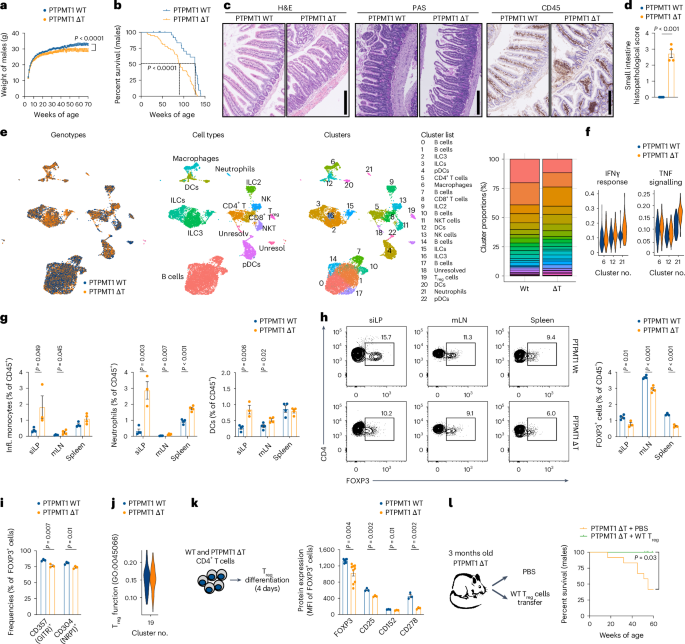
Histopathological scoring was performed using a composite system assessing epithelial hyperplasia, goblet cell depletion, inflammation and tissue involvement. Epithelial hyperplasia was scored from 0 to 3 (0, none; 1, mild, ~1.5×; 2, moderate, 2–3×; 3, severe, >3×). Goblet cell depletion was scored from 0 to 3 based on the percentage of loss (0, none; 1, mild, ~25%; 2, marked, 25–50%; 3, substantial, >50%). Inflammation in the lamina propria was graded from 0 to 3 (0, none or few leucocytes; 1, mild increase in leucocytes at crypt tips or presence of multiple lymphoid follicles; 2, moderate, marked infiltrate with notable crypt broadening; 3, severe, dense infiltrate throughout). The area affected was scored according to the percentage of the section involved.
Lipidomics
Mass spectrometry (MS)-based lipid analysis was performed by Lipotype as described75. Lipids from 10 × 106 CD4+ Treg cells per sample were extracted using a chloroform–methanol procedure76. Samples were spiked with internal lipid standard mixture containing: cardiolipin 14:0/14:0/14:0/14:0 (CL), ceramide 18:1;2/17:0 (Cer), diacylglycerol 17:0/17:0 (DAG), hexosylceramide 18:1;2/12:0 (HexCer), lyso-phosphatidate 17:0 (LPA), lyso-phosphatidylcholine 12:0 (LPC), lyso-phosphatidylethanolamine 17:1 (LPE), lyso-phosphatidylglycerol 17:1 (LPG), lyso-phosphatidylinositol 17:1 (LPI), lyso-phosphatidylserine 17:1 (LPS), phosphatidate 17:0/17:0 (PA), phosphatidylcholine 15:0/18:1 D7 (PC), phosphatidylethanolamine 17:0/17:0 (PE), phosphatidylglycerol 17:0/17:0 (PG), phosphatidylinositol 16:0/16:0 (PI), phosphatidylserine 17:0/17:0 (PS), cholesterol ester 16:0 D7 (CE), sphingomyelin 18:1;2/12:0;0 (SM) and triacylglycerol 17:0/17:0/17:0 (TAG). After extraction, the organic phase was transferred to an infusion plate and dried in a speed vacuum concentrator. The dry extract was resuspended in 7.5 mM ammonium formate in chloroform–methanol–propanol (1:2:4; vol:vol:vol). All liquid handling steps were performed using Hamilton Robotics STARlet robotic platform with the Anti Droplet Control feature for organic solvents pipetting. Samples were analysed by direct infusion on a QExactive mass spectrometer (Thermo Scientific) equipped with a TriVersa NanoMate ion source (Advion Biosciences). Samples were analysed in both positive and negative ion modes with a resolution of Rm/z = 200 = 280,000 for MS and Rm/z = 200 = 17,500 for MS/MS experiments, in a single acquisition. MS/MS was triggered by an inclusion list encompassing corresponding MS mass ranges scanned in 1-Da increments77. Both MS and MS/MS data were combined to monitor CE, DAG, TAG and TAG O- ions as ammonium adducts; LPC, LPC O-, PC and PC O- as formiate adducts; and CL, LPS, PA, PE, PE O-, PG, PI and PS as deprotonated anions. MS only was used to monitor LPA, LPE, LPE O-, LPG and LPI as deprotonated anions, and Cer, HexCer and SM as formiate adducts. Data were analysed using LipotypeXplorer, a proprietary software developed by Lipotype, which is based on LipidXplorer78,79. Data post-processing and normalization were performed using an in-house developed data management system. Only lipid identifications with a signal-to-noise ratio > 5 and a signal intensity fivefold higher than in corresponding blank samples were considered for further data analysis. PGPs were identified based on the accurate m/z of the precursor ion, species-specific fatty acids and class-specific head group fragments. Quantification was performed based on the signals of the precursor ions of the reported species.
Proteomics
CD4+ Treg cells (4 × 10⁶) were lysed in 8 M urea/50 mM TEAB buffer and sonified using Bioruptor (10 min, cycle 30/30 s). After centrifugation at 20,000g for 15 min, proteins were quantified. DTT to a final concentration of 5 mM was added to 50 µg of proteins and incubated at 25 °C for 1 h. CAA was then added to a final concentration of 40 mM, vortexed and incubated in the dark for 30 min. Lys-C protease was then added at an enzyme:substrate ratio of 1:75 and incubated at 25 °C for 4 h. After 4 h samples were diluted with 50 mM TEAB buffer to achieve a final concentration of urea ≤ 2 M. Trypsin was finally added at an enzyme:substrate ratio of 1:75 and incubated at 25 °C overnight. Then, formic acid was added to the samples to a final concentration of 1% and samples were loaded on SDB-RP stage tips. Samples were analysed by the CECAD Proteomics Facility on an Orbitrap Exploris 480 (Thermo Scientific) mass spectrometer equipped with a FAIMS pro differential ion mobility device that was coupled to an UltiMate 3000 (Thermo Scientific). Samples were loaded onto a precolumn (Acclaim 5 µm PepMap 300 µm Cartridge) for 2 min at 15 µl flow before being reverse-flushed onto an in-house packed analytical column (30 cm in length, 75-µm inner diameter, filled with 2.7 µm Poroshell EC120 C18, Agilent). Peptides were chromatographically separated at a constant flow rate of 300 nl min−1 and the following gradient: initial 6% B (0.1% formic acid in 80% acetonitrile), up to 32% B in 72 min, up to 55% B within 7 min and up to 95% solvent B within 2 min, followed by column wash with 95% solvent B and re-equilibration to initial condition. The FAIMS pro was operated at −50 V compensation voltage and electrode temperatures of 99.5 °C for the inner and 85 °C for the outer electrode. MS1 scans were acquired from 399 m/z to 1,001 m/z at at a resolution of 15,000. Maximum injection time was set to 22 ms and the automatic gain control target to 100%. MS2 scans ranged from 400 m/z to 1,000 m/z and were acquired at a resolution of 15,000 with a maximum injection time of 22 ms and an automatic gain control target of 100%. DIA scans covering the precursor range of 400–1,000 m/z were acquired in 60 × 10-m/z windows with an overlap of 1 m/z. All scans were stored as centroid. Samples were analysed in DIA-NN (1.8.1)80. A Swissprot mouse canonical database (UP589, downloaded 18 June 2020) was used for library building with settings matching acquisition parameters and the match-between-runs function enabled. Here, samples are directly used to refine the library for a second search of the sample data. DIA-NN was run with the additional command line prompts ‘–report-lib-info’ and ‘–relaxed-prot-inf’. Further output settings were: filtered at 0.01 FDR; N-terminal methionine excision enabled; maximum number of missed cleavages set to 1; minimum peptide length set to 7; maximum peptide length set to 30; minimum precursor m/z set to 400; maximum precursor m/z set to 1,000; cysteine carbamidomethylation enabled as a fixed modification. Afterwards, DIA-NN output was further filtered on library q value and global q value ≤ 0.01 and at least two unique peptides per protein using R (4.1.3). Finally, LFQ values were calculated using the DIA-NN R package. Afterwards, analysis of results was performed in Perseus (1.6.15)81. FDR q values in gene-set enrichment analysis were calculated as previously described82. Proteomics datasets are available in PRIDE under accession numbers PXD060518 and PXD071483.
RNA-seq and cluster analysis
Libraries were prepared using the Illumina Stranded TruSeq RNA sample preparation Kit. Library preparation started with 500 ng total RNA. After poly-A selection (poly-T oligo-attached magnetic beads), mRNA was purified and fragmented using divalent cations under elevated temperature. The RNA fragments underwent reverse transcription using random primers. This was followed by second-strand cDNA synthesis with DNA Polymerase I and RNase H. After end repair and A-tailing, indexing adaptors were ligated. The products were then purified and amplified (15 PCR cycles) to create the final cDNA libraries. After library validation and quantification (Agilent Tape Station), equimolar amounts of the library were pooled. The pools were quantified using the Peqlab KAPA Library Quantification Kit and the Applied Biosystems 7900HT Sequence Detection System. The pool was sequenced on an Illumina NovaSeq 6000 sequencing instrument with a PE100 protocol. RNA-seq data were analysed using the Cologne Center for Genomics’ in-house pipeline for RNA-seq analysis based on the Nextflow DSL (version 20.01.0 build 5264). In short, fastq files were adaptor-trimmed with trimmomatic (v0.38), removing sequences of length < 18 nucleotides after trimming, then mapped against the hg38 human reference genome and the gene assembly v101 using STAR aligner (v2.6.1a) with the default settings. The count matrix was generated using subread (v1.6.4) and DEGs were called with DeSeq2 (v1.20.0) with an adjusted P-value cut-off of 0.05. Overrepresented Gene Ontology biological processes and KEGG pathways were discovered using clusterprofiler (v3.17.0) on upregulated or downregulated DEGs (with an adjusted P value < 0.05 and a fold change of >2 for either upregulated or downregulated). Volcano plots were generated with bioconductor package enchancedVolcano (v1.4.0; https://github.com/kevinblighe/EnhancedVolcano) and heat maps with the heatmap.2 or pheatmap sub-function of gplots (v3.1.0 or v1.0.12, respectively; https://github.com/talgalili/gplots/ and https://github.com/raivokolde/pheatmap/, respectively). For the analysis of the transcriptomic profile of WT, CHOP KO, PTPMT1 ΔT and DKO Treg cells, the raw fastq files were processed with the nf-core/RNA-seq pipeline under Nextflow v25.04.6 build 5954 on the ITCC HPC cluster. The counts were processed using a custom DESeq2 pipeline. In short, we processed the generated gene counts table (rsem.merged.gene_counts.tsv) from the nf-core/RNA-seq pipeline with DESeq2. We extracted the genes that were significantly differentially expressed in the pairwise comparison of each condition (1,148 genes that survived the adjusted P value < 0.05 and |logFC | >1 thresholds) and performed cluster analysis using the degPatterns function from the DEGreport package (v1.42), using the following parameters: summarize = ‘merge’, minc = 15, time = ‘group’, col = ‘group’, scale = ,plot = TRUE. For the ORA analysis of the genes from the annotated clusters, we used a custom function based on the enricher function from the clusterProfiler package (v4.14.6). For the background (universe) genes, we used the genes with no P value, as identified by the independent filtering method included in the DESeq2 pipeline. The gene sets were extracted using the msigdbr function (v.25.1.1). FDR q values in gene-set enrichment analysis were calculated as previously described82. RNA-seq datasets are available in the Gene Expression Omnibus (GEO) under accession numbers GSE288709 and GSE314259.
Cytokine measurements
Cytokine concentration was measured from mouse using Luminex xMAP technology for multiplexed quantification of 32 mouse cytokines, chemokines and growth factors. The multiplexing analysis was performed using the Luminex 200 system (Luminex) by Eve Technologies. Thirty-two markers were simultaneously measured in the samples using Eve Technologies’ Mouse Cytokine 32-Plex Discovery Assay (MilliporeSigma) according to the manufacturer’s protocol.
Metagenomics
Raw reads from Illumina were demultiplexed and their quality evaluated with FastQC (v0.12)83 and multiqc (v1.14)84. Sequence adaptors were trimmed and filtered following standard procedures by using Trimmomatic (v0.39)85. Sequences coming from the host were mapped against the Mus musculus reference genome (GRCm38) and dropped using bowtie2 (v.2.5.4)86. After pre-processing the reads, taxonomy assignment was done with MetaPhlAn 4.06 using default parameters87 to capture the species level with high quality. Taxonomy and OTU table were then processed and analysed in R. The main analysis was done using tidyverse v.2.0.1 and microeco (v.1.6.0)88. To capture the beta diversity of the samples, Bray–Curtis distances were used to calculate the principal coordinate analysis. Differences between the relative abundance of species were calculated using the Wilcoxon statistical test. Graphical representation of the results was done with the R package ggplot2 v.3.5.1.
scRNA-seq
CD45+ single cells were sorted with BD FACSAria Cell Sorter and prepared for scRNA-seq using the 10x Genomics 3′ scRNA v3 system. Libraries were sequenced on a NovaSeq 6000 at 250 million reads per sample. Samples were demultiplexed, quality checked, filtered and aligned to the genome build GRCm38 using pre-established pipelines implemented via Cell Ranger v.8.0.1. The resulting raw read count matrix of barcodes corresponding to cells and features corresponding to detected genes were processed, analysed and visualized in R v.4.3.1 using Seurat (v.5)89 with default parameters in all functions, unless specified. Poor-quality cells, with low total unique molecular identifier counts and high percentage mitochondrial gene expression, were excluded. Filtered samples were normalized using a regularized negative binomial regression (SCTransform)90 and integrated with Harmony91, using 50 principal components. Integrated gene expression matrices were visualized with a UMAP92 as a dimensionality reduction approach. Resolution for cell clustering was determined by evaluating hierarchical clustering trees at a range of resolutions (0–1.2) with Clustree93 and by calculating a silhouette score, selecting a value inducing minimal cluster instability and maintaining a high proportion of cells with a positive silhouette score. DEGs between clusters were identified as those expressed in at least 10% of cells with a greater than +1 log fold change and an adjusted P value of less than 0.01, by transforming read count matrices to pseudobulk using Libra (https://github.com/neurorestore/Libra/) and then applying DESeq2 (ref. 94) v.1.36 with default parameters. Artificial replicates for differential gene expression analysis were generated by randomly partitioning the single-cell dataset into three tiles. Ribosomal protein genes were excluded from results. Cluster-specific genes were explored for pathway enrichment using StringDB95. Gene-set scores were calculated using the UCell with default parameters96. The scRNA-seq dataset is available with accession number GSE288641.
Blue Native PAGE and immunoblotting assay
About 30 × 106 T cells were permeabilized with 200 μl of PBS and 200 μl of 8 mg ml−1 digitonin at 4 °C for 10 min. A total of 1 ml of PBS was added to block the digitonization, and samples were centrifuged for 10 min at 10,000g. Pellets were washed with 1 ml PBS, and after centrifugation, were resuspended in 80 μl of 1.5 M of aminocaproic acid, 50 mM Bis-Tris/HCl (pH 7) with 10 μl of digitonin at 10% (in aminocaproic acid). After incubation for 5 min at 4 °C, samples were centrifuged for 20 min at maximum speed. The supernatant was collected and mixed with 10 μl of 5% Serva Blue G dye (in 1 M 6-aminohexanoic acid). In total, 25 µl of the mitochondrial sample was separated by 3–13% gradient Blue Native gel97. After electrophoresis, gels were electroblotted onto Hybond-P-polyvinylidene fluoride (PVDF) membranes (GE Healthcare) and immunoblotted with specific antibodies for the different complexes of mitochondrial respiratory chain: anti-NDUFA9, for complex I (Abcam, ab14713); anti-MTCO1 (1D6E1A8) for detection of complex IV (Invitrogen, 459600); anti-UQCRC2, for detection of complex III (Proteintech, 14742-1-AP); anti-SDHA for complex II (Invitrogen 459200); and anti-VDAC1 (Abcam, ab15895) for normalization. Fluorescence secondary antibodies were anti-rabbit IgG (H + L) cross-adsorbed secondary antibody, Alexa Fluor 680 (A21076, Invitrogen), and anti-mouse IgG (H + L) cross-adsorbed secondary antibody, DyLight 800 (SA5-10176, Invitrogen). Signals were detected and quantified using Odyssey CLX (LI-COR).
Clinical information of patients with Barth syndrome
The Barth Syndrome Registry, organized and managed by the Barth Syndrome Foundation (https://www.barthsyndrome.org/), collects information on patients with a confirmed genetic diagnosis of Barth syndrome. The Barth Syndrome Registry was approved by the Institutional Review Boards of the two participating institutions: University of Florida and Boston Children’s Hospital. Inclusion criteria for the Registry are a diagnosis of Barth syndrome, TAZ gene mutation and the provision of informed consent. Data from the Barth Syndrome Registry presented herein are either extracted in an anonymized fashion from the registry or from the Barth Syndrome Registry reports58,59.
Quantification and statistical analysis
Flow cytometry data were analysed using FlowJo 10 (BD Biosciences). Statistical analyses were performed using Prism 7 software (GraphPad) and results are represented as the mean ± s.e.m., unless otherwise indicated. Comparisons for two groups were calculated using unpaired two-tailed Student’s t-tests. Comparisons of more than two groups were calculated using one-way ANOVA with Tukey’s or Dunn’s multiple-comparison tests. We observed normal distribution and no difference in variance between groups in individual comparisons. Selection of sample size was based on extensive experience with metabolic assays. The sample size for in vivo experiments was based on previous experience with infection experiments. The number of independent experiments performed, and the P values for each experiment are reported in the corresponding figure legends. For both in vitro and in vivo experiments, no initial exclusion criteria were used, and no animals or replicates were excluded from the study.
Data collection and randomization
Mice or cell culture samples or dishes were randomly assigned to experimental groups. Data collection and outcome assessments were performed in a randomized manner, when applicable. Experimental conditions and sample processing were organized to minimize bias, with randomization applied during sample allocation and data acquisition. The data distribution was assumed to be normal, but this was not formally tested. Researchers performing data collection and analysis were not blinded to experimental conditions.
Reporting summary
Further information on research design is available in the Nature Portfolio Reporting Summary linked to this article.