

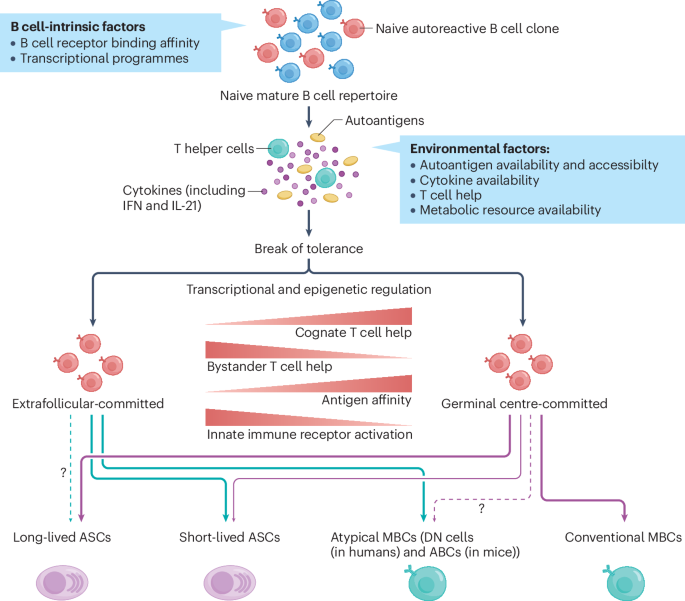
Degn, S. E. et al. Clonal evolution of autoreactive germinal centers. Cell 170, 913–926.e19 (2017).
van den Broek, T. et al. Invasion of spontaneous germinal centers by naive B cells is rapid and persistent. Sci. Immunol. 9, 1–11 (2024).
Malkiel, S., Barlev, A. N., Atisha-Fregoso, Y., Suurmond, J. & Diamond, B. Plasma cell differentiation pathways in systemic lupus erythematosus. Front. Immunol. 9, 427 (2018).
Jenks, S. A., Cashman, K. S., Woodruff, M. C., Lee, F. E. H. & Sanz, I. Extrafollicular responses in humans and SLE. Immunol. Rev. 288, 136–148 (2019).
García De Vinuesa, C., O’Leary, P., Sze, D. M. Y., Toellner, K. M. & MacLennan, I. C. M. T-independent type 2 antigens induce B cell proliferation in multiple splenic sites, but exponential growth is confined to extrafollicular foci. Eur. J. Immunol. 29, 1314–1323 (1999).
Arbuckle, M. R. et al. Development of autoantibodies before the clinical onset of systemic lupus erythematosus. N. Engl. J. Med. 349, 1526–1533 (2003).
Cornaby, C. et al. B cell epitope spreading: mechanisms and contribution to autoimmune diseases. Immunol. Lett. 163, 56–68 (2015).
Fahlquist-Hagert, C. et al. Antigen presentation by B cells enables epitope spreading across an MHC barrier. Nat. Commun. 14, 6941 (2023).
Jenks, S. A. et al. Distinct effector b cells induced by unregulated toll-like receptor 7 contribute to pathogenic responses in systemic lupus erythematosus. Immunity 49, 725–739.e6 (2018).
Voss, L. F. et al. The extrafollicular response is sufficient to drive initiation of autoimmunity and early disease hallmarks of lupus. Front. Immunol. 13, 1–19 (2022).
Zhu, D. Y. et al. CD21 primes extrafollicular differentiation of autoreactive B cells in a TLR7-driven lupus model. Sci. Immunol. 10, eads8226 (2025).
Baxter, R. M. et al. Expansion of extrafollicular B and T cell subsets in childhood-onset systemic lupus erythematosus. Front. Immunol. 14, 1208282 (2023).
Wardemann, H. et al. Predominant autoantibody production by early human B cell precursors. Science 301, 1374–1377 (2003).
Meffre, E. The establishment of early B cell tolerance in humans: lessons from primary immunodeficiency diseases. Ann. N. Y. Acad. Sci. 1246, 1–10 (2011).
Danke, N. A., Koelle, D. M., Yee, C., Beheray, S. & Kwok, W. W. Autoreactive T cells in healthy individuals. J. Immunol. 172, 5967–5972 (2004).
Lee, V. et al. The endogenous repertoire harbors self-reactive CD4+ T cell clones that adopt a follicular helper T cell-like phenotype at steady state. Nat. Immunol. 24, 487–500 (2023).
Akama-Garren, E. H. et al. T cell help shapes B cell tolerance. Sci. Immunol. 9, eadj7029 (2024).
Cashman, K. S. et al. Understanding and measuring human B-cell tolerance and its breakdown in autoimmune disease. Immunol. Rev. 292, 76–89 (2019).
Nemazee, D. Mechanisms of central tolerance for B cells. Nat. Rev. Immunol. 17, 281–294 (2017).
Nemazee, D. A. & Biirki, K. Clonal deletion of B lymphocytes in a transgenic mouse bearing anti-MHC class I antibody genes. Nature 337, 562–566 (1989).
Tan, C., Noviski, M., Huizar, J. & Zikherman, J. Self-reactivity on a spectrum: a sliding scale of peripheral B cell tolerance. Immunol. Rev. 292, 37–60 (2019).
Fischer, A. A., Corcoran, M., Brouwer, P. J. M. & Chernyshev, M. Isolation of genetically diverse influenza antibodies highlights the role of IG germline gene variation and informs the design of population- comprehensive vaccine strategies. Preprint at bioRxiv https://doi.org/10.1101/2025.07.04.663145 (2025).
Sangesland, M. et al. Allelic polymorphism controls autoreactivity and vaccine elicitation of human broadly neutralizing antibodies against influenza virus. Immunity 55, 1693–1709.e8 (2022).
Rodriguez, O. L. et al. Genetic variation in the immunoglobulin heavy chain locus shapes the human antibody repertoire. Nat. Commun. 14, 1–18 (2023).
Richardson, C. et al. Molecular basis of 9G4 B cell autoreactivity in human systemic lupus erythematosus. J. Immunol. 191, 4926–4939 (2013).
Tipton, C. M. et al. Diversity, cellular origin and autoreactivity of antibody-secreting cell population expansions in acute systemic lupus erythematosus. Nat. Immunol. 16, 755–765 (2015).
Isenberg, D. A. et al. Correlation of 9G4 idiotope with disease activity in patients with systemic lupus erythematosus. Ann. Rheum. Dis. 57, 566–570 (1998).
Charles, E. D. et al. Clonal B cells in patients with hepatitis C virus-associated mixed cryoglobulinemia contain an expanded anergic CD21low B-cell subset. Blood 117, 5425–5437 (2011).
Visentini, M. et al. The VH1-69-expressing marginal zone B cells expanded in HCV-associated mixed cryoglobulinemia display proliferative anergy irrespective of CD21low phenotype. Blood 118, 3440–3441 (2011).
Castrillon, C. et al. Complex subsets but redundant clonality after B cells egress from spontaneous germinal centers. eLife 12, 1–21 (2023).
Sprumont, A., Rodrigues, A., McGowan, S. J., Bannard, C. & Bannard, O. Germinal centers output clonally diverse plasma cell populations expressing high- and low-affinity antibodies. Cell 186, 5486–5499.e13 (2023).
Sutton, H. J. et al. Lack of affinity signature for germinal center cells that have initiated plasma cell differentiation. Immunity 57, 245–255.e5 (2024).
Schwickert, T. A. et al. In vivo imaging of germinal centres reveals a dynamic open structure. Nature 446, 83–87 (2007).
Tachó-Piñot, R. & Vinuesa, C. G. Affinity-independent plasma cell differentiation in germinal centers. Trends Immunol. 45, 234–236 (2024).
Cappione, A. et al. Germinal center exclusion of autoreactive B cells is defective in human systemic lupus erythematosus. J. Clin. Invest. 115, 3205–3216 (2005).
Chan, T. D. et al. Elimination of germinal-center-derived self-reactive b cells is governed by the location and concentration of self-antigen. Immunity 37, 893–904 (2012).
Berland, R. et al. Toll-like receptor 7-dependent loss of B cell tolerance in pathogenic autoantibody knockin mice. Immunity 25, 429–440 (2006).
van der Poel, C. E. et al. Follicular dendritic cells modulate germinal center B cell diversity through FcγRIIB. Cell Rep. 29, 2745–2755.e4 (2019).
Sanchez, G. M. et al. Aberrant zonal recycling of germinal center B cells impairs appropriate selection in lupus. Cell Rep. 43, 114978 (2024).
Chan, T. D. et al. Antigen affinity controls rapid T-dependent antibody production by driving the expansion rather than the differentiation or extrafollicular migration of early plasmablasts. J. Immunol. 183, 3139–3149 (2009).
MacLennan, I. C. M. et al. Extrafollicular antibody responses. Immunol. Rev. 194, 8–18 (2003).
Herlands, R. A., William, J., Hershberg, U. & Shlomchik, M. J. Anti-chromatin antibodies drive in vivo antigen-specific activation and somatic hypermutation of rheumatoid factor B cells at extrafollicular sites. Eur. J. Immunol. 37, 3339–3351 (2007).
Liu, Z., Zou, Y. R. & Davidson, A. Plasma cells in systemic lupus erythematosus: the long and short of it all. Eur. J. Immunol. 41, 588–591 (2011).
Baumgarth, N. Extrafollicular B cell responses — is one tent big enough? Immunol. Rev. 336, 1–9 (2025).
Eisenbarth, S. C. et al. A roadmap for defining “extrafollicular” B cell responses. Immunity 58, 2627–2645 (2025).
Balázs, M., Martin, F., Zhou, T. & Kearney, J. F. Blood dendritic cells interact with splenic marginal zone B cells to initiate T-independent immune responses. Immunity 17, 341–352 (2002).
Martin, F., Oliver, A. M. & Kearney, J. F. Marginal zone and B1 B cells unite in the early response against T-independent blood-borne particulate antigens. Immunity 14, 617–629 (2001).
Siu, J. H. Y. et al. Two subsets of human marginal zone B cells resolved by global analysis of lymphoid tissues and blood. Sci. Immunol. 7, eabm9060 (2022).
Yurasov, S. et al. Defective B cell tolerance checkpoints in systemic lupus erythematosus. J. Exp. Med. 201, 703–711 (2005).
Wei, C. et al. A new population of cells lacking expression of CD27 represents a notable component of the B cell memory compartment in systemic lupus erythematosus. J. Immunol. 178, 6624–6633 (2007).
Weiss, G. E. et al. Atypical memory B cells are greatly expanded in individuals living in a malaria-endemic area. J. Immunol. 183, 2176–2182 (2009).
Hao, Y., O’Neill, P., Naradikian, M. S., Scholz, J. L. & Cancro, M. P. A B-cell subset uniquely responsive to innate stimuli accumulates in aged mice. Blood 118, 1294–1304 (2011).
Rubtsov, A. V. et al. Toll-like receptor 7 (TLR7)-driven accumulation of a novel CD11c+ B-cell population is important for the development of autoimmunity. Blood 118, 1305–1315 (2011).
Gao, X. et al. Zeb2 drives the formation of CD11c+ atypical B cells to sustain germinal centers that control persistent infection. Sci. Immunol. 4748, eadj4748 (2024).
Oliviero, B. et al. Expansion of atypical memory B cells is a prominent feature of COVID-19. Cell. Mol. Immunol. 17, 1101–1103 (2020).
Fields, M. L. & Erikson, J. The regulation of lupus-associated autoantibodies: Immunoglobulin transgenic models. Curr. Opin. Immunol. 15, 709–717 (2003).
Shlomchik, M. J. Sites and stages of autoreactive B cell activation and regulation. Immunity 28, 18–28 (2008).
Paus, D. et al. Antigen recognition strength regulates the choice between extrafollicular plasma cell and germinal center B cell differentiation. J. Exp. Med. 203, 1081–1091 (2006).
Goodnow, C. C. et al. Altered immunoglobulin expression and functional silencing of self-reactive B lymphocytes in transgenic mice. Nature 334, 676–682 (1988).
Lau, C. M. et al. RNA-associated autoantigens activate B cells by combined B cell antigen receptor/Toll-like receptor 7 engagement. J. Exp. Med. 202, 1171–1177 (2005).
Viglianti, G. A. et al. Activation of autoreactive B cells by CpG dsDNA. Immunity 19, 837–847 (2003).
Uccellini, M. B. et al. Autoreactive B cells discriminate CpG-rich and CpG-poor DNA and this response is modulated by IFN-α. J. Immunol. 181, 5875–5884 (2008).
Sweet, R. A. et al. Facultative role for T cells in extrafollicular Toll-like receptor-dependent autoreactive B-cell responses in vivo. Proc. Natl Acad. Sci. USA 108, 7932–7937 (2011).
Herlands, R. A., Christensen, S. R., Sweet, R. A., Hershberg, U. & Shlomchik, M. J. T cell-independent and Toll-like receptor-dependent antigen-driven activation of autoreactive B cells. Immunity 29, 249–260 (2008).
Castrillon, C. et al. Complex subsets but redundant clonality after B cells egress from spontaneous germinal centers. eLife 12, e81012 (2022).
Elsner, R. A. & Shlomchik, M. J. Germinal center and extrafollicular B cell responses in vaccination, immunity, and autoimmunity. Immunity 53, 1136–1150 (2020).
He, Y. & Vinuesa, C. G. Germinal center versus extrafollicular responses in systemic autoimmunity: who turns the blade on self? Adv. Immunol. 162, 109–133 (2024).
Staniek, J. & Rizzi, M. Signaling activation and modulation in extrafollicular B cell responses. Immunol. Rev. 330, e70004 (2025).
He, X. et al. Plasmablast-derived polyclonal antibody response after influenza vaccination. J. Immunol. Methods 365, 67–75 (2011).
Kyu, S. Y. et al. Frequencies of human influenza-specific antibody secreting cells or plasmablasts post vaccination from fresh and frozen peripheral blood mononuclear cells. J. Immunol. Methods 340, 42–47 (2009).
Scharer, C. D. et al. Antibody-secreting cell destiny emerges during the initial stages of B-cell activation. Nat. Commun. 11, 1–14 (2020).
Glaros, V. et al. Limited access to antigen drives generation of early B cell memory while restraining the plasmablast response. Immunity 54, 2005–2023.e10 (2021).
Aung, A. et al. Low protease activity in B cell follicles promotes retention of intact antigens after immunization. Science 379, eabn8934 (2023).
Aung, A. & Irvine, D. J. Modulating antigen availability in lymphoid organs to shape the humoral immune response to vaccines. J. Immunol. 212, 171–178 (2024).
Dai, D. et al. The transcription factor ZEB2 drives the formation of age-associated B cells. Science 383, 413–421 (2024).
Goto, M. et al. Age-associated CD4+ T cells with B cell–promoting functions are regulated by ZEB2 in autoimmunity. Sci. Immunol. 9, 1–16 (2024).
Singh, A. Eliciting B cell immunity against infectious diseases using nanovaccines. Nat. Nanotechnol. 16, 16–24 (2021).
Heesters, B. A. et al. Endocytosis and recycling of immune complexes by follicular dendritic cells enhances B cell antigen binding and activation. Immunity 38, 1164–1175 (2013).
Napirei, M. et al. Features of systemic lupus erythematosus in Dnase1-deficient mice. Nat. Genet. 25, 177–181 (2000).
Al-Mayouf, S. M. et al. Loss-of-function variant in DNASE1L3 causes a familial form of systemic lupus erythematosus. Nat. Genet. 43, 1186–1188 (2011).
Kenny, E. F., Raupach, B., Abu Abed, U., Brinkmann, V. & Zychlinsky, A. Dnase1-deficient mice spontaneously develop a systemic lupus erythematosus-like disease. Eur. J. Immunol. 49, 590–599 (2019).
Soni, C. et al. Plasmacytoid dendritic cells and type I interferon promote extrafollicular B cell responses to extracellular self-DNA. Immunity 52, 1022–1038.e7 (2020).
Prodeus, A. P. et al. A critical role for complement in maintenance of self-tolerance. Immunity 9, 721–731 (1998).
Roozendaal, R. & Carroll, M. C. Complement receptors CD21 and CD35 in humoral immunity. Immunol. Rev. 219, 157–166 (2007).
Carroll, M. C. The complement system in B cell regulation. Mol. Immunol. 41, 141–146 (2004).
Einav, S., Pozdnyakova, O. O., Ma, M. & Carroll, M. C. Complement C4 Is protective for lupus disease independent of C31. J. Immunol. 168, 1036–1041 (2002).
Paul, E., Pozdnyakova, O. O., Mitchell, E. & Carroll, M. C. Anti-DNA autoreactivity in C4-deficient mice. Eur. J. Immunol. 32, 2672–2679 (2002).
Chatterjee, P. et al. Complement C4 maintains peripheral B-cell tolerance in a myeloid cell dependent manner. Eur. J. Immunol. 43, 2441–2450 (2013).
Simoni, L. et al. Complement C4A regulates autoreactive B cells in murine lupus. Cell Rep. 33, 108330 (2020).
Gretz, J. E., Norbury, C. C., Anderson, A. O., Proudfoot, A. E. I. & Shaw, S. Lymph-borne chemokines and other low molecular weight molecules reach high endothelial venules via specialized conduits while a functional barrier limits access to the lymphocyte microenvironments in lymph node cortex. J. Exp. Med. 192, 1425–1440 (2000).
Sixt, M. et al. The conduit system transports soluble antigens from the afferent lymph to resident dendritic cells in the T cell area of the lymph node. Immunity 22, 19–29 (2005).
Roozendaal, R. et al. Conduits mediate transport of low-molecular-weight antigen to lymph node follicles. Immunity 30, 264–276 (2009).
Elsner, R. A. & Shlomchik, M. J. IL-12 blocks Tfh cell differentiation during Salmonella infection, thereby contributing to germinal center suppression. Cell Rep. 29, 2796–2809.e5 (2019).
Biram, A. et al. Bacterial infection disrupts established germinal center reactions through monocyte recruitment and impaired metabolic adaptation. Immunity 55, 442–458.e8 (2022).
Elsner, R. A., Smita, S. & Shlomchik, M. J. IL-12 induces a B cell-intrinsic IL-12/IFNγ feed-forward loop promoting extrafollicular B cell responses. Nat. Immunol. 25, 1283–1295 (2024).
Munroe, M. E. et al. Altered type II interferon precedes autoantibody accrual and elevated type I interferon activity prior to systemic lupus erythematosus classification. Ann. Rheum. Dis. 75, 2014–2021 (2016).
Kim, C. C., Baccarella, A. M., Bayat, A., Pepper, M. & Fontana, M. F. FCRL5+ memory B cells exhibit robust recall responses. Cell Rep. 27, 1446–1460.e4 (2019).
Portugal, S. et al. Malaria-associated atypical memory B cells exhibit markedly reduced B cell receptor signaling and effector function. eLife 4, 1–21 (2015).
Faliti, C. E. et al. Interleukin-2-secreting T helper cells promote extra-follicular B cell maturation via intrinsic regulation of a B cell mTOR-AKT-Blimp-1 axis. Immunity 57, 2772–2789.e8 (2024).
Kim, Y. et al. IL-21 shapes the B cell response in a context-dependent manner. Cell Rep. 44, 115190 (2025).
Caielli, S. et al. A CD4+ T cell population expanded in lupus blood provides B cell help through interleukin-10 and succinate. Nat. Med. 25, 75–81 (2019).
Vinuesa, C. G., Shen, N. & Ware, T. Genetics of SLE: mechanistic insights from monogenic disease and disease-associated variants. Nat. Rev. Nephrol. 19, 558–572 (2023).
Scharer, C. D. et al. Epigenetic programming underpins B cell dysfunction in human SLE. Nat. Immunol. 20, 1071–1082 (2019).
Pan, Y. & Sawalha, A. H. Epigenetic regulation and the pathogenesis of systemic lupus erythematosus. Transl. Res. 153, 4–10 (2009).
Vijay, R. et al. Infection-induced plasmablasts are a nutrient sink that impairs humoral immunity to malaria. Nat. Immunol. 21, 790–801 (2020).
Akkaya, M., Kwak, K. & Pierce, S. K. B cell memory: building two walls of protection against pathogens. Nat. Rev. Immunol. 20, 229–238 (2020).
Martinis, E. et al. B cell immunometabolism in health and disease. Nat. Immunol. 26, 366–377 (2025).
Ersching, J. et al. Germinal center selection and affinity maturation require dynamic regulation of mTORC1 kinase. Immunity 46, 1045–1058.e6 (2017).
Pae, J. et al. Cyclin D3 drives inertial cell cycling in dark zone germinal center B cells. J. Exp. Med. 218, e20201699 (2021).
Sharma, R. et al. Distinct metabolic requirements regulate B cell activation and germinal center responses. Nat. Immunol. 24, 1358–1369 (2023).
Woodruff, M. C. et al. Extrafollicular B cell responses correlate with neutralizing antibodies and morbidity in COVID-19. Nat. Immunol. 21, 1506–1516 (2020).
Woodruff, M. C. et al. Dysregulated naive B cells and de novo autoreactivity in severe COVID-19. Nature 611, 139–147 (2022).
Cao, T. et al. Mitochondrial regulation of acute extrafollicular B-cell responses to COVID-19 severity. Clin. Transl. Med. 12, e1025 (2022).
Patiño-Martinez, E. & Kaplan, M. J. Immunometabolism in systemic lupus erythematosus. Nat. Rev. Rheumatol. 21, 377–395 (2025).
Zeng, Q. et al. The m6A demethylase FTO links TLR7 to mitochondrial oxidation driving age-associated B cell formation in systemic lupus erythematosus. Sci. Transl. Med. 17, eadu6015 (2025).
Gomez-Bañuelos, E. et al. Affinity maturation generates pathogenic antibodies with dual reactivity to DNase1L3 and dsDNA in systemic lupus erythematosus. Nat. Commun. 14, 1–14 (2023).
Shlomchik, M. et al. Anti-DNA antibodies from autoimmune mice arise by clonal expansion and somatic mutation. J. Exp. Med. 171, 265–297 (1990).
van den Broek, T. et al. Invasion of spontaneous germinal centers by naive B cells is rapid and persistent. Sci. Immunol. 9, eadi8150 (2024).
Sabouri, Z. et al. Redemption of autoantibodies on anergic B cells by variable-region glycosylation and mutation away from self-reactivity. Proc. Natl Acad. Sci. USA 111, E2567–E2575 (2014).
Burnett, D. L., Reed, J. H., Christ, D. & Goodnow, C. C. Clonal redemption and clonal anergy as mechanisms to balance B cell tolerance and immunity. Immunol. Rev. 292, 61–75 (2019).
Akama-Garren, E. H. & Carroll, M. C. T cell help in the autoreactive germinal center. Scand. J. Immunol. 95, 1–25 (2022).
He, J. et al. Circulating precursor CCR7loPD-1hi CXCR5+ CD4+ T cells indicate Tfh cell activity and promote antibody responses upon antigen reexposure. Immunity 39, 770–781 (2013).
Akama-Garren, E. H. & Carroll, M. C. Lupus susceptibility loci predispose mice to clonal lymphocytic responses and myeloid expansion. J. Immunol. 208, 2403–2424 (2022).
Simpson, N. et al. Expansion of circulating T cells resembling follicular helper T cells is a fixed phenotype that identifies a subset of severe systemic lupus erythematosus. Arthritis Rheum. 62, 234–244 (2010).
Ma, J. et al. Increased frequency of circulating follicular helper T cells in patients with rheumatoid arthritis. Clin. Dev. Immunol. 2012, 827480 (2012).
Szabo, K. et al. Follicular helper T cells may play an important role in the severity of primary Sjögren’s syndrome. Clin. Immunol. 147, 95–104 (2013).
Kawamoto, M. et al. Expression and function of inducible co-stimulator in patients with systemic lupus erythematosus: possible involvement in excessive interferon-γ and anti-double-stranded DNA antibody production. Arthritis Res. Ther. 8, R62 (2006).
Dhaeze, T. et al. Circulating follicular regulatory T cells are defective in multiple sclerosis. J. Immunol. 195, 832–840 (2015).
Fonseca, V. R. et al. Human blood Tfr cells are indicators of ongoing humoral activity not fully licensed with suppressive function. Sci. Immunol. 2, eaan1487 (2017).
Kawane, K., Tanaka, H., Kitahara, Y., Shimaoka, S. & Nagata, S. Cytokine-dependent but acquired immunity-independent arthritis caused by DNA escaped from degradation. Proc. Natl Acad. Sci. USA 107, 19432–19437 (2010).
Ritvo, P.-G. et al. High-resolution repertoire analysis reveals a major bystander activation of Tfh and Tfr cells. Proc. Natl Acad. Sci. USA 115, 9604–9609 (2018).
Akama-Garren, E. H. et al. Follicular T cells are clonally and transcriptionally distinct in B cell-driven mouse autoimmune disease. Nat. Commun. 12, 1–19 (2021).
Eberl, G., Brawand, P. & MacDonald, H. R. Selective bystander proliferation of memory CD4+ and CD8+ T cells upon NK T or T cell activation. J. Immunol. 165, 4305–4311 (2000).
Tough, D. F., Borrow, P. & Sprent, J. Induction of bystander T cell proliferation by viruses and type I interferon in vivo. Science 272, 1947–1950 (1996).
Harkiolaki, M. et al. T cell-mediated autoimmune disease due to low-affinity crossreactivity to common microbial peptides. Immunity 30, 348–357 (2009).
Mason, D. A very high level of crossreactivity is an essential feature of the T-cell receptor. Immunol. Today 19, 395–404 (1998).
Hägglöf, T. et al. Continuous germinal center invasion contributes to the diversity of the immune response. Cell 186, 147–161.e15 (2023).
Nemazee, D. Antigen receptor ‘capacity’ and the sensitivity of self-tolerance. Immunol. Today 17, 25–29 (1996).
Ochsenbein, A. F. et al. Control of early viral and bacterial distribution and disease by natural antibodies. Science 286, 2156–2159 (1999).
Mazor, R. D. et al. Tumor-reactive antibodies evolve from non-binding and autoreactive precursors. Cell 185, 1208–1222.e21 (2022).
Zhu, D. Y.-D., Castrillon, C. & Carroll, M. C. Innate immune receptors as dynamic modulators of extrafollicular autoimmune B cell Response. Immunol. Rev. 330, 1–15 (2025).
Flowers, E. M., Siniscalco, E. R. & Eisenbarth, S. C. Extrafollicular and other non-germinal center B cell responses: an evolutionary perspective. Immunol. Rev. 334, e70060 (2025).
Sasaki, T. et al. Clonal relationships between Tph and Tfh cells in patients with SLE and in murine lupus. Preprint at bioRxiv https://doi.org/10.1101/2025.01.27.635189 (2025).
Song, W. et al. Development of Tbet- and CD11c-expressing B cells in a viral infection requires T follicular helper cells outside of germinal centers. Immunity 55, 290–307.e5 (2022).
Odegard, J. M. et al. ICOS-dependent extrafollicular helper T cells elicit IgG production via IL-21 in systemic autoimmunity. J. Exp. Med. 205, 2873–2886 (2008).
Rao, D. A. et al. Pathologically expanded peripheral T helper cell subset drives B cells in rheumatoid arthritis. Nature 542, 110–114 (2017).
Bocharnikov, A. V. et al. PD-1hiCXCR5− T peripheral helper cells promote B cell responses in lupus via MAF and IL-21. JCI Insight 4, 1–19 (2019).
Gartshteyn, Y. et al. SAP-expressing T peripheral helper cells identify systemic lupus erythematosus patients with lupus nephritis. Front. Immunol. 15, 1–13 (2024).
Ito, T. et al. Plasmacytoid dendritic cells prime IL-10-producing T regulatory cells by inducible costimulator ligand. J. Exp. Med. 204, 105–115 (2007).
Bryant, V. L. et al. Cytokine-mediated regulation of human B cell differentiation into Ig-secreting cells: predominant role of IL-21 produced by CXCR5+ T follicular helper cells. J. Immunol. 179, 8180–8190 (2007).
Ettinger, R. et al. IL-21 induces differentiation of human naive and memory B cells into antibody-secreting plasma cells. J. Immunol. 175, 7867–7879 (2005).
Berglund, L. J. et al. IL-21 signalling via STAT3 primes human näive B cells to respond to IL-2 to enhance their differentiation into plasmablasts. Blood 122, 3940–3950 (2013).
Ozaki, K. et al. A critical role for IL-21 in regulating immunoglobulin production. Science 298, 1630–1634 (2002).
Abhiraman, G. C. et al. A structural blueprint for interleukin-21 signal modulation. Cell Rep. 42, 112657 (2023).
Wang, S. et al. IL-21 drives expansion and plasma cell differentiation of autoreactive CD11chiT-bet+ B cells in SLE. Nat. Commun. 9, 1–14 (2018).
Song, W. et al. IL-21 and tissue-specific signals instruct Tbet+CD11c+ B cell development following viral infection Wenzhi. J. Immunol. 210, 1861–1865 (2023).
Tarr, T. et al. Similarities and differences between pediatric and adult patients with systemic lupus erythematosus. Lupus 24, 796–803 (2015).
Cattoretti, G. et al. Nuclear and cytoplasmic AID in extrafollicular and germinal center B cells. Blood 107, 3967–3975 (2006).
Di Niro, R. et al. Salmonella infection drives promiscuous B cell activation followed by extrafollicular affinity maturation. Immunity 43, 120–131 (2015).
Toyama, H. et al. Memory B cells without somatic hypermutation are generated from Bcl6-deficient B cells. Immunity 17, 329–339 (2002).
Inamine, A. et al. Two waves of memory B-cell generation in the primary immune response. Int. Immunol. 17, 581–589 (2005).
Kenderes, K. J. et al. T-Bet+ IgM memory cells generate multi-lineage effector B cells. Cell Rep. 24, 824–837.e3 (2018).
Sutton, H. J. et al. Atypical B cells are part of an alternative lineage of B cells that participates in responses to vaccination and infection in humans. Cell Rep. 34, 108684 (2021).
Perugino, C. A. et al. Two distinct durable human class-switched memory B cell populations are induced by vaccination and infection. Cell Rep. 44, 115472 (2025).
Zumaquero, E. et al. IFNγ induces epigenetic programming of human T-bethi B cells and promotes TLR7/8 and IL-21 induced differentiation. eLife 8, 1–36 (2019).
Rubtsova, K., Rubtsov, A. V., Van Dyk, L. F., Kappler, J. W. & Marrack, P. T-box transcription factor T-bet, a key player in a unique type of B-cell activation essential for effective viral clearance. Proc. Natl Acad. Sci. USA 110, E3216–E3224 (2013).
Rubtsova, K. et al. B cells expressing the transcription factor T-bet drive lupus-like autoimmunity. J. Clin. Invest. 127, 1392–1404 (2017).
Rubtsova, K., Rubtsov, A. V., Cancro, M. P. & Marrack, P. Age-associated B cells: a T-bet-dependent effector with roles in protective and pathogenic immunity. J. Immunol. 195, 1933–1937 (2015).
Faliti, C. E. et al. Disease-associated B cells and immune endotypes shape adaptive immune responses to SARS-CoV-2 mRNA vaccination in human SLE. Nat. Immunol. 26, 131–145 (2025).
Schett, G. et al. Advancements and challenges in CAR T cell therapy in autoimmune diseases. Nat. Rev. Rheumatol. 20, 531–544 (2024).
Lee, D. S. W., Rojas, O. L. & Gommerman, J. L. B cell depletion therapies in autoimmune disease: advances and mechanistic insights. Nat. Rev. Drug Discov. 20, 179–199 (2021).
Mackensen, A. et al. Anti-CD19 CAR T cell therapy for refractory systemic lupus erythematosus. Nat. Med. 28, 2124–2132 (2022).
Müller, F. et al. CD19 CAR T-cell therapy in autoimmune disease — a case series with follow-up. N. Engl. J. Med. 390, 687–700 (2024).
Bhoj, V. G. et al. Persistence of long-lived plasma cells and humoral immunity in individuals responding to CD19-directed CAR T-cell therapy. Blood 128, 360–370 (2016).
Grenov, A. et al. Autoantibody origins in lupus and in relapse post CAR-T therapy. Preprint at bioRxiv https://doi.org/10.1101/2025.10.20.683393 (2025).
Dong, C. et al. Single-cell profiling of bone marrow B cells and early B cell developmental disorders associated with systemic lupus erythematosus. Arthritis Rheumatol. 76, 599–613 (2024).
Wemlinger, S. M. et al. Preclinical analysis of candidate anti-human CD79 therapeutic antibodies using a humanized CD79 mouse model. J. Immunol. 208, 1566–1584 (2022).
Boyles, J. S. et al. A nondepleting anti-CD19 antibody impairs B cell function and inhibits autoimmune diseases. JCI Insight 8, 1–20 (2023).
Cohen, I. J. et al. Chimeric antigen receptor T cells against the IGHV4-34 B cell receptor specifically eliminate neoplastic and autoimmune B cells. Sci. Transl. Med. 18, eadr9382 (2026).
Brown, G. J. et al. TLR7 gain-of-function genetic variation causes human lupus. Nature 605, 349–356 (2022).
Jacobson, B. A. et al. Anatomy of autoantibody production: dominant localization of antibody-producing cells to T cell zones in Fas-deficient mice. Immunity 3, 509–519 (1995).
Izui, S. et al. Induction of various autoantibodies by mutant gene lpr in several strains of mice. J. Immunol. 133, 227–233 (1984).
Dixon, F. J. et al. Etiology and pathogenesis of a spontaneous lupus-like syndrome in mice. Arthritis Rheum. 21, S64–S67 (1978).
William, J., Euler, C., Christensen, S. & Shlomchik, M. J. Evolution of autoantibody responses via somatic hypermutation outside of germinal centers. Science 297, 2066–2070 (2002).
William, J., Euler, C. & Shlomchik, M. J. Short-lived plasmablasts dominate the early spontaneous rheumatoid factor response: differentiation pathways, hypermutating cell types, and affinity maturation outside the germinal center. J. Immunol. 174, 6879–6887 (2005).
Carroll, M. C. & Isenman, D. E. Regulation of humoral immunity by complement. Immunity 37, 199–207 (2012).
Fearon, D. T. & Carroll, M. C. Regulation of B lymphocyte responses to foreign and self-antigens by the CD19/CD21 complex. Annu. Rev. Immunol. 18, 393–422 (2000).
Hoefer, M. M. & Illges, H. Ectodomain shedding and generation of two carboxy-terminal fragments of human complement receptor 2/CD21. Mol. Immunol. 46, 2630–2639 (2009).
Masilamani, M., Kassahn, D., Mikkat, S., Glocker, M. O. & Illges, H. B cell activation leads to shedding of complement receptor type II (CR2/CD21). Eur. J. Immunol. 33, 2391–2397 (2003).
Masilamani, M. et al. Reduction of soluble complement receptor 2/CD21 in systemic lupus erythematosus and Sjögren’s syndrome but not juvenile arthritis. Scand. J. Immunol. 60, 625–630 (2004).
Mond, J. J., Mongini, P. K., Sieckmann, D. & Paul, W. E. Role of T lymphocytes in the response to TNP-AECM-Ficoll. J. Immunol. 125, 1066–1070 (1980).
Letvin, N. L., Benacerraf, B. & Germain, R. N. B-lymphocyte responses to trinitrophenyl-conjugated Ficoll: requirement for T lymphocytes and Ia-bearing adherent cells. Proc. Natl Acad. Sci. USA 78, 5113–5117 (1981).
Nordin, A. A. & Schreier, M. H. T cell control of the antibody response to the T-independent antigen, DAGG-Ficoll. J. Immunol. 129, 557–562 (1982).
Lee, S. K. et al. B cell priming for extrafollicular antibody responses requires Bcl-6 expression by T cells. J. Exp. Med. 208, 1377–1388 (2011).
Ozaki, K. et al. Regulation of B cell differentiation and plasma cell generation by IL-21, a novel inducer of Blimp-1 and Bcl-6. J. Immunol. 173, 5361–5371 (2004).
Keller, B. et al. The expansion of human T-bet high CD21 low B cells is T cell dependent. Sci. Immunol. 6, 1–16 (2021).
Victora, G. D. & Nussenzweig, M. C. Germinal centers. Annu. Rev. Immunol. 40, 413–442 (2022).
Cancro, M. P. Age-associated B cells. Annu. Rev. Immunol. 38, 315–340 (2020).
Portugal, S., Obeng-Adjei, N., Moir, S., Crompton, P. D. & Pierce, S. K. Atypical memory B cells in human chronic infectious diseases: an interim report. Cell. Immunol. 321, 18–25 (2017).
Wong, J. B. et al. B-1a cells acquire their unique characteristics by bypassing the pre-BCR selection stage. Nat. Commun. 10, 4768 (2019).
Chaudhuri, J. & Alt, F. W. Class-switch recombination: interplay of transcription, DNA deamination and DNA repair. Nat. Rev. Immunol. 4, 541–552 (2004).
Platt, J. L., Garcia de Mattos Barbosa, M. & Cascalho, M. The five dimensions of B cell tolerance. Immunol. Rev. 292, 180–193 (2019).
Reed, J. H., Jackson, J., Christ, D. & Goodnow, C. C. Clonal redemption of autoantibodies by somatic hypermutation away from self-reactivity during human immunization. J. Exp. Med. 213, 1255–1265 (2016).
Pillai, S. & Cariappa, A. The follicular versus marginal zone B lymphocyte cell fate decision. Nat. Rev. Immunol. 9, 767–777 (2009).
Cerutti, A., Cols, M. & Puga, I. Marginal zone B cells: virtues of innate-like antibody-producing lymphocytes. Bone 23, 1–7 (2011).
Weill, J. C., Weller, S. & Reynaud, C. A. Human marginal zone B cells. Annu. Rev. Immunol. 27, 267–285 (2009).
Ruddle, N. H. & Akirav, E. M. Secondary lymphoid organs: responding to genetic and environmental cues in ontogeny and the immune response. J. Immunol. 183, 2205–2212 (2009).
Leube, J. et al. Single-cell fate mapping reveals widespread clonal ignorance of low-affinity T cells exposed to systemic infection. Eur. J. Immunol. 53, 1–12 (2023).
Crotty, S. T follicular helper cell differentiation, function, and roles in disease. Immunity 41, 529–542 (2014).
Lu, Y. & Craft, J. T follicular regulatory cells: choreographers of productive germinal center responses. Front. Immunol. 12, 1–6 (2021).