

Updated April 27, 2026 11:55AM
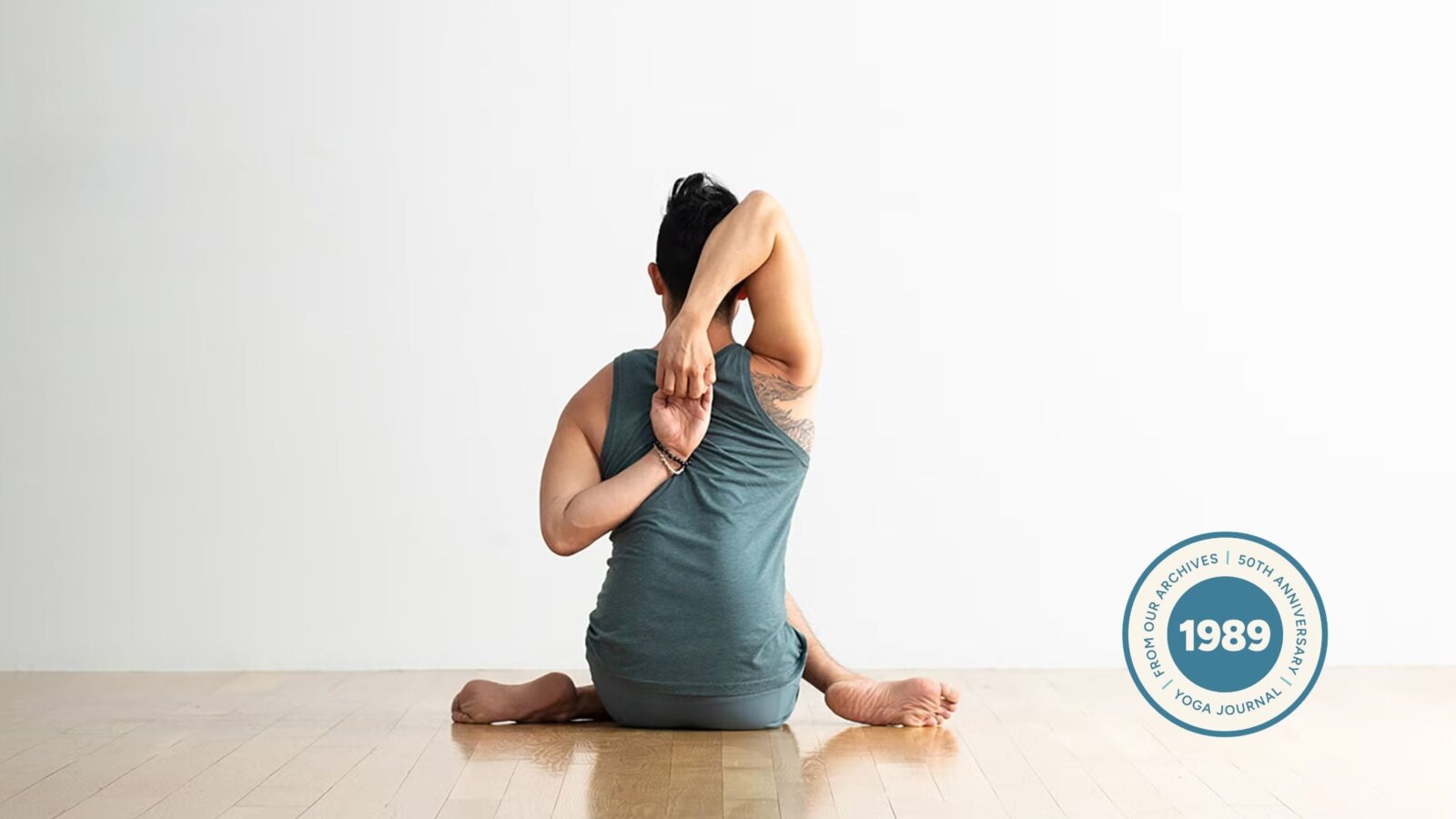
Yoga Journal’s archives series is a curated collection of articles originally published in past issues beginning in 1975. This article about Gomukhasana (Cow Face Pose) first appeared in the July-August 1989 issue of Yoga Journal.
In Yoga Sutra 2.1, Patanjali identifies the three basic elements of yoga practice as austerity or self-discipline (tapas); devotion or surrender to the divine (ishvara-pranidhana); and self-study (svadhyaya). These three elements, which are woven together inseparably like the strands of a rope, correspond to the three basic qualities of nature known as the gunas. Tapas (self-discipline) represents the masculine or dynamic principle of energy, rajas. Ishvara-pranidhana (surrender) corresponds to lamas, the feminine or receptive principle; and svadhyaya (self-study) reflects sattva, the state of equilibrium and clarity.
For Westerners, the notion of self-study implies the examination of motives and feelings, and a concern for personal growth. In the context of yoga philosophy, however, svadhyaya refers to the study of the higher self, the self we are trying to reach through the practice of yoga. Thus svadhyaya focuses on the study of those sacred scriptures which invoke the higher self (such as the Bhagavad Gita and the Upanishads) and on the contemplation of this ideal self to the exclusion of the personal self.
Indian psychoanalyst Sudhir Kakar comments on this divergence between East and West:
“The introspective element of Western civilization is ancient and can be traced back to later Greek thought, where definitions of self and of identity became contingent upon an active process of examining, sorting out, and scrutinizing the ‘events’ and ‘adventures’ of one’s own life. The activity of introspection became closely connected with the idea of ‘the true self,’ as typified by the Socratic use of the phrase ‘Know thyself.’ This kind of introspection is simply not a feature of Indian culture…
“The meditative procedures of Indian psychophilosophical schools of ‘self-realization’…are of a different nature and follow radically different goals. The Indian injunction ‘Know thyself’ (atman-amvidhi) is related to a Self other than the one referred to by Socrates. It is a self uncontaminated by time and space and thus without the life-historical dimension which is the focus of psychoanalysis and of Western romantic literature.”*
For the classical Indian yogi, the personal self is not even worthy of consideration. Consider the following description of an interview with a Hindu ascetic:
“Saccidananda was…reticent about his life before entering orders. It was as if his vows had obliterated his former life completely; at initiation, he had died to the secular world of personal relationships and had been reborn as an ascetic intent upon things eternal. He saw his role in the traditional terms of one who practices meditation and austerities to attain his own release from the cycle of birth and death. Such an authentic and sincere sadhu could not afford to be distracted by his personal feelings and considered it improper to waste time talking about himself as a distinct individual at all, because individuality belongs to the world of illusion (maya).”**
As Patanjali reminds us (Yoga Sutra 4.6.), the object of meditation and other yoga practice is to free the mind from samskaras, that is, from the impressions created by thoughts, feelings, actions, and desires. These impressions are stored in memory, and thus, in yogic tradition, memory is seen as an obstacle to knowledge and experience of the self.
In his later journals, Krishnamurti refers to memories as “scars.”*** In fact, throughout his teaching, Krishnamurti returns repeatedly to the theme of how we inflict injury and suffering on ourselves through memory, and through thought, which is the response of memory. “You say something to me which hurts me, and the pain is recorded…The moment you record it as a hurt, that recording is continued and for the rest of your life you are adding to that hurt.”****For Krishnamurti, our task is to observe without recording—without creating any impressions on the plate of memory—which can be done only by such total attention to the moment that all thought, all desire, all judgment is suspended. He himself could not remember even the most important events of his youth and early manhood.
If the personal self must be obliterated, if memory must be eradicated in order to realize the higher self, then of course any inquiry into personal motives or feelings will be regarded as irrelevant or even misleading. Thus yogis have usually rejected the Western tradition of introspection in general and psychotherapy in particular. Krishnamurti declares categorically that introspective or intellectual analysis is “totally wrong.” Another great Indian philosopher of this century, Sri Aurobindo, dismissed psychoanalysis by remarking curtly, “One cannot discover the meaning of the lotus by analyzing the secrets of the mud in which it grows.” ******
Those of us who practice yoga in the West cannot accept this split between the spiritual self and the personal self, for it means that one can have a highly developed spiritual side and yet be personally immature or inadequate. Nor can we force ourselves into the psychological mold of the Yoga Sutras, which grew from a radically different culture. Rather, we must seek a new integration of the spiritual self and the personal self. For us, the meaning of the lotus lies in the very fact that it arises out of the mud—that by knowing and understanding our own darkness, we are better able to reach the light. Just as Buddhism changed when it was brought to Korea and Japan and became something unique, beautiful, and integral to itself in Zen Buddhism, so yoga will manifest itself differently in the West, as it responds to our needs and our values—and begins to express the mode of self-realization that is natural for us.
Why Gomukhasana (Cow Face Pose) is Challenging
In our practice of hatha yoga, we learn that memory is stored in the body as well as in the brain. We begin to release the chronic tension of muscles that are still trying to protect an old injury or defend against a childhood trauma. We rediscover the past in order to let go. Recently, a student informed me that after using a strap around her elbows in Sarvangasana (Shoulderstand), she developed a terrible rash all over her forearms. Often as a child, her arms had been tied behind her back, and she had been beaten. Even the cells of the body remember!
The memory may not always be a specific memory, as from an accident or trauma, but rather a habit of moving or pattern of holding. Thus, a pose like Gomukhasana (Cow’s Head Pose) can evoke nausea, tears, anger, because so much emotion has been locked into the shoulder joints.
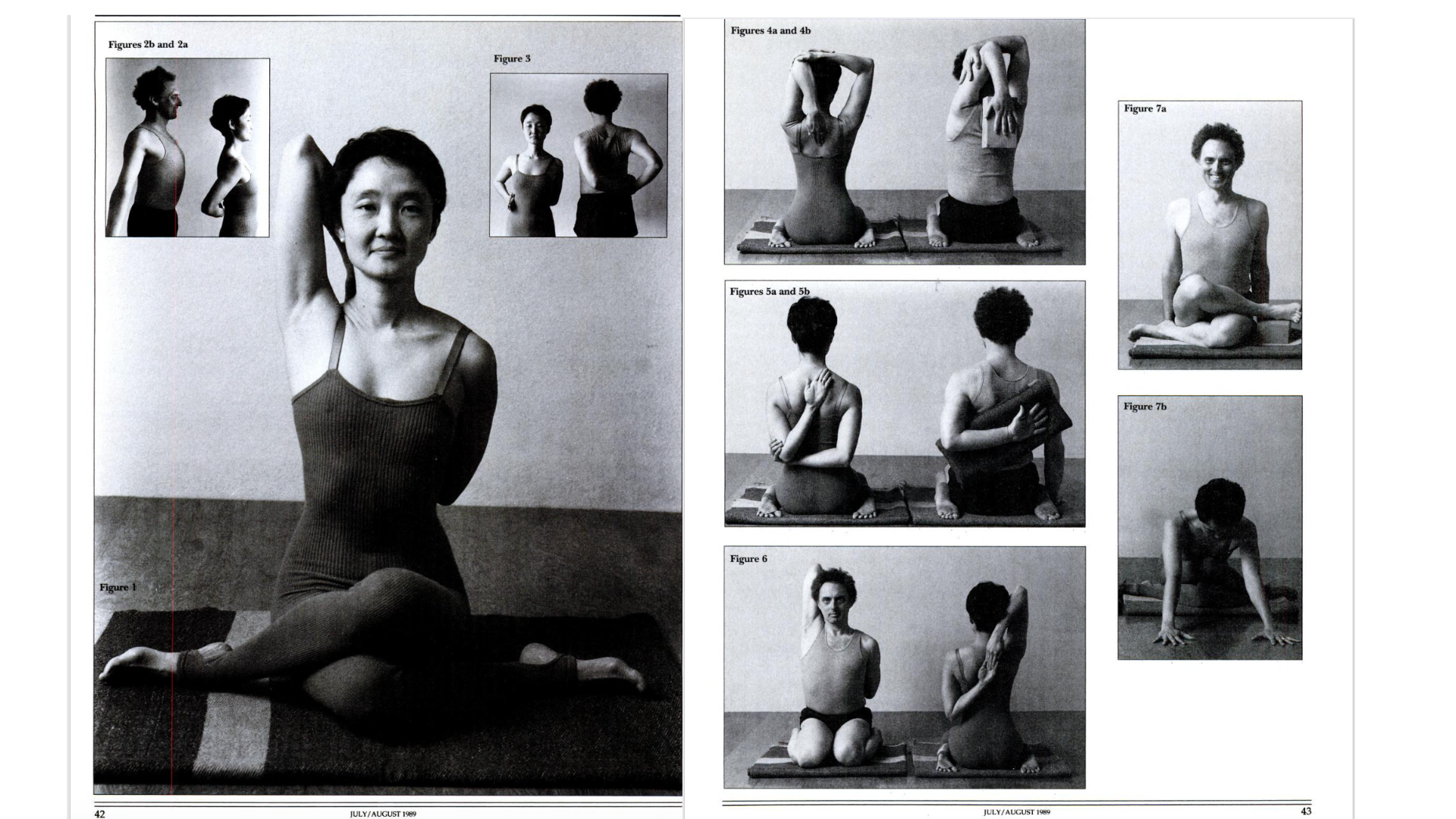
The freedom and openness of the shoulder joint depends to a great extent on the rotation of the upper arm. If you stand in Tadasana (Mountain Pose) and turn the upper arms inward, you will feel how the shoulders automatically begin to hunch and roll forward and how the shoulder blades lift away from the rib cage. The effect on the shoulders is even more exaggerated when you first roll the upper arm in and then bring the forearm behind the back, as we do for Gomukhasana (Figure 2a). When this movement is initiated from the upper arm, the trapezius muscle of the shoulder becomes tight and rigid, and the head of the upper arm bone (humerus) digs forward into the shoulder cap. The result is all too often a sharp, unbearable line of pain that cuts through the deltoid muscle of the upper arm (outer shoulder cap).
Conversely, if one shoulder is higher than the other, the upper arm on that side rolls in more. You can correct the imbalance of the shoulders by simply rolling the upper arm out as far as it will go (Figure 2b). Furthermore, when the upper arm rolls in, tension is created around the shoulder joint, and the whole arm seems to dangle lifelessly, held up by the grip of the shoulder joint rather than descending naturally and gracefully with the gentle pull of gravity, as in the beautiful South Indian statue of Parvati from the early 12th century A.D.
How to Prep for Gomukhasana (Cow Face Pose)
The following exercise helps to release tension from deep within the shoulder joint and can be practiced as a resting position between the standing poses. [Editor’s Note: You can also practice this between deadlines at your desk.]
1. Behind-the-Back Arm Stretch
Stand in Tadasana with the feet together, and lengthen the inner legs firmly toward the floor. Bring both hands to the right-hand side of the waist without arching the back. Then broaden the palm of the left hand against the palm of the right hand, and with this action draw the upper left arm away from the shoulder joint (Figure 3). With the broadening of the left palm, the muscles around the left shoulder will release their grip, and space will be created in the shoulder joint itself. Hold this position for a few seconds, continuing to broaden one palm against the other, then repeat with the hands at the left side of the waist.
2. Practice Your Raised Arm
Gomukhasana is an excellent pose to practice before Sirsasana (Headstand) and Sarvangasana (Shoulderstand), because it opens the shoulders and teaches some of the basic arm movements that are essential for the inverted poses. In fact, I often refer to the raised arm in Gomukhasana as the Sirsasana arm, since it shows me what problems a student is likely to encounter in Headstand. For instance, if the back of the raised arm faces out rather than directly forward, I know the student’s elbow will slide out to the side in Sirsasana, because the triceps muscle at the back of the arm isn’t working properly. The following preparation for Gomukhasana focuses on the raised arm—the Sirsasana arm.
Start by sitting in Virasana (Hero Pose) with the sitting bones resting on the floor between the feet or supported by a blanket or bolster if necessary. Then extend the arms overhead with the palms facing each other, and lengthen the back of the arms from the outer armpit to the elbow. Turn the upper arms slightly inward, so that the back of the arm (triceps muscle faces directly forward. Keep the left elbow lifted, and drop the left hand behind the back.
Take hold of the upper left arm with the right hand, drawing the back of the left arm up toward the elbow and in toward the back of the head (Figure 4a). Keep the palm of the left hand broad, and hold the position for several breaths, allowing the shoulder joint to release from deep inside. Then repeat the pose on the other side.
You will find there is even more movement in the shoulder of the raised arm if you place a block between the left hand and the upper back as in Figure 4b. For this variation, do not grip the block with the fingers, but hold it in place by broadening the palm of the left hand against the block and lengthening the fingers. Maintain the position for several breaths, using the right hand to lift the back of the left arm toward the elbow. Then release and repeat to the other side.
3. Practice Your Lower Arm
The next preparation for Gomukhasana concentrates on the movement of the arm that is held behind the back—the Sarvangasana arm.
Sit in Virasana with the sitting bones resting on the floor between the feet or supported by a blanket or bolster if necessary. Turn the left arm out from the shoulder joint, and draw the arm back several inches, keeping the left shoulder blade in firm contact with the rib cage.
Then bend the left arm, and bring the forearm against the back, disturbing the upper arm as little as possible. Take hold of the left elbow with the right hand, and keeping the rib cage stable, draw the left elbow down and in toward the spine. Broaden the palm of the left hand as though you were pressing against a wall, and hold the position for about half a minute (Figure 5a). Then release the arms, and repeat to the other side.
4. Stretch the Shoulders
The next variation works the shoulder of the Sarvangasana arm even more intensely.
First sit in Virasana. Then place a blanket folded into a narrow strip about eight inches wide on the floor behind your back. Taking hold of the blanket with both hands, bend the torso forward onto the thighs, and place the blanket across the middle back. Bring the left forearm onto the blanket and return the torso to a sitting position as in Figure 5b. Broaden the back of the left hand and extend the fingers, as you bring the left shoulder blade flatter against the back. You may not be able to bring the forearm as high as you did in the previous exercise, but the flap of the upper chest just beneath the left collarbone will remain very open and broad. Hold this position for half a minute, then repeat to the other side.
5. Practice Both Arms at Once
The final arm position for Gomukhasana can be practiced either standing in Tadasana or seated in Virasana as in Figure 6. Turn the left arm out from the shoulder joint, and draw the arm back several inches. Bring the left forearm behind the back, and squeeze the left shoulder blade flat against the rib cage before moving the left wrist closer to the center of the back. Now bring your right hand to your right shoulder, and lift the right elbow toward the ceiling, so that the right hand slides down your back and takes hold of the left hand. If you are not able to catch hold, use a strap between the hands. Press the sitting bones into the floor, and broaden the lower back rib cage against your arm, as you lengthen the elbows away from each other. Hold this position for half a minute, then release the arms and repeat to the other side.
6. Practice the Leg Position
The following variations work with the leg positions of Gomukhasana.
Sit in Dandasana (Staff Pose) with the legs extended and the back erect. (If your hips are very tight, you will need to sit on the edge of a bolster or folded blanket.) Cross the left leg over the right leg and draw the left foot back to the outer right hip, so that the left knee is directly over the right knee. Then draw the right foot back to the outer left hip, making sure that the right foot is placed parallel to the left foot. If you pull the right foot back farther than the left, the weight of the torso will collapse onto the left side, and there will be uneven pressure on the lumbar spine.
Now check the angle of the left foot and the height of the left knee. If the left foot is turned inward, as though you were walking on the outer edge of the foot, place a folded blanket or a block underneath the foot as in Figure 7a. The support of the blanket under the foot allows the left knee to drop farther and creates an outward rotation of the left thigh, which will help improve your Padmasana (Lotus Pose). Hold this position for a minute or two, feeling the stretch of the external rotator muscles deep in the outer left hip. Then bring your hands forward, and lengthen the torso along the top thigh as in Figure 7b. Hold for another minute, then repeat to the other side.
How to Practice Gomukhasana (Cow-Face Pose)
The final version of Gomukhasana combines the arm and leg positions.
Sit in Dandasana (Staff Pose) with the legs extended. Place a folded blanket or bolster underneath the sitting bones if your hips or hamstrings are tight. Cross the left leg over the right leg, and draw the left foot back to the outer right hip. Then draw the right foot back to the outer left hip, until it is parallel to the left foot. Turn the left arm out and bring the forearm behind the back, pressing the left shoulder blade flat against the rib cage and moving the left wrist to the center of the back. Since the left leg is above the right leg, the left arm is placed below the right arm to counterbalance the pose. Now bring your right hand to your right shoulder, keeping the palm broad, and raise the right elbow toward the ceiling.
The right hand slides down your back and takes hold of the fingers, palm, or wrist of the left hand (Figure 1). When the left arm is behind the back, the left side of the rib cage tends to collapse, and the right side overextends. To maintain the proper alignment, lengthen the left side of the spine, then press the left shoulder blade into the rib cage, as you continue to lift the back of the upper right arm. Hold this position for half a minute, releasing any tension from deep within the shoulder joints, and then repeat to the other side.
References
* Sudhir Kakar, Shamans, Mystics & Doctors (New York: Knopf, 1982), p. 7.
** David Miller and Dorothy Wertz, Hindu Monastic Life (Montreal: McGill-Queen’s University Press, 1976), p. 22.
*** Mary Lutyens, Krishnamurti, The Years Willment (New York: Farrar Straus Girou 1983), p. 197.
**** J. Krishnamurti, The Awakening of Intelligence (San Francisco: Harper & Row, 1973), p. 66.
***** Ibid., p. 64.
***** Sudhir Kakar, op. cit., p. 121.