

Background/objectives
To determine whether the risk of incident, undifferentiated, anterior uveitis increases with worsening glycaemic control.
Subjects/methods
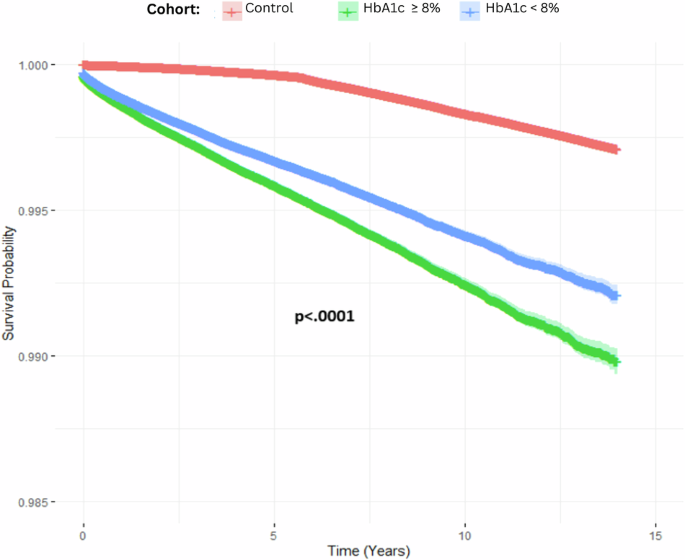
This retrospective, multicentre cohort study analysed 12,192,033 adults (>= 18 years) from the TriNetX database (2010–2023). Individuals with pre-existing uveitis or systemic inflammatory diseases were excluded. The primary outcome was the incidence of undifferentiated anterior uveitis. HbA1c was modelled both categorically (non-diabetic, well-controlled diabetes [<8.0%], poorly controlled diabetes [>= 8.0%]) and continuously. Cox proportional hazards regression estimated adjusted hazard ratios (aHRs) with 95% confidence intervals (CIs); logistic regression modelled the continuous association.
Results
Increasing HbA1c levels were strongly associated with incident uveitis (P < 0.001). Compared with non-diabetic controls, risk was elevated among patients with well-controlled diabetes (aHR 3.25; 95% CI 3.16–3.34) and further increased with poor control (aHR 4.07; 95% CI 3.95–4.19). For each 1% rise in HbA1c, the odds of developing uveitis increased by 10% (adjusted OR 1.10; 95% CI 1.10–1.11). Predicted probabilities rose non-linearly, reaching 1.11% at HbA1c 18%.
Conclusions
The risk of undifferentiated anterior uveitis increases with increasing HbA1c values.