

Gravallese, E. M. & Firestein, G. S. Rheumatoid arthritis – common origins, divergent mechanisms. N. Engl. J. Med. 388, 529–542 (2023).
Larid, G., Vix, J., Garlantezec, R., Loppin, E. & Gervais, E. Increased remission with fewer corticosteroids and more biologics in rheumatoid arthritis at 7-year follow-up in real-life conditions. Sci. Rep. 12, 2563 (2022).
Lillegraven, S. et al. Effect of tapered versus stable treatment with tumour necrosis factor inhibitors on disease flares in patients with rheumatoid arthritis in remission: a randomised, open label, non-inferiority trial. Ann. Rheum. Dis. 82, 1394–1403 (2023).
Jarvinen, P. & Aho, K. Twin studies in rheumatic diseases. Semin. Arthritis Rheum. 24, 19–28 (1994).
Bach, J. F. The effect of infections on susceptibility to autoimmune and allergic diseases. N. Engl. J. Med. 347, 911–920 (2002).
Gianfrancesco, M. A. et al. Smoking is associated with higher disease activity in rheumatoid arthritis: a longitudinal study controlling for time-varying covariates. J. Rheumatol. 46, 370–375 (2019).
Konig, M. F. et al. Aggregatibacter actinomycetemcomitans-induced hypercitrullination links periodontal infection to autoimmunity in rheumatoid arthritis. Sci. Transl. Med. 8, 369ra176 (2016).
Schmajuk, G., Trupin, L., Yelin, E. & Blanc, P. D. Prevalence of arthritis and rheumatoid arthritis in coal mining counties of the United States. Arthritis Care Res. 71, 1209–1215 (2019).
Brusca, S. B., Abramson, S. B. & Scher, J. U. Microbiome and mucosal inflammation as extra-articular triggers for rheumatoid arthritis and autoimmunity. Curr. Opin. Rheumatol. 26, 101–107 (2014).
Arrieta, M. C. et al. Early infancy microbial and metabolic alterations affect risk of childhood asthma. Sci. Transl. Med. 7, 307ra152 (2015).
Ivanov, I. I. et al. Induction of Intestinal Th17 cells by segmented filamentous bacteria. Cell 139, 485–498 (2009).
Wu, H. J. et al. Gut-residing segmented filamentous bacteria drive autoimmune arthritis via T helper 17 cells. Immunity 32, 815–827 (2010).
Vivier, E. et al. Innate lymphoid cells: 10 years on. Cell 174, 1054–1066 (2018).
Clottu, A. S., Humbel, M., Fluder, N., Karampetsou, M. P. & Comte, D. Innate lymphoid cells in autoimmune diseases. Front. Immunol. 12, 789788 (2021).
Kabil, A. et al. Microbial intestinal dysbiosis drives long-term allergic susceptibility by sculpting an ILC2-B1 cell-innate IgE axis. J. Allergy Clin. Immunol. 154, 1260–1276.e9 (2024).
Kabil, A. K. et al. Early-life microbiota skews long-term gene expression and chromatin states of bone marrow hematopoietic precursors. Cell Rep. 45, 116871 (2026).
Kabil, A. K. et al. Microbial dysbiosis sculpts a systemic ILC3/IL-17 axis governing lung inflammatory responses and central hematopoiesis. Mucosal Immunol. 1139–1158, https://doi.org/10.1016/j.mucimm.2025.07.002 (2025).
Eberl, G., Colonna, M., Di Santo, J. P. & McKenzie, A. N. Innate lymphoid cells. Innate lymphoid cells: a new paradigm in immunology. Science 348, aaa6566 (2015).
Cherrier, M. & Eberl, G. The development of LTi cells. Curr. Opin. Immunol. 24, 178–183 (2012).
Shin, S. B. & McNagny, K. M. ILC-You in the thymus: a fresh look at innate lymphoid cell development. Front. Immunol. 12, 681110 (2021).
Jan-Abu, S. C., Kabil, A. & McNagny, K. M. Parallel origins and functions of T cells and ILCs. Clin. Exp. Immunol. 213, 76–86 (2023).
von Moltke, J., Ji, M., Liang, H. E. & Locksley, R. M. Tuft-cell-derived IL-25 regulates an intestinal ILC2-epithelial response circuit. Nature 529, 221–225 (2016).
Gold, M. J. et al. Group 2 innate lymphoid cells facilitate sensitization to local, but not systemic, TH2-inducing allergen exposures. J. Allergy Clin. Immunol. 133, 1142–1148 (2014).
Halim, T. Y., Krauss, R. H., Sun, A. C. & Takei, F. Lung natural helper cells are a critical source of Th2 cell-type cytokines in protease allergen-induced airway inflammation. Immunity 36, 451–463 (2012).
Halim, T. Y. et al. Group 2 innate lymphoid cells are critical for the initiation of adaptive T helper 2 cell-mediated allergic lung inflammation. Immunity 40, 425–435 (2014).
Schneider, C. et al. Tissue-Resident Group 2 innate lymphoid cells differentiate by layered ontogeny and in situ perinatal priming. Immunity 50, 1425–1438.e5 (2019).
Panda, S. K. & Colonna, M. Innate lymphoid cells in mucosal immunity. Front. Immunol. 10, 861 (2019).
Wang, X. et al. Innate lymphoid cells originate from fetal liver-derived tissue-resident progenitors. Sci. Immunol. 10, eadu7962 (2025).
Ghaedi, M. & Takei, F. Innate lymphoid cell development. J. Allergy Clin. Immunol. 147, 1549–1560 (2021).
Simic, M. et al. Distinct waves from the hemogenic endothelium give rise to layered lymphoid tissue inducer cell ontogeny. Cell Rep. 32, 108004 (2020).
Ding, Y. et al. Distinct developmental pathways generate functionally distinct populations of natural killer cells. Nat. Immunol. 25, 1183–1192 (2024).
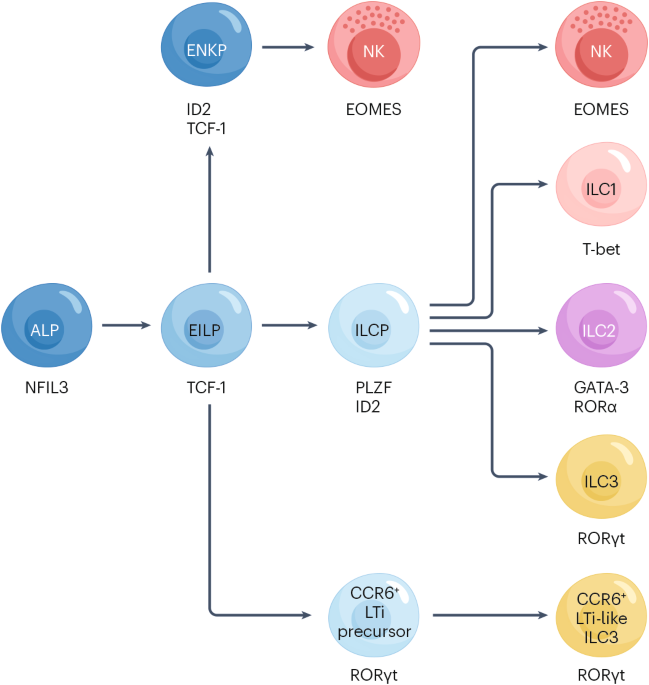
Harly, C. et al. The transcription factor TCF-1 enforces commitment to the innate lymphoid cell lineage. Nat. Immunol. 20, 1150–1160 (2019).
Klose, C. S. N. et al. Differentiation of type 1 ILCs from a common progenitor to all helper-like innate lymphoid cell lineages. Cell 157, 340–356 (2014).
Constantinides, M. G., McDonald, B. D., Verhoef, P. A. & Bendelac, A. A committed precursor to innate lymphoid cells. Nature 508, 397–401 (2014).
Zeis, P. et al. In situ maturation and tissue adaptation of type 2 innate lymphoid cell progenitors. Immunity 53, 775–792.e9 (2020).
Oherle, K. et al. Insulin-like growth factor 1 supports a pulmonary niche that promotes type 3 innate lymphoid cell development in newborn lungs. Immunity 52, 275–294.e9 (2020).
Ghaedi, M. et al. Single-cell analysis of RORα tracer mouse lung reveals ILC progenitors and effector ILC2 subsets. J. Exp. Med. 217, 20182293 (2020).
Lo, B. C. et al. The transcription factor RORα preserves ILC3 lineage identity and function during chronic intestinal infection. J. Immunol. 203, 3209–3215 (2019).
Lo, B. C. et al. The orphan nuclear receptor ROR alpha and group 3 innate lymphoid cells drive fibrosis in a mouse model of Crohn’s disease. Sci. Immunol. 1, eaaf8864 (2016).
Shin, S. B. et al. Abortive γδTCR rearrangements suggest ILC2s are derived from T-cell precursors. Blood Adv. 4, 5362–5372 (2020).
Colonna, M. Innate lymphoid cells: diversity, plasticity, and unique functions in immunity. Immunity 48, 1104–1117 (2018).
Kabil, A., Shin, S. B., Hughes, M. R. & McNagny, K. M. “Just one word, plastic!”: Controversies and caveats in innate lymphoid cell plasticity. Front. Immunol. 13, 946905 (2022).
Lim, A. I., Verrier, T., Vosshenrich, C. A. & Di Santo, J. P. Developmental options and functional plasticity of innate lymphoid cells. Curr. Opin. Immunol. 44, 61–68 (2017).
Fang, W., Zhang, Y. & Chen, Z. Innate lymphoid cells in inflammatory arthritis. Arthritis Res. Ther. 22, 25 (2020).
Wu, X. Innate lymphocytes in inflammatory arthritis. Front. Immunol. 11, 565275
Huang, Y. et al. S1P-dependent interorgan trafficking of group 2 innate lymphoid cells supports host defense. Science 359, 114–119 (2018).
Burrows, K. et al. A gut commensal protozoan determines respiratory disease outcomes by shaping pulmonary immunity. Cell 188, 316–330.e12 (2025).
Sun, X. H. & Bajana, S. ILC differentiation in the thymus. Adv. Exp. Med. Biol. 1365, 25–39 (2022).
Gronke, K., Kofoed-Nielsen, M. & Diefenbach, A. Innate lymphoid cells, precursors and plasticity. Immunol. Lett. 179, 9–18 (2016).
Quatrini, L. et al. Glucocorticoids inhibit human hematopoietic stem cell differentiation toward a common ILC precursor. J. Allergy Clin. Immunol. 149, 1772–1785 (2022).
Lim, A. I. et al. Systemic human ILC precursors provide a substrate for tissue ILC differentiation. Cell 168, 1086–1100.e10 (2017).
Cherrier, D. E., Serafini, N. & Di Santo, J. P. Innate lymphoid cell development: a T cell perspective. Immunity 48, 1091–1103 (2018).
Yu, H., Jacquelot, N. & Belz, G. T. Metabolic features of innate lymphoid cells. J. Exp. Med. 219, e20221140 (2022).
Surace, L. et al. Dichotomous metabolic networks govern human ILC2 proliferation and function. Nat. Immunol. 22, 1367–1374 (2021).
Zhou, L., Lin, Q. & Sonnenberg, G. F. Metabolic control of innate lymphoid cells in health and disease. Nat. Metab. 4, 1650–1659 (2022).
Hodge, S. H. et al. Amino acid availability acts as a metabolic rheostat to determine the magnitude of ILC2 responses. J. Exp. Med. 220, e20221073 (2023).
Fu, L. et al. A mitochondrial STAT3-methionine metabolism axis promotes ILC2-driven allergic lung inflammation. J. Allergy Clin. Immunol. 149, 2091–2104 (2022).
Ham, J., Yang, W. & Kim, H. Y. Tissue-specific metabolic reprogramming in innate lymphoid cells and its impact on disease. Immune Netw. 25, e3 (2025).
Kania, A. K., Kokkinou, E., Pearce, E. & Pearce, E. Metabolic adaptations of ILC2 and Th2 cells in type 2 immunity. Curr. Opin. Immunol. 91, 102503 (2024).
Zheng, Q. H., Zhai, Y., Wang, Y. H. & Pan, Z. The role of hypoxic microenvironment in rheumatoid arthritis. Front. Immunol. 16, 1633406 (2025).
Chimenti, M. S. et al. The interplay between inflammation and metabolism in rheumatoid arthritis. Cell Death Dis. 6, e1887 (2015).
Molofsky, A. B. & Locksley, R. M. The ins and outs of innate and adaptive type 2 immunity. Immunity 56, 704–722 (2023).
Eberl, G. Immunity by equilibrium. Nat. Rev. Immunol. 16, 524–532 (2016).
Gieseck, R. L. 3rd, Wilson, M. S. & Wynn, T. A. Type 2 immunity in tissue repair and fibrosis. Nat. Rev. Immunol. 18, 62–76 (2018).
Rauber, S. et al. Resolution of inflammation by interleukin-9-producing type 2 innate lymphoid cells. Nat. Med. 23, 938–944 (2017).
Hirota, K. et al. Autoimmune Th17 cells induced synovial stromal and innate lymphoid cell Secretion of the cytokine GM-CSF to initiate and augment autoimmune arthritis. Immunity 48, 1220–1232.e5 (2018).
Omata, Y. et al. Group 2 innate lymphoid cells attenuate inflammatory arthritis and protect from bone destruction in mice. Cell Rep. 24, 169–180 (2018).
Kabil, A. et al. Functional targeting of ILC2s and ILC3s reveals selective roles in intestinal fibrosis and homeostasis. J. Exp. Med. 222, e20241671 (2025).
Bando, J. K. et al. ILC2s are the predominant source of intestinal ILC-derived IL-10. J. Exp. Med. 217, e20191520 (2020).
Liu, D. et al. IL-25 attenuates rheumatoid arthritis through suppression of Th17 immune responses in an IL-13-dependent manner. Sci. Rep. 6, 36002 (2016).
Fallon, P. G. et al. Identification of an interleukin (IL)-25-dependent cell population that provides IL-4, IL-5, and IL-13 at the onset of helminth expulsion. J. Exp. Med. 203, 1105–1116 (2006).
Sakaguchi, N. et al. Altered thymic T-cell selection due to a mutation of the ZAP-70 gene causes autoimmune arthritis in mice. Nature 426, 454–460 (2003).
Keller, K. K. et al. SKG arthritis as a model for evaluating therapies in rheumatoid arthritis with special focus on bone changes. Rheumatol. Int. 33, 1127–1133 (2013).
Hirota, K. et al. T cell self-reactivity forms a cytokine milieu for spontaneous development of IL-17+ Th cells that cause autoimmune arthritis. J. Exp. Med. 204, 41–47 (2007).
Cook, A. D., Braine, E. L., Campbell, I. K., Rich, M. J. & Hamilton, J. A. Blockade of collagen-induced arthritis post-onset by antibody to granulocyte-macrophage colony-stimulating factor (GM-CSF): requirement for GM-CSF in the effector phase of disease. Arthritis Res. 3, 293–298 (2001).
Cook, A. D. et al. TNF and granulocyte macrophage-colony stimulating factor interdependence mediates inflammation via CCL17. JCI Insight 3, e99249 (2018).
Lee, K. M. C., Achuthan, A. A. & Hamilton, J. A. GM-CSF: a promising target in inflammation and autoimmunity. Immunotargets Ther. 9, 225–240 (2020).
Hamilton, J. A., Cook, A. D. & Tak, P. P. Anti-colony-stimulating factor therapies for inflammatory and autoimmune diseases. Nat. Rev. Drug. Discov. 16, 53–70 (2016).
Nakae, S., Nambu, A., Sudo, K. & Iwakura, Y. Suppression of immune induction of collagen-induced arthritis in IL-17-deficient mice. J. Immunol. 171, 6173–6177 (2003).
Geremia, A. et al. IL-23-responsive innate lymphoid cells are increased in inflammatory bowel disease. J. Exp. Med. 208, 1127–1133 (2011).
Cua, D. J. & Tato, C. M. Innate IL-17-producing cells: the sentinels of the immune system. Nat. Rev. Immunol. 10, 479–489 (2010).
Cua, D. J. et al. Interleukin-23 rather than interleukin-12 is the critical cytokine for autoimmune inflammation of the brain. Nature 421, 744–748 (2003).
Murphy, C. A. et al. Divergent pro- and antiinflammatory roles for IL-23 and IL-12 in joint autoimmune inflammation. J. Exp. Med. 198, 1951–1957 (2003).
Cornelissen, F. et al. Interleukin-23 is critical for full-blown expression of a non-autoimmune destructive arthritis and regulates interleukin-17A and RORγt in γδ T cells. Arthritis Res. Ther. 11, R194 (2009).
Takaki-Kuwahara, A. et al. CCR6+ group 3 innate lymphoid cells accumulate in inflamed joints in rheumatoid arthritis and produce Th17 cytokines. Arthritis Res. Ther. 21, 198 (2019).
Wang, T. et al. Imbalance of Th17, Treg, and helper innate lymphoid cell in the peripheral blood of patients with rheumatoid arthritis. Clin. Rheumatol. 41, 3837–3849 (2022).
Melo-Gonzalez, F. & Hepworth, M. R. Functional and phenotypic heterogeneity of group 3 innate lymphoid cells. Immunology 150, 265–275 (2017).
Rodriguez-Carrio, J. et al. Brief report: altered innate lymphoid cell subsets in human lymph node biopsy specimens obtained during the at-risk and earliest phases of rheumatoid arthritis. Arthritis Rheumatol. 69, 70–76 (2017).
Chan, T. Y. et al. Increased ILC3s associated with higher levels of IL-1β aggravates inflammatory arthritis in mice lacking phagocytic NADPH oxidase. Eur. J. Immunol. 49, 2063–2073 (2019).
Leijten, E. F. et al. Brief report: enrichment of activated group 3 innate lymphoid cells in psoriatic arthritis synovial fluid. Arthritis Rheumatol. 67, 2673–2678 (2015).
Liu, X. et al. Group 3 innate lymphoid cells promotes Th17 cells differentiation in rheumatoid arthritis. Clin. Exp. Rheumatol. 42, 2183–2193 (2024).
Grigg, J. B. et al. Antigen-presenting innate lymphoid cells orchestrate neuroinflammation. Nature 600, 707–712 (2021).
Rodrigues, P. F. et al. Rorδt-positive dendritic cells are required for the induction of peripheral regulatory T cells in response to oral antigens. Cell 188, 2720–2737.e22 (2025).
Ulezko Antonova, A. et al. A distinct human cell type expressing MHCII and RORγt with dual characteristics of dendritic cells and type 3 innate lymphoid cells. Proc. Natl Acad. Sci. USA 120, e2318710120 (2023).
Akagbosu, B. et al. Novel antigen-presenting cell imparts Treg-dependent tolerance to gut microbiota. Nature 610, 752–760 (2022).
Kedmi, R. et al. A RORγt+ cell instructs gut microbiota-specific Treg cell differentiation. Nature 610, 737–743 (2022).
Cabric, V. et al. A wave of Thetis cells imparts tolerance to food antigens early in life. Science 389, 268–274 (2025).
Croft, A. P. et al. Rheumatoid synovial fibroblasts differentiate into distinct subsets in the presence of cytokines and cartilage. Arthritis Res. Ther. 18, 270 (2016).
Orange, D. E. et al. RNA identification of PRIME cells predicting rheumatoid arthritis flares. N. Engl. J. Med. 383, 218–228 (2020).
Dahlgren, M. W. et al. Adventitial stromal cells define group 2 innate lymphoid cell tissue niches. Immunity 50, 707–722.e6 (2019).
Qian, H. et al. Targeting pathogenic fibroblast-like synoviocyte subsets in rheumatoid arthritis. Arthritis Res. Ther. 26, 103 (2024).
Rauber, S. et al. CD200+ fibroblasts form a pro-resolving mesenchymal network in arthritis. Nat. Immunol. 25, 682–692 (2024).
Sun, J. C., Beilke, J. N. & Lanier, L. L. Adaptive immune features of natural killer cells. Nature 457, 557–561 (2009).
Weizman, O. E. et al. Mouse cytomegalovirus-experienced ILC1s acquire a memory response dependent on the viral glycoprotein m12. Nat. Immunol. 20, 1004–1011 (2019).
Klose, C. S. N. & Artis, D. Innate lymphoid cells control signaling circuits to regulate tissue-specific immunity. Cell Res. 30, 475–491 (2020).
Biniaris-Georgallis, S. I. et al. Amplification of autoimmune organ damage by NKp46-activated ILC1s. Nature 634, 952–960 (2024).
Yang, F. et al. Dysregulation of innate lymphoid cells in patients with active rheumatoid arthritis and mice with collagen-induced arthritis. Mediators Inflamm. 2021, 1915068 (2021).
Sparano, C. et al. Embryonic and neonatal waves generate distinct populations of hepatic ILC1s. Sci. Immunol. 7, eabo6641 (2022).
Cutolo, M., Campitiello, R., Gotelli, E. & Soldano, S. The role of M1/M2 macrophage polarization in rheumatoid arthritis synovitis. Front. Immunol. 13, 867260 (2022).
Mackay, L. K. et al. Hobit and Blimp1 instruct a universal transcriptional program of tissue residency in lymphocytes. Science 352, 459–463 (2016).
Yomogida, K. et al. Hobit confers tissue-dependent programs to type 1 innate lymphoid cells. Proc. Natl Acad. Sci. USA 118, e2117965118 (2021).
Ducimetiere, L. et al. Conventional NK cells and tissue-resident ILC1s join forces to control liver metastasis. Proc. Natl Acad. Sci. USA 118, e2026271118 (2021).
Woods, J. M., Haines, G. K., Shah, M. R., Rayan, G. & Koch, A. E. Low-level production of interleukin-13 in synovial fluid and tissue from patients with arthritis. Clin. Immunol. Immunopathol. 85, 210–220 (1997).
Iwaszko, M., Bialy, S. & Bogunia-Kubik, K. Significance of interleukin (IL)-4 and IL-13 in inflammatory arthritis. Cells 10, 3000 (2021).
Ciccia, F. et al. Type 3 innate lymphoid cells producing IL-17 and IL-22 are expanded in the gut, in the peripheral blood, synovial fluid and bone marrow of patients with ankylosing spondylitis. Ann. Rheum. Dis. 74, 1739–1747 (2015).
Ciccia, F. et al. Proinflammatory CX3CR1+CD59+tumor necrosis factor-like molecule 1A+interleukin-23+ monocytes are expanded in patients with ankylosing spondylitis and modulate innate lymphoid cell 3 immune functions. Arthritis Rheumatol. 70, 2003–2013 (2018).
Inamo, J. et al. Deep immunophenotyping reveals circulating activated lymphocytes in individuals at risk for rheumatoid arthritis. J. Clin. Invest. 135, e185217 (2025).
Lundberg, M. et al. Multiplexed homogeneous proximity ligation assays for high-throughput protein biomarker research in serological material. Mol. Cell Proteom. 10, M110 004978 (2011).
Van Acker, N. et al. Spatial mapping of innate lymphoid cells in human lymphoid tissues and lymphoma at single-cell resolution. Nat. Commun. 16, 4545 (2025).
Yudanin, N. A. et al. Spatial and temporal mapping of human innate lymphoid cells reveals elements of tissue specificity. Immunity 50, 505–519.e4 (2019).
Hashemi, E., McCarthy, C., Rao, S. & Malarkannan, S. Transcriptomic diversity of innate lymphoid cells in human lymph nodes compared to BM and spleen. Commun. Biol. 7, 769 (2024).
Qi, J. et al. Single-cell transcriptomic landscape reveals tumor specific innate lymphoid cells associated with colorectal cancer progression. Cell Rep. Med. 2, 100353 (2021).
Krausgruber, T. et al. Single-cell and spatial transcriptomics reveal aberrant lymphoid developmental programs driving granuloma formation. Immunity 56, 289–306.e287 (2023).
Young, J., Inamo, J., Caterer, Z., Krishna, R. & Zhang, F. CellPhenoX: an explainable machine learning method for identifying cell phenotypes to predict clinical outcomes from single-cell multi-omics. Adv. Sci. 12, e03289 https://doi.org/10.1002/advs.202503289e03289 (2025).
Kuo, I. C., Brassard, J., Zandstra, P. W. & McNagny, K. M. Innate lymphoid cells in the spotlight: from biomarkers to blueprint for innovative immunotherapy. Front. Immunol. 16, 1655730 (2025).
Howard, E. et al. IL-10 production by ILC2s requires Blimp-1 and cMaf, modulates cellular metabolism, and ameliorates airway hyperreactivity. J. Allergy Clin. Immunol. 147, 1281–1295.e5 (2021).
Seehus, C. R. et al. Alternative activation generates IL-10 producing type 2 innate lymphoid cells. Nat. Commun. 8, 1900 (2017).
Chen, S. et al. Selective targeting of PI3Kδ suppresses human IL-17-producing T cells and innate-like lymphocytes and may be therapeutic for IL-17-mediated diseases. J. Autoimmun. 111, 102435 (2020).
Lo Pizzo, M. et al. JAK/STAT inhibition modifies the ILC1 immune response in patients with rheumatoid arthritis. Clin. Exp. Rheumatol. 42, 593–600 (2024).
Stabile, H. et al. JAK/STAT signaling in regulation of innate lymphoid cells: the gods before the guardians. Immunol. Rev. 286, 148–159 (2018).
Kato, M. et al. Associations of ultrasound-based inflammation patterns with peripheral innate lymphoid cell populations, serum cytokines/chemokines, and treatment response to methotrexate in rheumatoid arthritis and spondyloarthritis. PLoS ONE 16, e0252116 (2021).
Arra, A. et al. PD1+ innate lymphoid cells 3 predict JAK-dependent inflammation in rheumatoid arthritis. J. Autoimmun. 154, 103424 (2025).
Colpitts, S. J. et al. Cell therapy with human interleukin 10-producing ILC2s enhances islet function and inhibits allograft rejection. Am. J. Transpl. 25, 1858–1869 (2025).
Reid, K. T. et al. Cell therapy with human IL-10-producing ILC2s limits xenogeneic graft-versus-host disease by inhibiting pathogenic T cell responses. Cell Rep. 44, 115102 (2025).
Wright, G. P. et al. Adoptive therapy with redirected primary regulatory T cells results in antigen-specific suppression of arthritis. Proc. Natl Acad. Sci. USA 106, 19078–19083 (2009).
Asnagli, H. et al. Type 1 regulatory T cells specific for collagen type II as an efficient cell-based therapy in arthritis. Arthritis Res. Ther. 16, R115 (2014).
Wang, T. et al. Regulatory T cells in rheumatoid arthritis showed increased plasticity toward Th17 but retained suppressive function in peripheral blood. Ann. Rheum. Dis. 74, 1293–1301 (2015).
Van Steendam, K. et al. Citrullinated vimentin as an important antigen in immune complexes from synovial fluid of rheumatoid arthritis patients with antibodies against citrullinated proteins. Arthritis Res. Ther. 12, R132 (2010).
Li, S. et al. Strength of CAR signaling determines T cell versus ILC differentiation from pluripotent stem cells. Cell Rep. 42, 112241 (2023).
Halim, T. Y. F. Emerging in vivo tools for ILC2 research. J. Exp. Med. 222, e20250883 (2025).
Jarick, K. J. et al. Non-redundant functions of group 2 innate lymphoid cells. Nature 611, 794–800 (2022).
Tsou, A. M. et al. Neuropeptide regulation of non-redundant ILC2 responses at barrier surfaces. Nature 611, 787–793 (2022).
Eberl, G. et al. An essential function for the nuclear receptor RORγt in the generation of fetal lymphoid tissue inducer cells. Nat. Immunol. 5, 64–73 (2004).