

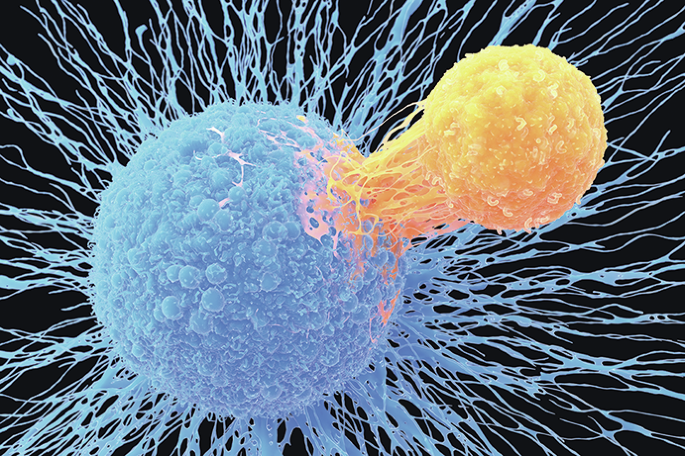
Reporting in Immunity, Al Souz et al. provide evidence that kidney-infiltrating CD8+ T cells contribute to the pathogenesis of lupus nephritis in both mice and humans. Notably, they show that such pathological CD8+ T cells can retain effector functions in the kidneys despite upregulating immune checkpoint molecules and showing a terminally differentiated phenotype.
To address this, the authors characterized CD8+ T cell responses in the MRL-lpr mouse model of lupus. They found that CD8+ T cells in the inflamed kidneys of these mice predominantly showed a CD44hiCD62Llow effector cell phenotype, whereas CD8+ T cells in the renal lymph nodes (RLNs) and spleens comprised naive, memory and effector T cell subsets. Furthermore, a stem-like TCF1+SLAMF6+ CD8+ T cell population predominated in the RLNs and spleen, but was mainly lost from the kidneys, where most CD8+ T cells showed a TCF1−CXCR6+ phenotype and were enriched for granzyme B expression. Compared with in lymphoid tissues, a higher proportion of CD8+ T cells in the kidneys expressed PD-1 and TIM3 (consistent with terminal differentiation) and CD69 and CD103, suggesting previous activation and a tissue-resident memory phenotype. These CD8+ T cells accumulated in the kidneys and showed higher expression of PD-1, TIM3 and granzyme B with increasing age, and their accumulation correlated with progressive kidney damage. Moreover, antibody-mediated depletion of CD8+ T cells prevented progressive kidney injury.