

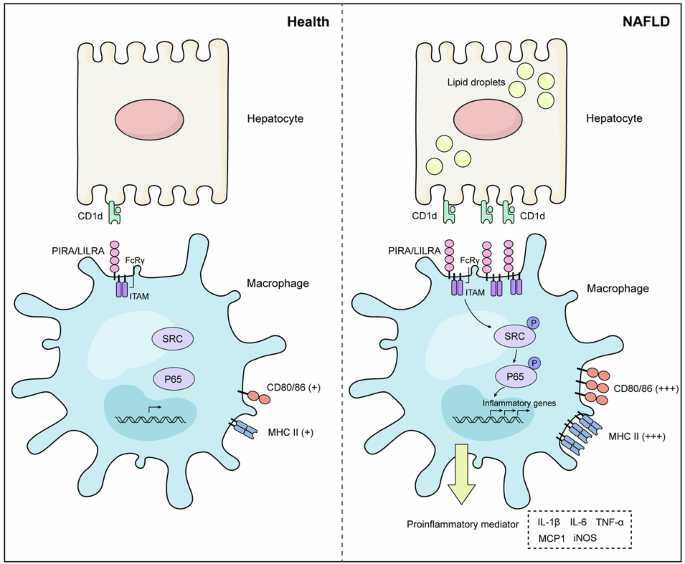
Liver inflammation is a key driver of nonalcoholic fatty liver disease (NAFLD) and its progressive subtype, nonalcoholic steatohepatitis (NASH). Macrophages, as central players in the innate immune response, are crucial to disease pathogenesis; however, the upstream events that initiate their activation remain poorly defined. Here, we employed a cell-based chimeric receptor screening system and identified CD1d as a surface ligand for PIRA2. We subsequently demonstrated that CD1d stimulation activated macrophages both in vitro and in vivo. Co-immunoprecipitation assays further confirmed a direct interaction between CD1d and PIRA2. Using Pira2-deficient (Pira2−/−) mice, we observed significantly reduced hepatic inflammation and lipid accumulation compared to wild-type controls. Importantly, macrophage-specific Pira2 conditional knockout mice similarly exhibited reduced macrophage activation and inflammatory cytokine production in vivo, confirming a macrophage-intrinsic role of PIRA2. Mechanistically, CD1d-PIRA2 interaction involves the α1 and α2 domains of CD1d and the D1 and D2 domains of PIRA2, leading to FcRγ ITAM tyrosine phosphorylation and downstream inflammatory signaling-events that are impaired in Pira2−/− macrophages. Additionally, CD1d and LILRA2 protein levels were elevated in NAFLD patients, and CD1d stimulation induced proinflammatory cytokine expression in human macrophages, which was attenuated by LILRA2 blockade. A recombinant LILRA2/Fc fusion protein effectively blocked CD1d-induced inflammatory gene expression in human macrophages, highlighting its potential as a therapeutic strategy for NAFLD. Collectively, our findings identify CD1d as a functional ligand of PIRA2 that promotes macrophage activation and inflammation, contributing to inflammatory progression in NAFLD.
