

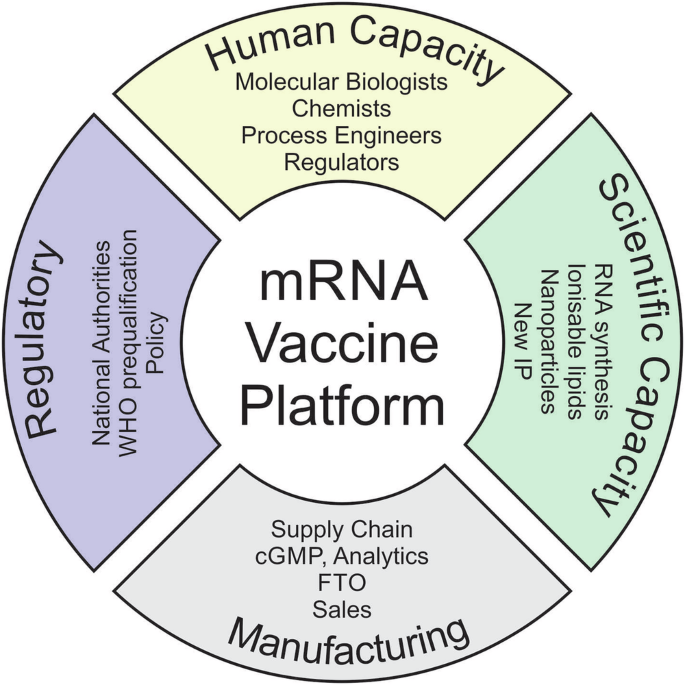
The success of mRNA vaccines during COVID-19 indicated the feasibility of this technology for rapidly strengthening manufacturing capacity in LMICs. Unlike traditional platforms, which often require complicated methods or specialised facilities, mRNA vaccine production uses modular, rapidly adaptable and scalable cell-free enzymatic synthesis. The World Health Organization (WHO) and Medicines Patent Pool (MPP) recognised the strategic opportunity offered by mRNA-based approaches7,8. Based on this insight the WHO/MPP mRNA Technology Transfer (TT) Programme was set up. By enabling mastery of the full spectrum of mRNA vaccine development, the initiative aimed to build self-reliance and resilience in LMICs. The programme was supported by multiple national governments, the European Union, the African Union and the ELMA Foundation. The investment was intended to support pandemic preparedness and nurture human capacity development.
Establishing a complete mRNA vaccine pipeline requires coordinated advances in several different fields. Initially, the WHO/MPP mRNA TT Programme drew on the technical experience of the Antiviral Gene Therapy Research Unit (AGTRU) of the University of the Witwatersrand (Wits) and the South African Medical Research Council (SAMRC). AGTRU’s experience with therapeutic mRNA was rapidly adapted for vaccine production and transferred to Afrigen Biologics and Vaccines in Cape Town, the WHO/MPP-designated hub, before dissemination to partner countries through a “hub-and-spoke” model. This mechanism rapidly enabled partners to produce high-quality research-grade mRNA and was a precursor to establishing current Good Manufacturing Practice- (cGMP-) compliant manufacturing procedures that are needed for use of mRNA in humans. Expertise in mRNA lipid nanoparticle (LNP) formulation, scale-up through process expansion followed, albeit at an uneven pace, throughout Africa8.
The complex intellectual property (IP) landscape of mRNA vaccines, which includes patents covering mRNA design, LNP delivery systems and manufacturing processes, may impede vaccine rollout in LMICs. These difficulties potentially create barriers to freedom to operate (FTO), increase costs and delay development of vaccine manufacturing capacity. Therefore, the mRNA TT Programme also aimed to assist LMICs to overcome intellectual property (IP) barriers. Ideally, to avoid costly license agreements and infringing others’ patents, local vaccine manufacturing industries should be based on use of proprietary IP in LMICs. This FTO is, however, not easily achieved. An interesting alternative approach that resulted in new African-led IP entailed the synthesis of novel ionisable lipids derived from rare phenolic compounds extracted from cashew nutshell liquid (CNSL)9,10. Ionisable lipids are essential for mRNA LNP formulation, but supply is dominated by a small number of patent holders, which may restrict FTO and increase licensing complexity. Cashew nuts are abundantly produced in Africa, and the nutshells are an agricultural waste product. Use of CNSL-derived phenolic compounds also avoids dependence on precursors derived from the petroleum industry. The ionisable lipids, generated by teams from the Wits Synthetic Organic Chemistry group and AGTRU, function very efficiently in preclinical vaccine formulations10. In addition to providing FTO, these lipids are considerably cheaper to synthesise than currently licensed compounds, which is advantageous for manufacture of affordable mRNA vaccines in Africa.