

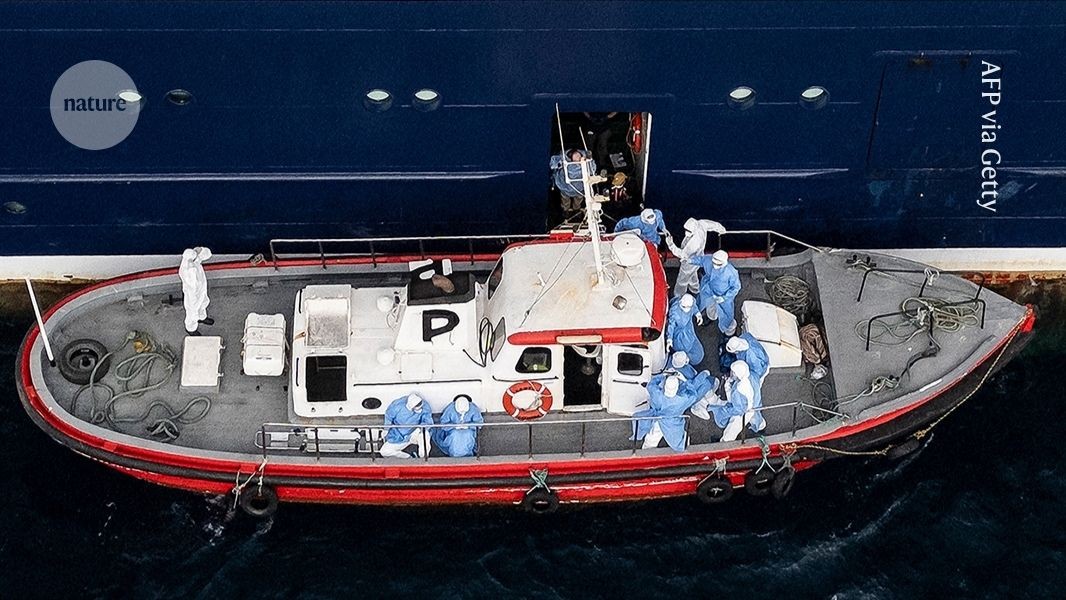

Medical staff arrive to evacuate passengers from MV Hondius, the cruise ship stricken by an outbreak of hantavirus.Credit: AFP via Getty Images
An outbreak of hantavirus onboard the cruise ship MV Hondius has thrown a spotlight on the rare but deadly infection and the lack of options for treatment and prevention.
Three people who were on the ship have tested positive for the virus, including one passenger who died. Among another five people with suspected infections, two have died.
Hantavirus typically spreads through the air, in particles from rodent urine, droppings or saliva. But some strains can occasionally spread between people who are in close contact. One of these strains, called Andes virus, is responsible for an ongoing outbreak in Argentina, and World Health Organization director-general Tedros Adhanom Ghebreyesus has confirmed that the passengers were infected with this strain, for which there are no specific treatments or vaccines. Scientists suspect that some of the travellers might have been infected in Argentina before boarding the cruise. Although hantavirus infections are rare, some strains have a fatality rate of up to 50%.
For more than three decades, Jay Hooper, a virologist at the US Army Medical Research Institute of Infectious Diseases in Frederick, Maryland, has been working to develop a vaccine against several strains of hantavirus that can infect people, including the Andes virus.
He talks to Nature about why these vaccines remain elusive.
Is this outbreak a sign that the risk of infection with hantavirus is increasing?
Some people have suggested, and I have said it before, that climate change could alter rodent populations and increase the number of people living in or entering areas where these rodents are present. That might increase case numbers.
As with any zoonotic virus — an animal-borne virus that spills into humans — the situation is inherently unpredictable. Look at what happened with monkeypox virus.
How long has your team been working on hantavirus vaccines?
Because these viruses are rodent-borne and pose a risk to troops on the ground, the military has long wanted a vaccine. I work at the US Army Medical Research Institute of Infectious Diseases, which has been working on hantavirus vaccines since around the 1980s.
I joined in the team in the 1990s. At that time, new hantaviruses causing hantavirus pulmonary syndrome (HPS) appeared: the Sin Nombre virus in the Four Corners region of the United States and the Andes virus in South America. The lab started developing vaccines for these strains.
A key advance of our team has been developing hamster models of a lethal disease very similar to human HPS1. This provides a realistic animal model to test vaccines and therapeutics.
We have done phase 1 clinical trials of vaccines for Andes virus2 and two other strains, Hantaan and Puumala3.
In humans, the Andes DNA vaccine induces neutralizing antibodies, which are important for protection, so the vaccine looks promising. However, it requires at least three doses (prime plus two boosts) instead of a single shot or simple prime–boost regimen.
We are now taking neutralizing antibodies from vaccinated humans and testing them as a vaccine in the hamster model; results will be reported in a future publication.
Because human cases of Andres virus are rare and geographically scattered, there is no obvious region to run a classic phase 3 efficacy trial, so to meet the requirements for licensing the vaccine requires more creative approaches. Hence the emphasis on neutralizing antibodies as a correlate of protection.
Another major barrier for hantavirus vaccines is funding for advanced development.